
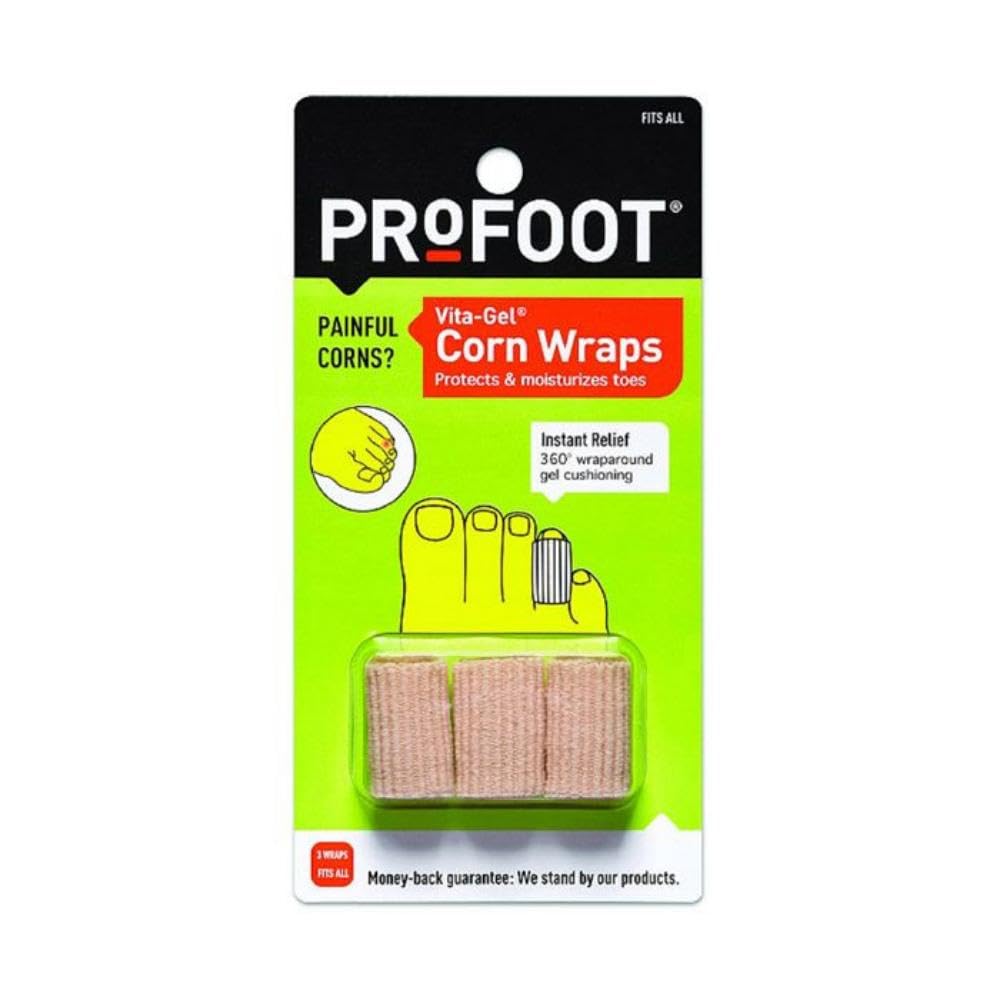
Corn wraps occupy an awkward middle ground in foot care. They are not as invisible as a medicated patch, not as durable as a felt pad, and not as targeted as a pumice-and-file routine. The ProFoot Vita-Gel Corn Wraps sit in that space, and whether they make sense depends largely on where your corn is and how much time you spend on your feet. This two-pack ships three wraps per pack, so six wraps total, which is worth noting because these are reusable rather than one-and-done.
The basic idea is straightforward. Each wrap is a small sleeve of soft gel material that slips over a toe and positions a cushioned section against the corn. The gel is the functional core here: it spreads pressure across a wider area instead of letting a single point take the full load of a shoe. ProFoot markets the material as Vita-Gel, which is essentially a mineral oil-infused polymer gel. In practice, that means the wrap has a slightly tacky, pliable feel and is designed to be washed and reused rather than discarded after a day.
Real-world use is less glamorous than the packaging suggests. Most people reach for these when a corn has become painful enough to notice with every step, usually on the top or side of a toe where a shoe upper rubs. The wrap goes on like a small finger cot, the gel pad sits over the corn, and then you put on socks and shoes. The sleeve stays in place reasonably well inside a sock, though it can shift if you wear loose footwear or walk barefoot around the house. That is the honest use case: inside closed shoes, during the part of the day when pressure is actually being applied.
On features, there is not much to unpack, which is not a criticism. The wrap is a single-piece design with no adhesive, no medication, and no straps. That simplicity is the point. Unlike medicated corn pads, which rely on salicylic acid to gradually break down the thickened skin, these wraps do nothing chemically. They are purely mechanical: cushion, redistribute pressure, reduce friction. For people who have had irritation from acid-based patches, or who are managing diabetes and have been told to avoid them, that distinction matters. It also means the wraps will not remove a corn on their own. They buy comfort while the underlying cause is addressed, whether that is different shoes, a toe spacer, or professional debridement.
The trade-offs are real. The gel sleeve adds bulk, and in a tight dress shoe or a narrow toe box it can make an already crowded fit worse. The material is soft and comfortable against skin, but it is not indestructible; repeated washing and flexing will eventually cause the gel to tear or lose its shape, and six wraps do not last forever. There is also the fit question. These are sized for toes, and a corn on the sole of the foot or the side of the heel is simply outside their reach. If your corn is plantar, a wrap is the wrong format and a felt pad or a custom insole is the more sensible comparison. Even on toes, a very small toe may find the sleeve loose, while a swollen toe may find it snug.
Compared with the alternatives, the category split is fairly clean. Medicated patches are cheaper per unit and more discreet, but they involve acid and require careful skin monitoring. Foam or felt corn cushions with adhesive are low-profile and stay put, but they wear out quickly and can leave residue. Silicone toe sleeves without a dedicated pad are comfortable but do not concentrate cushioning over the corn. The Vita-Gel wraps land between these: more cushioning than a plain sleeve, less chemical commitment than a patch, and more reusable than an adhesive pad, at the cost of bulk and a higher upfront price for the pack.
Who is this for? Reasonably, it suits someone with a mild to moderate corn on a toe who wants cushioning during the workday, especially if they have sensitive skin or have been advised against medicated patches. It also works as a short-term measure while waiting for a podiatry appointment or while breaking in new shoes. Who is it not for? Anyone with a corn on a non-toe location, people who need a low-profile solution for tight formal shoes, and anyone expecting the corn itself to disappear. It is also a poor fit for open sores, broken skin, or circulation problems without a clinician’s input.
The realistic expectation is modest and useful: less pain during the hours you wear them, no change to the corn itself, and a lifespan measured in weeks rather than months. That is a fair trade for a simple mechanical cushion, provided the fit and location are right.