
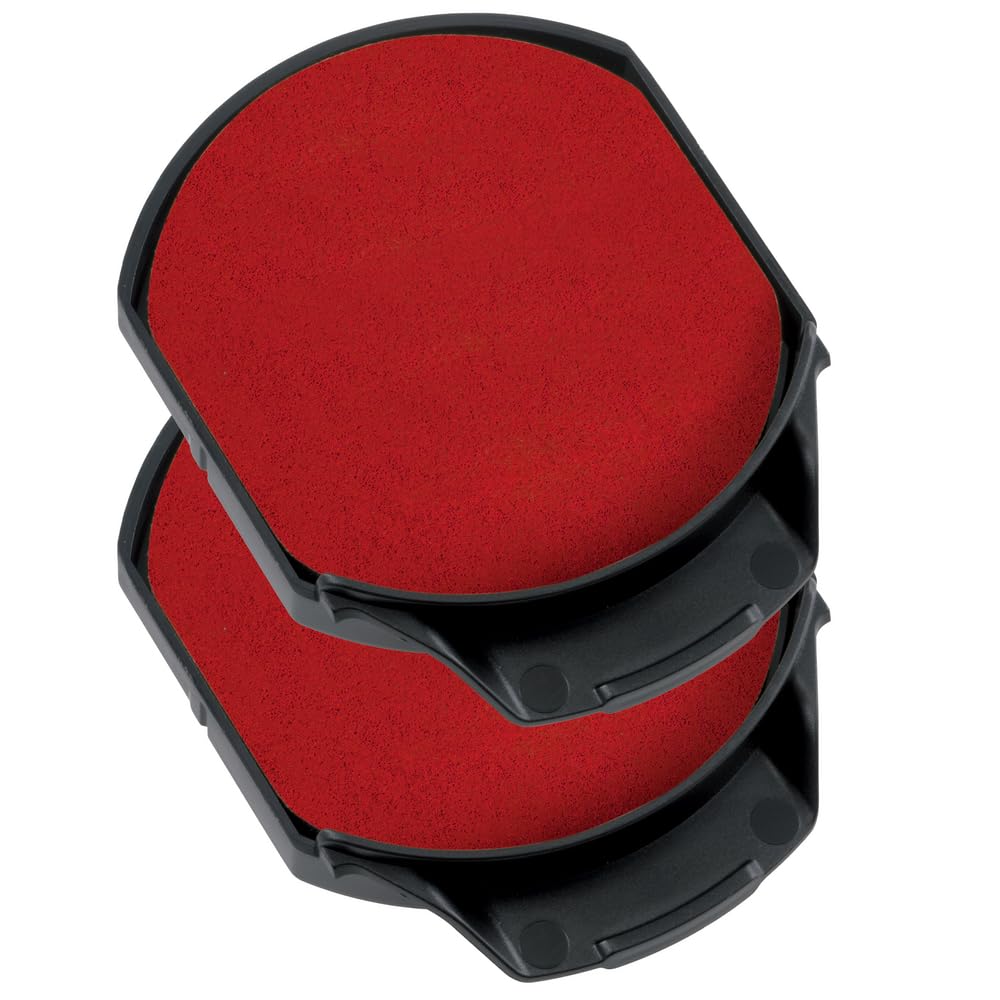
Anyone who has spent time at a reception desk, a shipping station, or a records office knows the small indignities of a stamp that has gone faint. The Trodat 6/15 replacement ink pads are the consumable part behind that problem for two specific self-inking models, the Professional 5215 and 5415. This is a two-pack of red pads, and the appeal is less about the ink itself than about keeping a working stamp working without buying a new unit.
The pads are designed as a direct fit for those two Trodat models. The 6/15 designation refers to the pad size and format, and the packaging is deliberately plain: two sealed pads, red ink, no tools or instructions beyond what the stamp’s own mechanism requires. Replacing one is a matter of releasing the old pad from the stamp’s carrier and seating the new one, a process that takes a minute or two once you have done it once. The pads arrive pre-inked, so there is no re-inking step and no bottle of ink to store.
In daily use, these pads suit the kind of stamping that happens in bursts rather than continuously. A receptionist date-stamping incoming mail, a warehouse clerk marking cartons, a notary adding a red notation to a document: all of these are realistic contexts. Red ink is the practical choice when a mark needs to stand apart from black printed text, which is why it shows up on routing slips, receiving forms, and internal paperwork that needs to be spotted quickly. The 5215 and 5415 are heavier-duty self-inking stamps, and the pads are built to match that role rather than to serve a light desktop stamper.
Functionally, the pads are straightforward. They are pre-inked, replaceable, and sold in pairs, which means one can go into the stamp while the other sits in a drawer as a spare. The ink is formulated for the stamp’s mechanism, so impressions come out evenly across the die rather than pooling at the edges. That evenness matters more than raw darkness: a pad that lays down too much ink produces smudged, bled impressions on porous paper, while one that lays down too little forces the user to press harder and rock the stamp. The 6/15 pads sit in the middle of that range, producing a clear, legible red mark on standard office paper without obvious bleed-through.
There are trade-offs worth naming. The first is that this is a consumable tied to a specific stamp family. If you own a different Trodat model, or a stamp from another brand, these pads will not fit, and the 6/15 format is not a universal standard. The second is longevity. Pre-inked pads dry out over time, and how quickly depends heavily on usage and storage. A stamp left uncapped in a warm, dry office will fade faster than one kept closed between uses. Users should expect a pad to last through a reasonable volume of impressions, but not indefinitely, and a spare in the pack is genuinely useful rather than padding. The third is color: red is the only option in this listing, so anyone needing black, blue, or green for color-coded workflows will need a different SKU.
Compared with the alternative of re-inking a felt pad from a bottle, these replacement pads are cleaner and more consistent. Re-inking is cheaper per application but messier, and it is easy to over-ink, which leads to smudged impressions until the excess works out. Compared with buying a new self-inking stamp when the old one fades, replacement pads are the more sensible route, since the stamp mechanism itself usually outlasts several pads. The main competitor category is third-party compatible pads, which can be cheaper but vary more in ink quality and fit; for a stamp used on documents that matter, the branded pad is the lower-risk choice.
Who is this for? Primarily offices and individuals already running a Trodat Professional 5215 or 5415 who want to keep it in service with a minimum of fuss. It suits high-frequency users who want a spare on hand and low-frequency users who simply need to refresh a stamp that has gone faint. It is not suitable for anyone with a different stamp model, anyone who needs a color other than red, or anyone expecting a pad to last years of heavy daily use. It is also not a substitute for a stamp that has mechanical problems; if the die is worn or the mechanism sticks, a new pad will not fix it.
The realistic expectation is modest and useful: two pre-inked red pads that fit two specific stamps, produce clean impressions for a reasonable service life, and cost less than replacing the stamp. That is a narrow brief, executed without much to complain about beyond the usual limits of consumables.