
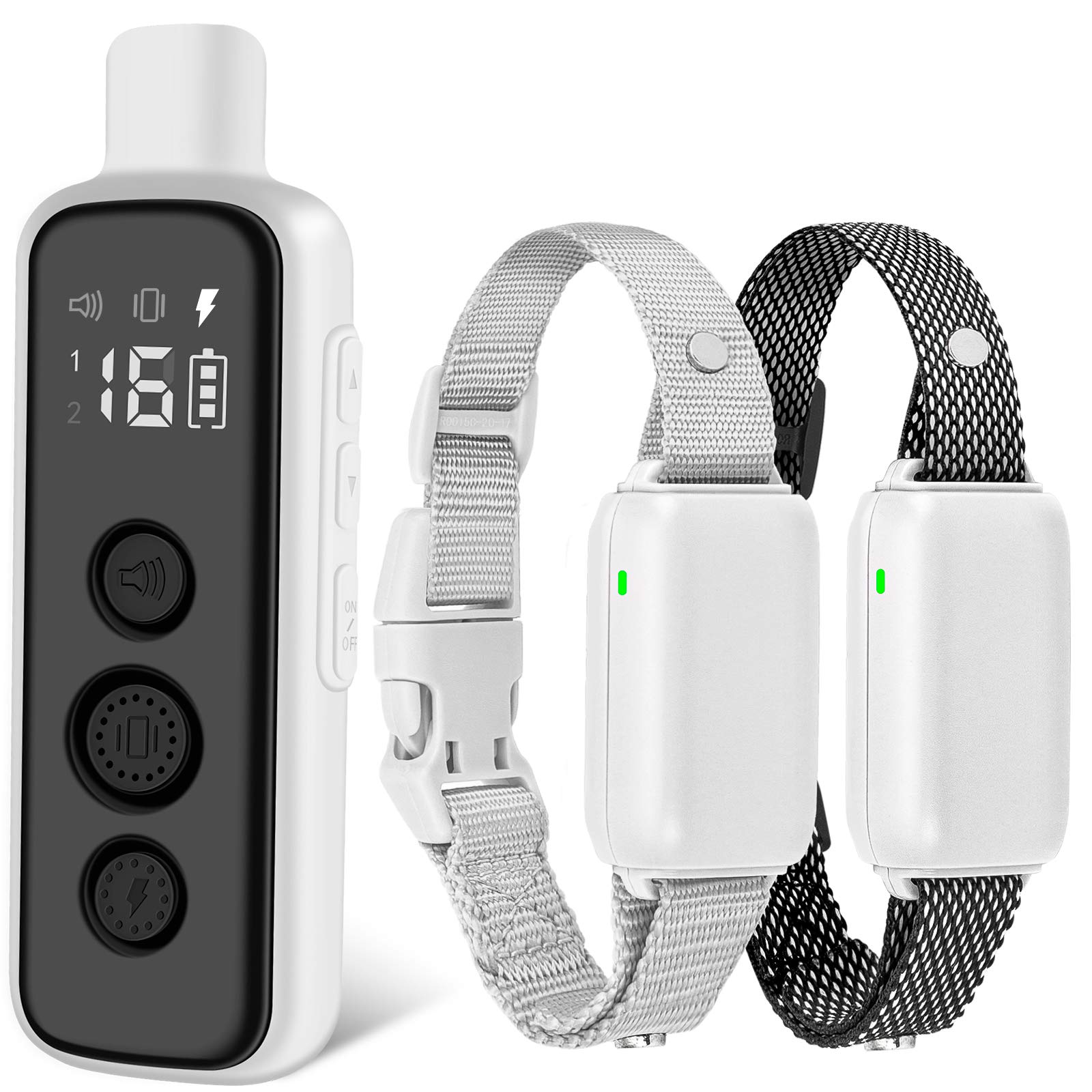
The Bousnic Dog Shock Collar for 2 Dogs is a dual-receiver remote training system aimed at households with more than one dog. It combines a handheld remote with two collar units, which means you can manage both animals from a single controller rather than juggling separate devices. The kit is marketed for dogs from 8 to 120 lbs, covering a wide range from small breeds up to large ones, and it uses three correction types: tone, vibration, and static stimulation. For anyone trying to train two dogs at once, the appeal is obvious, but the real question is whether the hardware and behavior hold up in daily use.
In practice, a system like this tends to be used for everyday obedience and boundary work rather than serious behavior modification. Owners commonly reach for it during off-leash recall practice, to interrupt barking or jumping, or to reinforce commands in a yard where fences are unreliable. The two-receiver setup is most useful when both dogs have different temperaments and need different levels of correction. You can assign each collar to a separate channel on the remote, so correcting one dog does not necessarily affect the other. That said, the remote requires you to switch channels deliberately, and in a chaotic moment, fumbling between channels is a real possibility.
The core features are fairly standard for this category. The remote offers adjustable static levels, typically ranging from low settings intended for sensitive dogs to higher ones for stubborn or larger animals. Tone and vibration modes give you non-static options, which matter for owners who want a warning cue before any stimulation is applied. The collars are described as waterproof and rechargeable, and the receiver units are sized to fit necks across the stated weight range. Battery life is usually measured in days rather than weeks, and the actual runtime depends heavily on how often you use vibration and static. Charging both collars and the remote adds a routine to your week that a simple slip lead does not require.
One of the more important limitations is the nature of static correction itself. Even on lower levels, not every dog responds the same way. Some dogs shut down or become anxious with static stimulation, while others seem largely unaffected. The vibration mode is a reasonable middle ground, but it can also startle sensitive dogs. The tone is the least aversive option, though it only works as a conditioned cue if you pair it consistently with commands. This is not a plug-and-play device, and the manual that ships with it is unlikely to substitute for actual training guidance. Owners who have never used an e-collar before should expect a learning curve, and in some cases, professional guidance is worth the expense.
Another trade-off is fit and comfort on smaller dogs. The system claims to accommodate dogs as small as 8 lbs, but the receiver box and strap can look bulky on a toy breed. The contact points need to touch the skin to deliver static correction, which means the collar has to sit fairly snug. On a short-coated dog, that is manageable; on a thick-coated or long-haired breed, contact can be inconsistent, and you may need to adjust placement or use longer contact points. The stated 120 lb upper limit is generous, but very large dogs with thick necks may still test the strap length.
Compared with a single-dog e-collar from a brand like Sportdog or Dogtra, the Bousnic two-dog kit offers convenience at a lower price point but generally lacks the refinement of higher-end systems. The build feels more plastic than premium, the buttons are functional rather than precise, and the range is adequate for a yard or park but not for wide-open terrain. Compared with a simple vibration-only collar or a citronella spray collar, this system gives you more options, but it also introduces more ways to misuse it. The spray collar is less versatile but arguably harder to overcorrect with.
Who is this for? It suits owners of two dogs who already have a basic understanding of training and want a single remote to manage both animals during recall and obedience work. It is also a reasonable entry point for someone curious about e-collars who does not want to spend several hundred dollars on a premium brand. Who is it not for? It is a poor fit for first-time dog owners with no training background, for dogs with anxiety or fear-based behaviors, and for anyone hoping a collar will solve a problem without consistent practice. It is also not ideal for very small or very thick-coated dogs where fit and contact become unreliable. Treated as a tool within a broader training plan, it can be useful; treated as a shortcut, it will disappoint.