
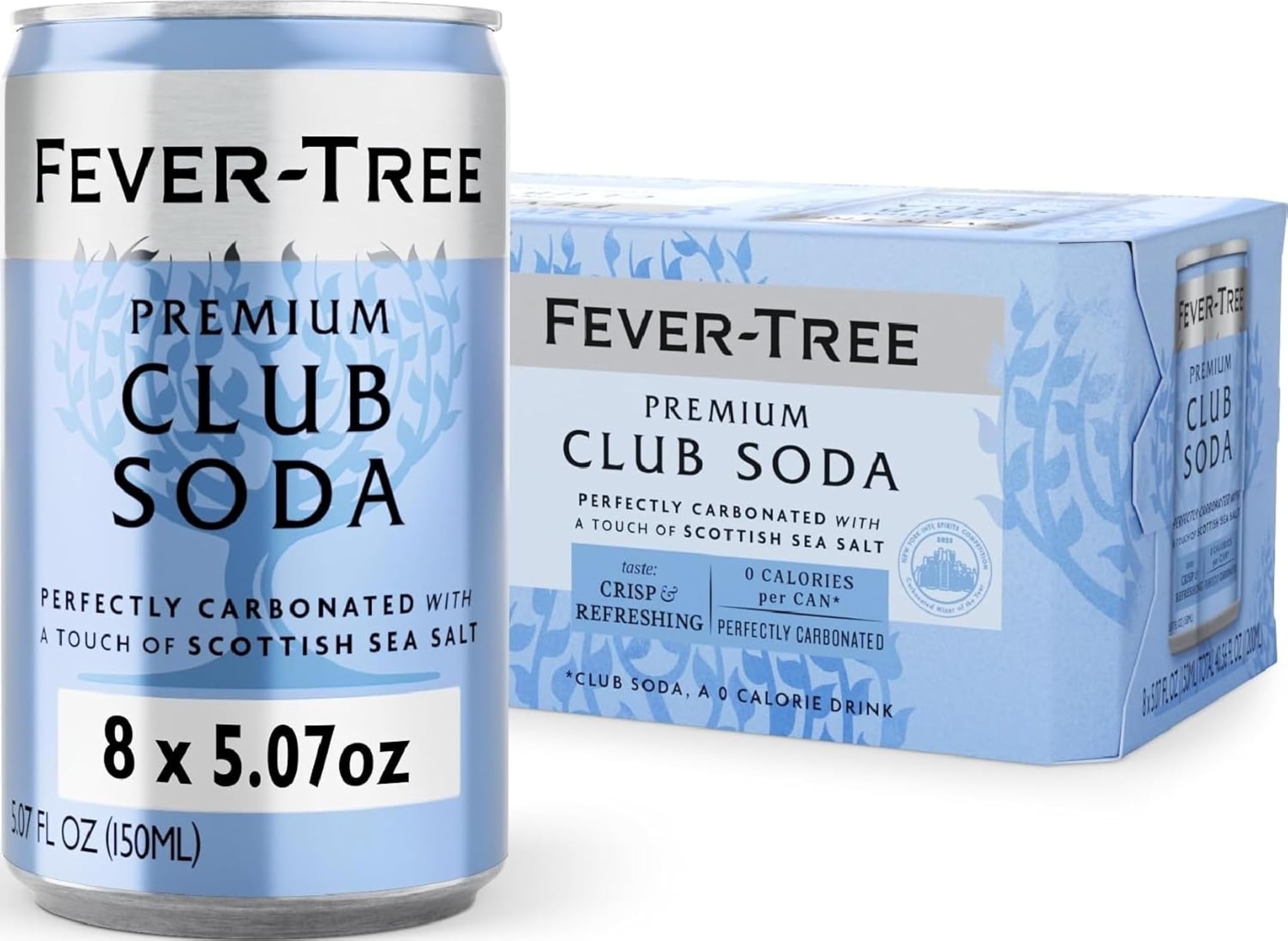
Club soda occupies an odd position in the drinks aisle. It is rarely the point of a purchase on its own, yet it quietly determines whether a mixed drink tastes clean or flat. Fever-Tree’s version, sold in 5.1 fl oz cans and flavored with Scottish sea salt, is aimed at people who care enough about that distinction to spend more than they would on a supermarket own-brand seltzer. Whether that premium is justified depends heavily on how the cans are used.
The format is the first thing worth noting. At roughly 150 ml per can, these are small — closer to a single-serve mixer than a full glass of soda. That sizing is deliberate and, in practice, quite sensible for cocktails: one can tops off a highball without leaving half a flat can behind. For anyone expecting to drink club soda as a standalone beverage, though, the cans will feel frustratingly short. Two or three would be needed to fill a standard tumbler, which makes the per-ounce cost harder to justify.
Functionally, the product is straightforward. It is carbonated water with added minerals, including Scottish sea salt, and no sweetener. The salt is the distinguishing feature; it rounds out the carbonation and adds a faint savory edge that plain sparkling water lacks. In a whiskey highball or a gin and tonic made with a lighter gin, that mineral backbone keeps the drink from tasting thin. It also works in non-alcoholic contexts — topped with a splash of bitters or citrus, it reads as a more deliberate drink than tap seltzer.
- Pack size: 8 cans, 5.1 fl oz each
- Ingredients: Carbonated water, Scottish sea salt (no sugar, no sweetener)
- Format: Small-format cans, intended as a mixer rather than a standalone drink
- Carbonation: Moderate to lively; holds up reasonably well once opened but not indefinitely
Carbonation is where club soda lives or dies, and Fever-Tree’s is respectable without being remarkable. The bubbles are fine and persistent enough to carry aromatics in a cocktail, but a can left open for twenty minutes will go noticeably soft. That is true of nearly all canned soda, so it is less a flaw than a reminder that the small format exists for a reason: finish the can.
The clearest limitation is cost. These cans sit at a premium price point, and the gap between them and a basic store-brand club soda is wide. In a drink where the mixer is a supporting player — a rum and soda, say, or a spritz with a strong aperitivo — the difference is subtle enough that many drinkers will not notice it. The sea salt is also a matter of taste. It is restrained, but anyone expecting a neutral, purely clean soda water may find the mineral note slightly distracting, particularly when drinking it straight.
Compared with tonic water, club soda is the quieter option: no quinine bitterness, no sugar, and far more flexibility. Compared with plain sparkling mineral water, it brings a touch more texture and salinity but less of a distinct terroir. And compared with a soda siphon or a large bottle of club soda, the cans trade economy for convenience and consistent freshness. A siphon is cheaper per serving and arguably more sustainable, but it requires charging, storage, and a bit of fuss. The cans are the lower-effort choice, and for occasional cocktail making that trade-off is reasonable.
In real-world use, the product fits most naturally into a home bar setup where a highball or a gin and tonic is made a few times a week rather than nightly. The eight-pack disappears quickly if entertaining, since each drink consumes a full can. It is also a practical option for anyone who wants a decent non-alcoholic drink without opening a large bottle that will go flat before it is finished.
Who is it for? People who make cocktails at home with some regularity and want a mixer that does not undermine the spirit. It suits highball drinkers, G&T drinkers using lighter gins, and anyone building low- or no-alcohol drinks who wants more structure than plain seltzer provides. Who is it not for? Budget-conscious buyers mixing drinks where the soda is incidental; people who drink club soda by the glass rather than as a mixer; and anyone who prefers a completely neutral, salt-free soda water. The premium is real, and so is the small can — both are features, but neither suits every kitchen.
Overall, this is a well-made mixer with a clear point of view. It performs reliably in the drinks it was designed for, and the salt adds something a generic club soda does not. The trade-offs — price, can size, and a mineral flavor that is not for everyone — are worth weighing before committing to a multi-pack. Buy a single pack first, make a highball, and decide whether the difference registers. For some drinkers it will; for others, a cheaper can will do the job just as well.