
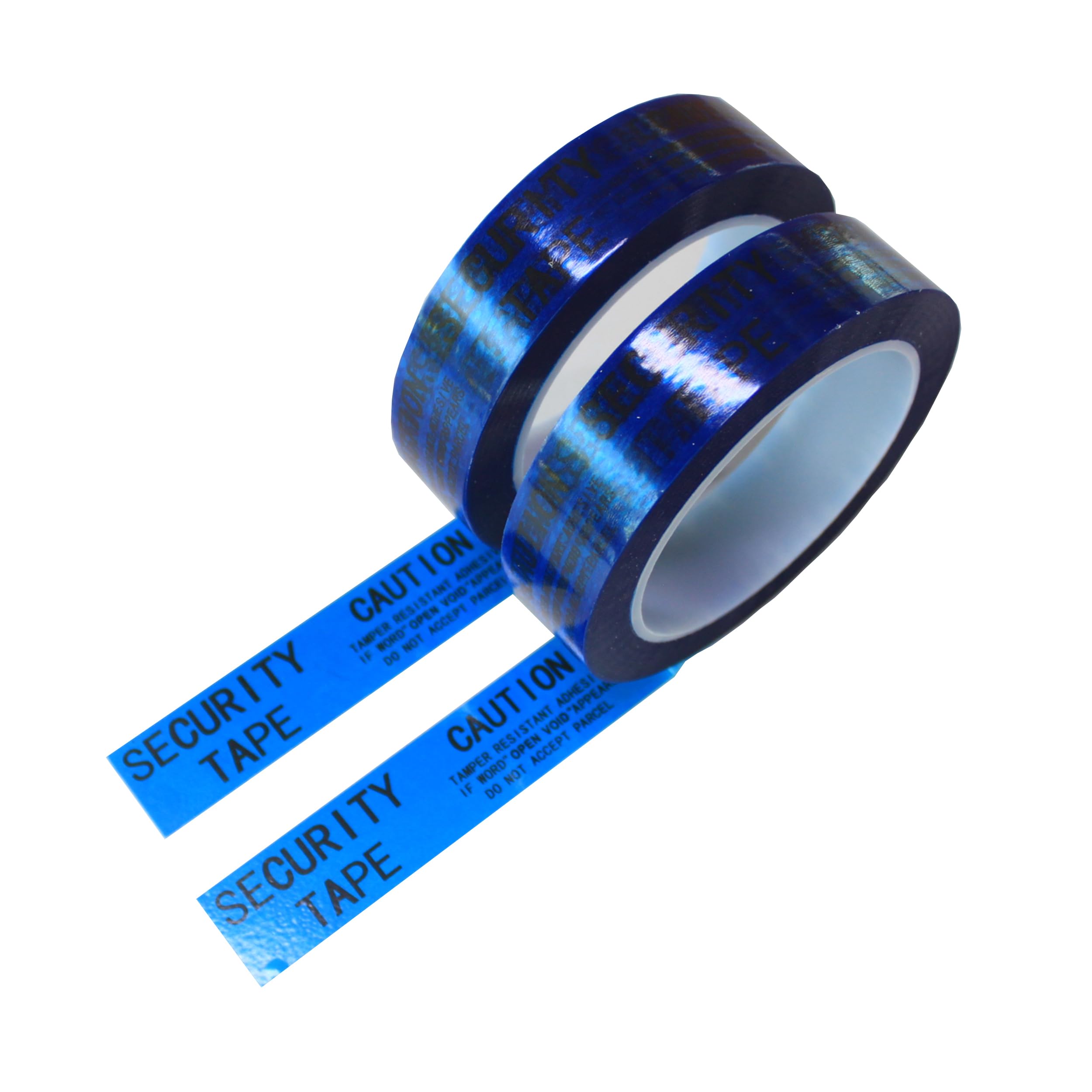
Tamper-evident tape occupies an odd corner of the packaging world. It is not glamorous, and most buyers only think about it after something has gone missing or been disturbed. This two-roll pack of 1-inch by 55-yard blue non-transfer security tape is a fairly typical example of the category, and understanding what “non-transfer” actually means matters more than the roll count or the color.
The core function here is straightforward: the tape is designed to leave a visible residue or pattern behind if someone tries to peel it back. The adhesive is formulated so that the bond to the surface is stronger than the internal cohesion of the tape itself. When someone lifts an edge, the tape delaminates, and a checkerboard or message pattern remains stuck to the substrate. That is the entire point of the product, and it is the feature worth evaluating first.
The “non-transfer” label is where buyers often get confused. It generally means the residue stays on the surface being sealed rather than transferring cleanly onto the tape and leaving the surface pristine. In practice, this is the behavior you want on corrugated cartons, plastic totes, and rigid containers, because the leftover pattern is the evidence. It is not the right choice for surfaces you care about keeping clean, such as finished wood, painted metal, or anything you plan to resell. The residue is meant to be permanent, and it usually is.
Real-world usage falls into a few predictable buckets. Small businesses use it to seal outgoing shipments of electronics, documents, or high-value parts where a customer dispute about whether a box was opened is possible. Property managers and storage facilities use it on lockers and utility cabinets. Some people use it on luggage or moving boxes during transit. The 1-inch width is a reasonable middle ground: wide enough to bridge the seam of a standard carton flap, narrow enough to run along the edge of a smaller container or a file drawer. The 55-yard length per roll is generous for occasional use and roughly adequate for a small operation sealing a few dozen packages a week.
Functionally, the tape is a standard acrylic adhesive on a film backing. It applies cleanly by hand, does not require a dispenser, and holds well to clean, dry cardboard. It is not reinforced, so it will not add structural strength to a box the way filament or strapping tape would. It is also not designed for extreme cold or very dusty surfaces, where adhesion drops off and the tamper pattern may not release cleanly. Expect it to perform well in normal indoor and sheltered shipping conditions and to be less reliable on recycled or heavily coated corrugated, which often has a slick finish that the adhesive struggles to grip.
One limitation worth stating plainly: two rolls is not a large quantity if you are sealing at any real volume. A 55-yard roll yields about 1,980 inches, which sounds like a lot until you are running a strip along both flap seams of a medium box. For a home user or a very small shop, this pack is fine. For a fulfillment operation, it is a sample size, and you will be reordering quickly. The blue color is also a matter of preference; it is highly visible, which helps with inspection, but it is not subtle and will stand out on any package.
Compared with a generic clear packing tape, the trade-off is obvious. Clear tape is cheaper, stronger per inch, and leaves no residue, but it offers no evidence of tampering and can be resealed almost invisibly. Tamper-evident tape costs more and is messier to remove, but that is the product doing its job. Compared with heat-shrink bands or security seals, tape is less tamper-resistant in absolute terms, since a determined person can sometimes slice along a seam and re-tape over the evidence. It is a deterrent and a record, not a vault.
This tape suits small shippers, storage users, and anyone who needs a low-cost visual check on whether a container has been opened. It does not suit high-volume operations, surfaces where residue is unacceptable, or situations requiring genuine tamper-proofing rather than tamper-evidence. Buy it for what it is: a practical, disposable indicator, not a security system.