
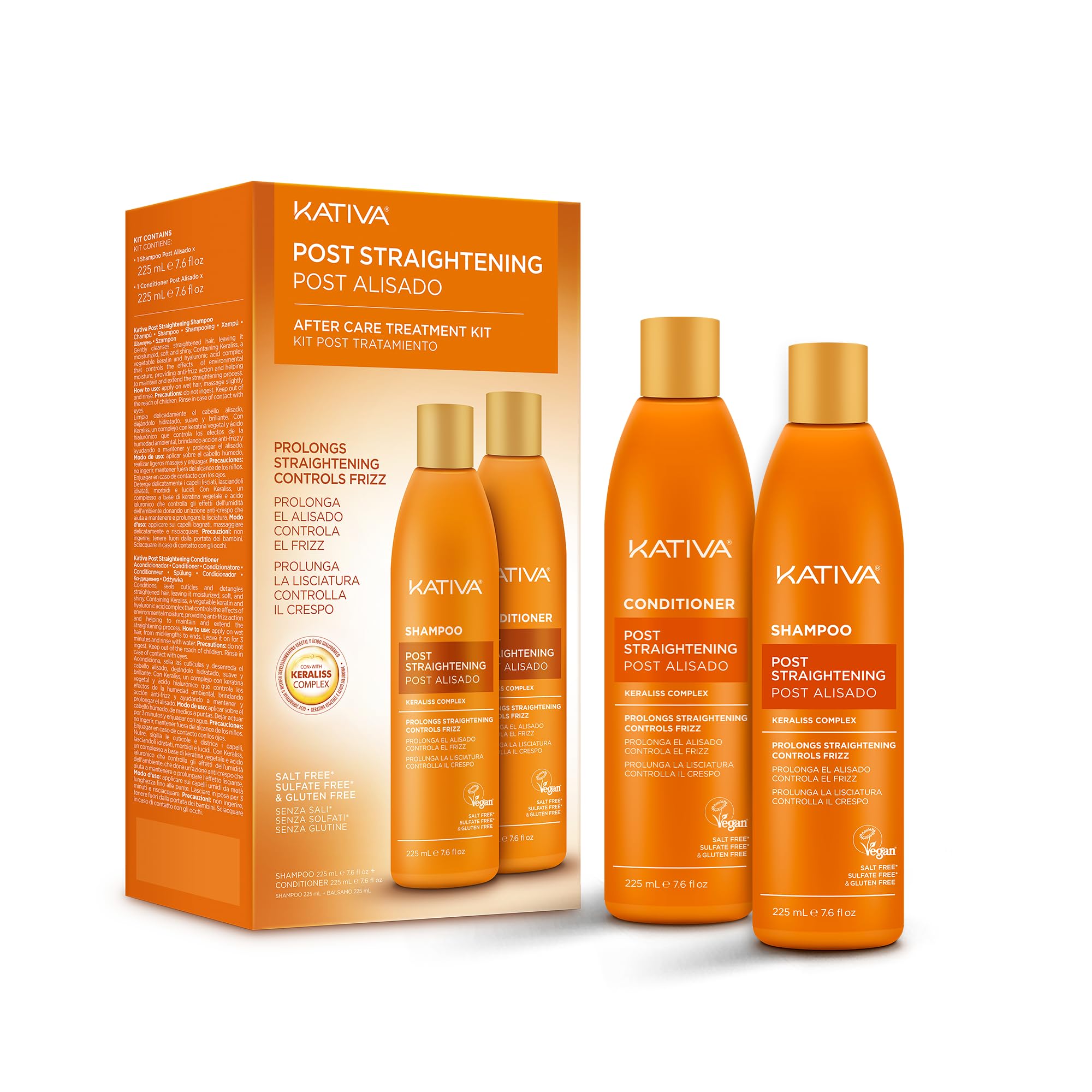
Kativa’s Post-Straightening Hair Care Kit pairs a salt-free shampoo with a matching conditioner, both built around vegetal keratin and hyaluronic acid. The premise is straightforward: after a salon straightening treatment, ordinary shampoos—especially those with high salt content—can strip the treatment and shorten its lifespan. This two-bottle set is aimed at the maintenance phase, the weeks and months when the real work is simply not undoing what was done at the salon. Each bottle is 7.6 fluid ounces, which is on the smaller side for a shampoo-and-conditioner pair, so frequent washers should factor that into the cost per use.
The salt-free formulation is the central functional claim here. Sodium chloride and similar salts are common thickeners and cheap fillers in drugstore shampoos, and they are widely blamed for accelerating the breakdown of keratin straightening treatments. Whether salt is the single decisive factor is debated among stylists, but avoiding it is a low-risk choice for anyone who has paid for a smoothing service. The inclusion of vegetal keratin is meant to temporarily fill in and smooth the cuticle, while hyaluronic acid adds a humectant layer that helps hair feel less dry and brittle, which matters because straightened hair often loses moisture. Neither ingredient repairs bonds permanently in the way a salon treatment does; the effect is cosmetic and cumulative over repeated washes.
In real-world use, the kit fits into a normal wash routine rather than replacing it. The shampoo lathers less aggressively than sulfate-heavy formulas, which is expected for a salt-free product—some users interpret the thinner lather as a sign it isn’t cleaning, but it generally does the job on everyday oil and product buildup. The conditioner is the more substantial of the two, with enough slip to detangle mid-length to long hair without requiring a separate mask on every wash. Most people will use it after each shampoo, and the paired formulas are designed to layer without weighing hair down. The 18-week claim printed on the packaging deserves a caveat: that figure is a best-case scenario tied to a professional straightening service and consistent use of the full routine, and results depend heavily on hair type, water hardness, heat styling habits, and how often the hair is washed. Readers should treat 18 weeks as an upper bound, not a promise.
There is a genuine trade-off to consider. Salt-free, sulfate-light shampoos tend to clean more gently, and people with very oily scalps or heavy silicone buildup may find this one underpowered for regular use—it can leave roots feeling coated after a few days. Those with fine hair should also watch the conditioner, which is rich enough to flatten volume if applied too close to the scalp. The small bottle size compounds this: a household with two people using the kit will go through it quickly, and the price per ounce is higher than mass-market alternatives.
Compared with a generic sulfate-free shampoo and conditioner duo, the Kativa kit’s advantage is narrower than the marketing suggests. A plain sulfate-free pair will also be gentle on straightened hair, though it may still contain salts, so checking labels matters. The real comparison is against dedicated bond-repair systems or salon-recommended post-treatment lines, which typically cost more but target the treatment chemistry more directly. This kit sits in the middle: more focused than a drugstore pair, less specialized than a salon system, and priced accordingly.
It suits people who have recently had a keratin or similar smoothing treatment and want a simple, salt-free daily routine that won’t actively work against it. It also works for anyone with dry, chemically treated hair looking for a gentler wash day. It is not the right pick for those with very oily scalps who need stronger cleansing, for fine hair that struggles with heavy conditioners, or for anyone expecting the kit alone to straighten hair—it maintains a treatment, it does not create one. Shoppers should also be realistic about the 18-week figure and budget for repurchasing relatively often.