
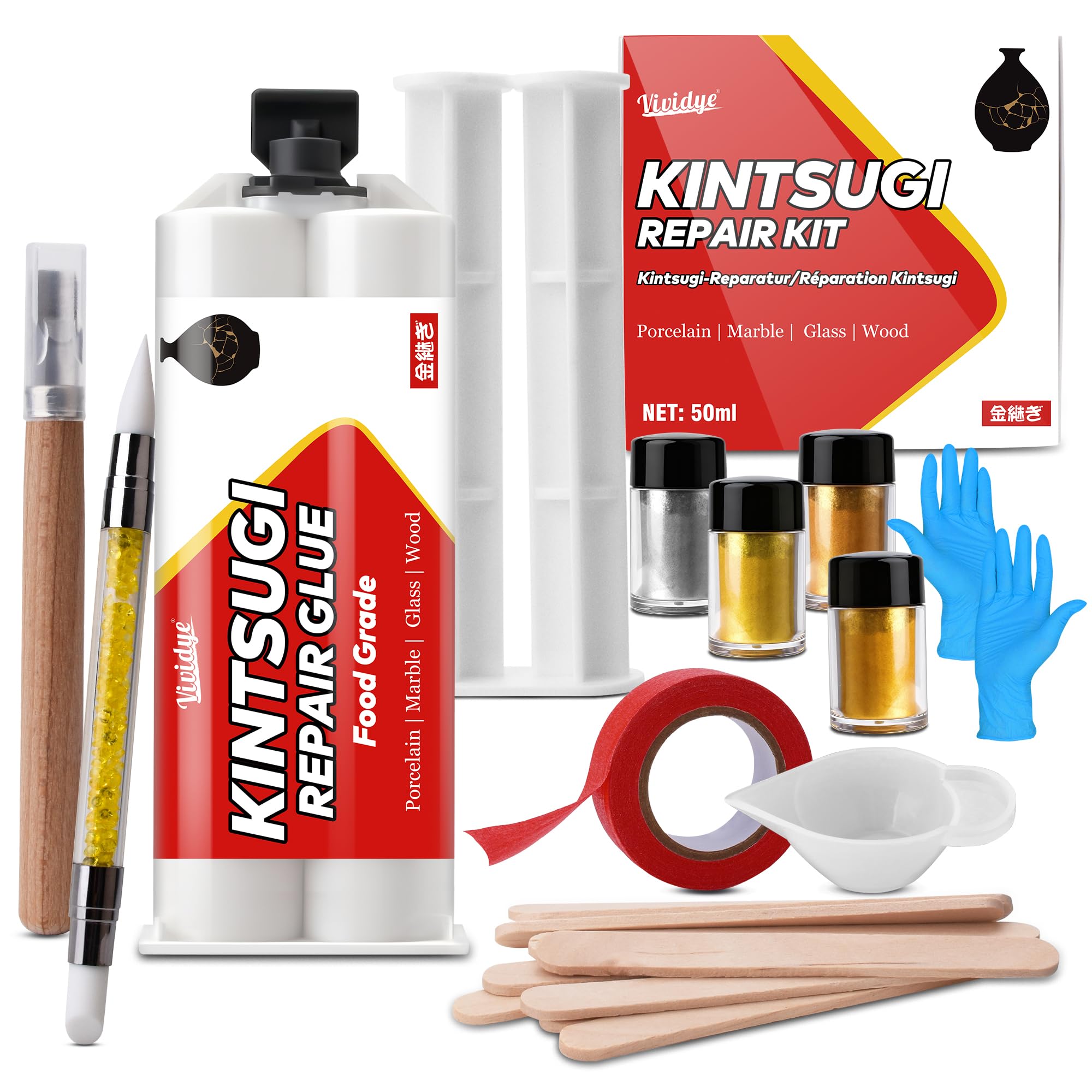
Repairing broken ceramics with gold has a long history in Japan, but the traditional urushi lacquer process is slow, requires skill, and isn’t food-safe until fully cured. The Kintsugi Repair Kit with food-safe ceramic glue and gold/silver powders offers a more approachable route. It’s aimed at people who want to fix a chipped mug or cracked bowl while highlighting the repair rather than hiding it. This review looks at what the kit actually delivers, where it falls short, and who might find it useful.
The kit typically includes a two-part epoxy adhesive, gold and silver metal powders, mixing sticks, brushes, and sometimes gloves and sandpaper. The epoxy is the workhorse: it bonds ceramic and is declared food-safe once cured. The metal powders are meant to be mixed into the epoxy or dusted onto the wet adhesive to create a gilded seam. In practice, the process involves cleaning the break, mixing the epoxy, applying it, joining the pieces, and then decorating the repair line. Curing takes 24 hours or more, depending on temperature and humidity.
Real-world use is straightforward but not instant. For a clean break, the epoxy gives you a few minutes of working time—enough to adjust but not to dawdle. The gold powder can be mixed into the adhesive for a uniform color, or brushed on after joining for a more textured look. The silver powder behaves similarly. Results are best on non-porous glazed ceramics; on unglazed clay or rough textures, the metallic effect can look patchy. The kit is not a substitute for proper kintsugi lacquer, but it’s far more forgiving for beginners.
Functionally, the epoxy is strong. Once cured, the bond holds up to normal use—hand washing, light knocks—but it’s not indestructible. Thermal shock is a concern: pouring boiling water into a repaired mug can weaken the bond over time, and dishwashers are a bad idea. The food-safe claim applies to the cured epoxy, but the gold and silver powders are decorative and shouldn’t be ingested; keep them away from direct contact with food and drink, especially on rims. That’s a limitation worth noting: the metallic finish is not meant to be eaten off, so repairs on the inside of a cup or bowl need extra care or a food-safe sealant over the top.
Compared to a standard ceramic glue (like a clear epoxy or cyanoacrylate), this kit adds the decorative element and a more controlled mixing setup. It’s also more expensive than a tube of super glue, and the results depend heavily on the user’s patience and technique. Unlike traditional kintsugi, which uses urushi lacquer and real gold, this kit uses epoxy and metal powders—a practical compromise that sacrifices some authenticity for safety and ease. If you’re after a museum-quality restoration, this isn’t it. If you want a visible, sturdy repair with a bit of character, it works.
Who is it for? Someone with a cherished but broken ceramic—a favorite mug, a sentimental plate—who doesn’t mind a visible repair and is willing to spend an hour or two on the process. It’s also a decent entry point for learning the basics of kintsugi without the cost and toxicity concerns of urushi. Who is it not for? Anyone expecting invisible fixes, people repairing items that go in the dishwasher or microwave, and those working with porous or unglazed ceramics where the metallic powder won’t adhere well. Also, if you’re repairing a piece that will hold hot liquids, the epoxy’s heat resistance is limited; check the manufacturer’s temperature limits before using it on a teapot or soup bowl.
In use, the kit’s instructions are generally clear, but they gloss over the importance of surface preparation. Cleaning the break with alcohol and lightly sanding the edges improves adhesion significantly—something many beginners skip. The gold powder can be messy; it’s fine and statics easily, so work over a sheet of paper to catch excess. The silver powder is less dramatic but more forgiving if your technique is uneven. Curing time feels long if you’re eager to use the piece, but rushing it leads to weak bonds.
Overall, the Kintsugi Repair Kit is a niche product that delivers on its core promise: a food-safe adhesive with decorative metal powders for visible repairs. It’s not a professional restoration system, and it has clear limitations around heat, dishwasher safety, and food contact with the metallic finish. But for the occasional repair where the break becomes part of the object’s story, it’s a practical and relatively affordable option. Just go in with realistic expectations: the result will look handmade, not machine-perfect, and that’s part of the point.