
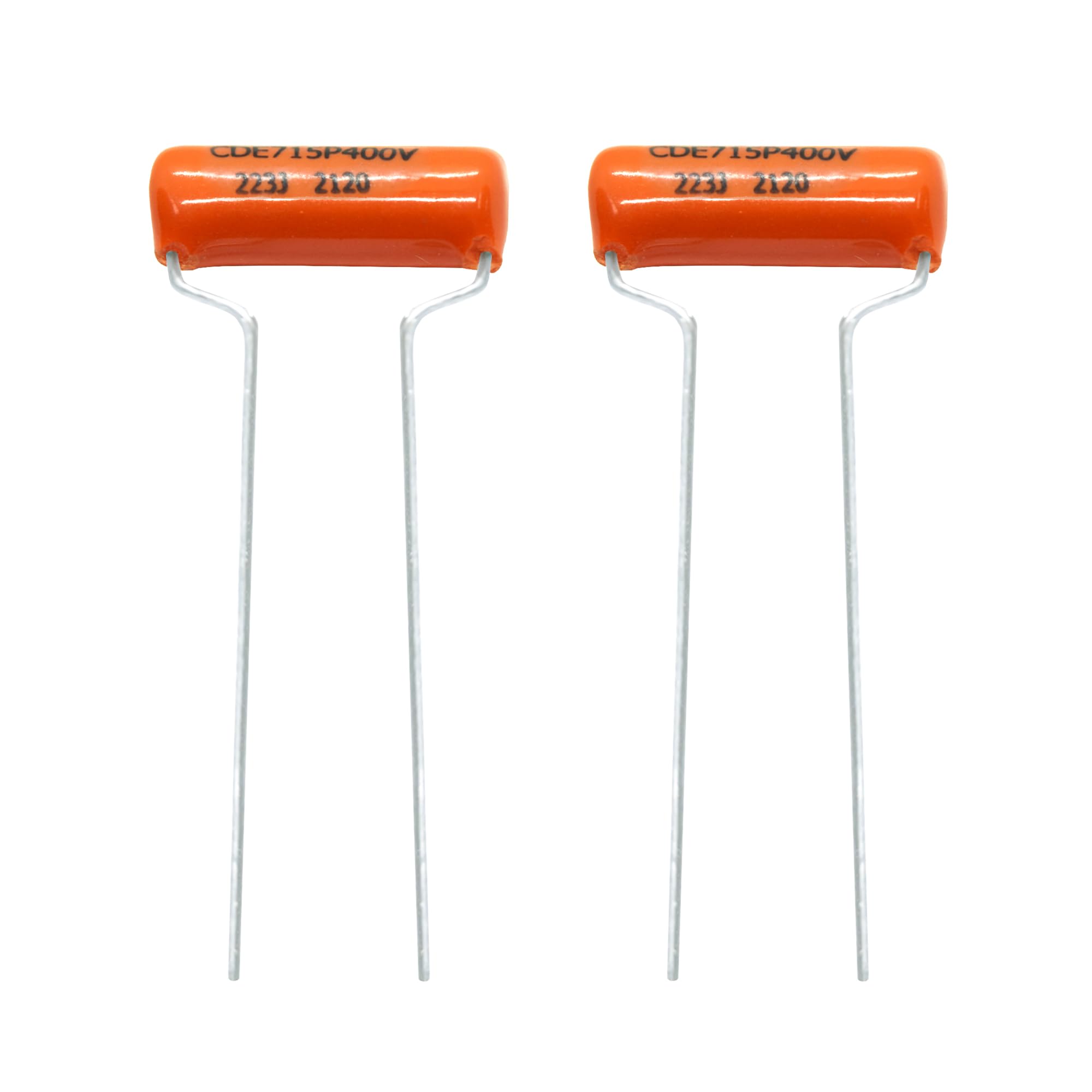
Orange Drop capacitors have a long history in guitar electronics and amplifier circuits, and this pair of .022uF/400V units is a common sight in tone control mods and repair jobs. But like any component, they come with trade-offs. This review looks at what these capacitors actually do, where they fit, and whether they’re the right choice for your project.
If you’ve spent any time around guitar wiring or amp repair, you’ve probably encountered Orange Drop capacitors. The .022uF/400V rating is particularly common in tone circuits for humbucker-equipped guitars and in various spots within tube amplifiers. This pair offers two identical capacitors, which is handy for stereo setups, matched pairs in amps, or simply having a spare on hand.
What you’re getting
These are film capacitors with a 0.022 microfarad capacitance and a 400-volt rating. The “Orange Drop” name comes from the distinctive orange epoxy coating, which is more than cosmetic—it protects the capacitor from moisture and mechanical damage. The 400V rating is more than adequate for typical guitar tone circuits, which see only a fraction of that voltage. In amplifier applications, 400V is suitable for many preamp and some power amp positions, but you’ll want to check your schematic for exact requirements.
The tolerance on these capacitors is typically around 5% or 10%, meaning the actual capacitance could be slightly above or below .022uF. For most guitar tone applications, this variance is inaudible, but in critical filter circuits, it might matter. The film construction itself is known for stability over time and low leakage, which is why Orange Drops are often chosen for signal path positions where reliability is key.
Where they fit in real use
In a guitar’s tone control, a .022uF capacitor is the standard value for humbuckers and many single-coil setups. It determines how much high frequency is rolled off as you turn the tone knob. Swap in an Orange Drop, and you might notice a slightly smoother taper compared to cheaper ceramic capacitors, though the difference is subtle and depends on the rest of the circuit. Many players report that Orange Drops sound “warmer” or “more musical,” but that’s subjective—what’s certain is that they’re built to last and won’t degrade like some older capacitor types.
In amplifiers, these capacitors might appear as coupling caps, tone stack components, or bypass caps. The 400V rating makes them suitable for many tube amp positions, but not all—output transformers and power supply sections may require higher voltage ratings. Always consult the schematic and consider the voltage margins. For repair work, having a pair means you can replace both capacitors in a stereo circuit or keep one as a spare.
Performance and limitations
Electrically, these capacitors perform as expected: they block DC while passing AC, and their film construction provides good stability. They’re not “magic” components—they won’t transform a poorly set up guitar or fix a noisy amp. In fact, if you’re expecting a dramatic tone change from swapping capacitors alone, you’ll likely be disappointed. The difference between a .022uF Orange Drop and a generic film capacitor of the same value is minimal in most blind tests.
One trade-off is size: Orange Drops are physically larger than ceramic disc capacitors, which can make installation in tight guitar cavities or densely packed amp chassis a bit fiddly. The leads are sturdy but may require careful bending to fit. Also, the 400V rating, while sufficient for many applications, is not universal for amplifier work—if you’re working on a high-power amp, you might need capacitors rated for 630V or more in certain positions.
Another consideration is cost. Orange Drops are generally more expensive than basic ceramic or film capacitors. Whether that premium is worth it depends on your priorities: for a vintage-correct restoration or a high-end build, the extra cost might be justified; for a budget practice amp or a first-time mod, a cheaper capacitor might suffice.
How they compare
Compared to ceramic capacitors, Orange Drops offer better stability and lower distortion, but they’re also larger and pricier. Ceramic caps are fine for many non-critical applications and are often used in budget guitars. On the other hand, paper-in-oil capacitors (often found in vintage amps) have a different reputation—some players swear by their tone, but they can be leaky and unreliable over time. Orange Drops strike a balance between reliability and performance, making them a popular choice for both new builds and repairs.
If you’re specifically looking for a “vintage” tone, you might be drawn to paper-in-oil or polyester film capacitors, but those come with their own quirks. Orange Drops are more of a modern standard—consistent, durable, and widely available.
Who should buy this
This pair is well-suited for guitarists who want to upgrade their tone circuit with a reliable capacitor, especially if they’re doing a first-time mod or restoration. It’s also a good option for amp techs who need a couple of spares for common repairs. However, if you’re on a tight budget or working on a project where capacitor size is critical, you might want to consider alternatives. And if you’re expecting a night-and-day tonal improvement, temper your expectations—capacitors are just one part of the signal chain.
Ultimately, these Orange Drop capacitors are a solid, dependable choice for many electronics projects. They’re not glamorous, but they do their job well. Just be sure to verify the voltage rating for your specific application and double-check the capacitance value if precision is required.