
Dorothy Ashby’s Rubaiyat has long sat in an odd corner of the jazz catalog: admired by harpists and crate-diggers, overlooked by the broader listening public, and never quite as easy to find on good-sounding vinyl as its reputation suggests. This SHM-CD edition from Universal Japan puts the 1970 album back into circulation on a format that a certain kind of listener has come to trust for quiet, clean transfers. Whether that trust is warranted here is worth examining rather than assuming.
For context, the album itself is a curious hybrid. Ashby, one of the few jazz harpists to record as a leader, built the record around Persian and Middle Eastern imagery, with the title nodding to Omar Khayyam’s quatrains. The arrangements fold harp, flute, kalimba, and a rhythm section into modal jazz and soul-jazz frameworks, with vocals on a handful of tracks. It is not straight-ahead bebop, and it is not quite the psychedelic soul that some of its later sampling fame might imply. It sits somewhere between chamber jazz and early-seventies crossover, and that in-between quality is part of why it rewards repeated listening.
The SHM-CD format is the main reason to consider this particular pressing. Super High Material CD is a disc substrate developed by JVC and Universal, claimed to offer better optical read accuracy than standard polycarbonate. In practice, the audible difference comes less from the plastic itself than from the mastering decisions made for these Japanese reissues, which tend to favor restrained EQ and conservative compression. On this disc, the harp’s upper register is clear without being glassy, and the low end on tracks like the title cut has enough body to register on modest systems. It is a clean, slightly polite presentation. Listeners who want a warm, vinyl-like bloom may find it a touch clinical.
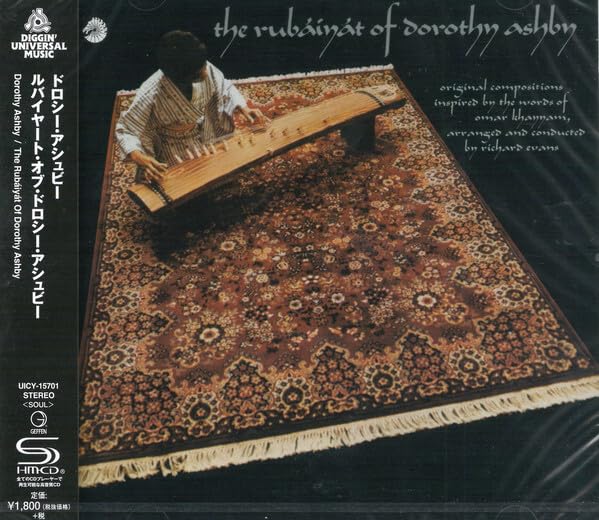
How people actually use a disc like this matters. It is the sort of purchase made by someone who already knows the album, or knows of it through hip-hop producers who have mined its grooves, and wants a reliable physical copy that will play without surface noise on a CD player, a rip to a server, or a computer drive. The SHM-CD plays in any standard CD player, so there is no compatibility issue. The packaging follows the Japanese mini-LP convention: a cardboard sleeve replicating the original artwork, often with an obi strip and Japanese liner notes. That presentation is a genuine draw for collectors, though the sleeve is thin and not especially protective; it is display packaging, not archival housing.
There are trade-offs worth naming. First, the price. Japanese SHM-CD reissues routinely cost more than a domestic CD or a standard streaming subscription month, and the premium buys you mastering and packaging rather than additional music. Second, the format’s claimed technical advantages are difficult to verify and easy to overstate; buyers should treat SHM as a marker of careful sourcing, not a dramatic upgrade. Third, the album’s vocal tracks divide listeners. Some find them charming period pieces; others skip past them to the instrumentals, which are the stronger material. If you are coming for the harp-led modal pieces, expect to program around a few tracks.
Compared with alternatives, the calculus is straightforward. A standard CD reissue or a good digital stream will get you the music for less, and on a mid-fi setup the differences may be marginal. A clean original LP, if you can find one, offers a different character entirely, with the warmth and slight compression of the era, but at collector prices and with the usual vinyl caveats. The SHM-CD sits between those options: more consistent than vinyl, more expensive than streaming, and more carefully presented than a budget CD. It is a reasonable choice for someone who wants one good physical copy and values the Japanese reissue approach.
This edition suits listeners who already know the album or are exploring Ashby’s catalog seriously, who own a decent CD player or ripping setup, and who appreciate mini-LP packaging. It is less suitable for casual listeners who might stream first to decide, for anyone on a tight budget, or for those expecting the SHM format to transform a modest system. The music itself remains the draw: an unusual, atmospheric record that has aged unevenly but still sounds like little else. This reissue presents it honestly, with modest sonic gains and a premium price, and that is a fair summary of what it offers.