
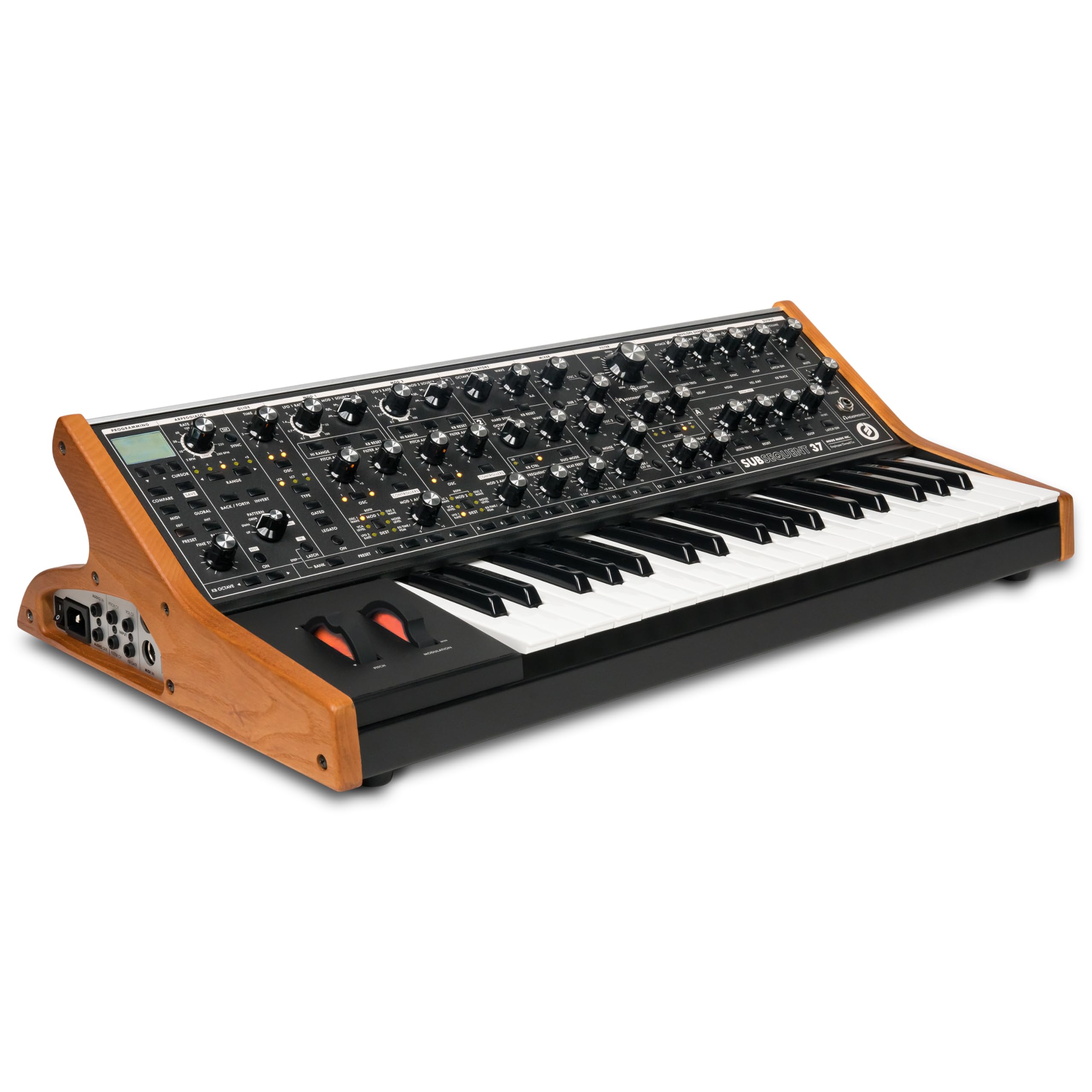
The Subsequent 37 sits in an unusual spot in Moog’s lineup. It is a descendant of the Sub 37, itself a reworking of the Sub Phatty platform, and it occupies the space between a straightforward mono bass synth and something closer to a performance instrument. Moog bills it as paraphonic rather than polyphonic, and that distinction matters more than the spec sheet suggests. Understanding what it actually does in a studio or on stage is the difference between finding it indispensable and finding it frustrating.
The core architecture is two analog oscillators per voice, a Moog ladder filter (a 24 dB/octave design with a selectable 6 dB slope on the Sub 37 lineage), two envelopes, an arpeggiator, and a step sequencer. The paraphonic mode lets the two oscillators split into two separate pitches, so you can play two notes at once through a shared filter and amplifier. In practice this is useful for simple two-note chords, octave doubling, or basslines with a moving upper voice, but it is not a substitute for a true polysynth. The shared filter means both notes interact with the same envelope and resonance settings, and complex chords are simply off the table. Players who buy it expecting to comp chords will be disappointed; players who treat it as a mono synth with a useful extra voice will find it flexible.
Where the instrument earns its place is in the tactile experience. The control surface is dense but logical, with nearly every parameter available as a physical knob or switch rather than buried in a menu. The 37-note keyboard is velocity- and aftertouch-sensitive, and the modulation routing is extensive enough to keep sound design interesting for a long time. The step sequencer and arpeggiator are genuinely playable, not afterthoughts, and the front-panel layout encourages improvisation. In a live context, this is the kind of synth you can reach for without staring at a screen, which is increasingly rare at this price point.
Sonically, the Subsequent 37 has a thicker, more aggressive character than the original Sub 37, largely due to a revised gain staging and drive circuit. The overdrive can push the filter into saturated territory that sits well in a mix, particularly for bass and lead lines in electronic and rock contexts. It is not a clean, polite instrument by default; the sweet spots tend toward grit and weight. That is a strength for some genres and a limitation for others. Producers looking for glassy pads or delicate plucks will find the raw tone leans heavy, and cleaning it up requires deliberate gain management.
One real trade-off is weight and size. At roughly 22 pounds and with a full metal chassis, it is a substantial piece of gear. It is manageable in a studio, but touring players should factor in the case and the space it takes up. The front panel is also crowded; while the layout is logical, the density of controls means it takes time to build muscle memory, and the small labels on some switches are not the easiest to read in low light.
Compared with a true polysynth such as a Prophet Rev2 or a Novation Peak, the Subsequent 37 gives up polyphony and some tonal versatility. Compared with a simpler mono like a Moog Minitaur or a Korg Monologue, it offers far more modulation, sequencing, and performance control. It sits in the middle: more capable than a basic mono, less flexible than a poly. That middle ground is exactly where many bass and lead players want to be, but it is not a universal fit.
It suits producers and performers who want a hands-on analog instrument with a strong low-end character, built-in sequencing, and enough modulation to keep sound design engaging. It is less suitable for anyone who needs chordal playing, a lightweight gigging board, or a clean, neutral tone. The paraphonic mode is a useful bonus, not a reason to buy it. Treated as a characterful mono synth with a few extra tricks, the Subsequent 37 is a well-built, musically rewarding instrument; treated as a polysynth, it will fall short of expectations.