
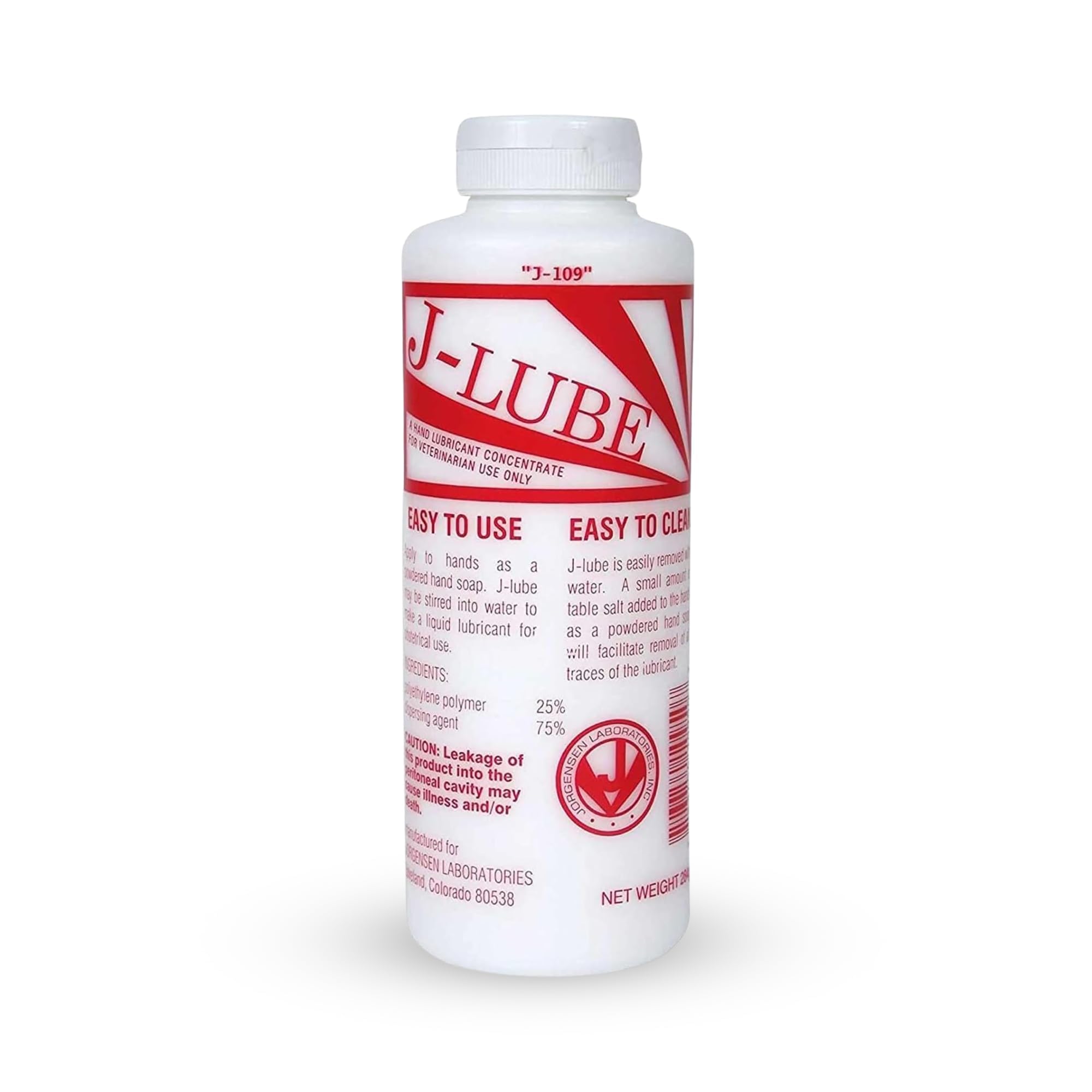
J-Lube is one of those products that circulates mostly by word of mouth in veterinary and livestock circles rather than through conventional retail marketing. The premise is straightforward: a 10-ounce bottle of powder that, once mixed with water, yields somewhere between six and eight gallons of lubricant. That ratio is the entire appeal. Anyone who has bought pre-mixed lubricant by the gallon for obstetrical work or large-animal exams understands why a powder concentrate makes practical sense.
In actual use, J-Lube is mixed on site. The powder is added to water and stirred, and the resulting gel is used for obstetrical procedures, palpation, and general lubrication where a slick, water-soluble medium is needed. Veterinarians and livestock handlers typically mix small batches as needed rather than preparing the full yield at once, since the reconstituted product has a limited shelf life and can grow bacteria if left sitting. The mixing process itself takes some practice; adding powder too quickly or in the wrong proportion produces clumps that are tedious to break up. Getting a smooth consistency is a learned skill, not an instant result.
Functionally, the product is a polyethylene-oxide-based powder, which is what gives it the distinctive slick, slightly stringy texture when mixed. It is water-soluble, which matters for cleanup and for compatibility with instruments and gloves. The concentrate is non-irritating in typical veterinary applications, though as with any lubricant, individual sensitivity varies and it is not intended for every use case. The 10-ounce bottle is compact and stores well before mixing, which is a real advantage over jugs of ready-made gel that take up shelf space and expire.
Where J-Lube earns its reputation is in high-volume, low-fuss scenarios: calving assistance, equine reproduction work, and other situations where a lot of lubricant is needed quickly and cost matters. The cost-per-gallon math is dramatically better than buying pre-mixed lubricant, and that is the honest reason most people seek it out.
The trade-offs are worth stating plainly. First, the mixing requirement is a genuine inconvenience. It is not a grab-and-go product; you need water, a container, and a few minutes, and the ratio has to be roughly right or the texture suffers. Second, the reconstituted gel does not keep indefinitely, so mixing more than you need is wasteful and potentially unhygienic. Third, the texture is notably different from commercial personal lubricants or surgical gels — stringier and tackier — which some users find off-putting even when it performs well. Fourth, the powder is fine and can become airborne during handling, so care is needed to avoid inhaling it or coating surfaces.
Compared with conventional pre-mixed obstetrical lubricants sold in squeeze bottles or gallon jugs, J-Lube trades convenience for economy and storage efficiency. A ready-to-use gel is easier to deploy in a hurry and has a predictable texture every time. J-Lube asks more of the user but delivers far more volume per dollar. Compared with generic surgical lubricants, it is less refined and less consistent, but it is also far cheaper for bulk applications where refinement is not the priority.
This product suits veterinarians, livestock producers, breeders, and others who regularly need large quantities of water-soluble lubricant and are willing to mix it themselves. It is also reasonable for people who want a concentrated backup supply that stores compactly. It is not a good fit for anyone wanting a ready-to-use product, for casual or occasional users who would never approach the full yield, or for applications where a consistent, cosmetically refined gel is expected. Households with pets or small children should store the powder carefully, since the concentrate is not meant for casual handling.
Overall, J-Lube is a utilitarian product that does a specific job well and makes no pretense of being anything else. Its value depends entirely on whether the mixing workflow and bulk-volume use case match your needs. For the right user, the economics are hard to argue with; for everyone else, the convenience gap is real.