
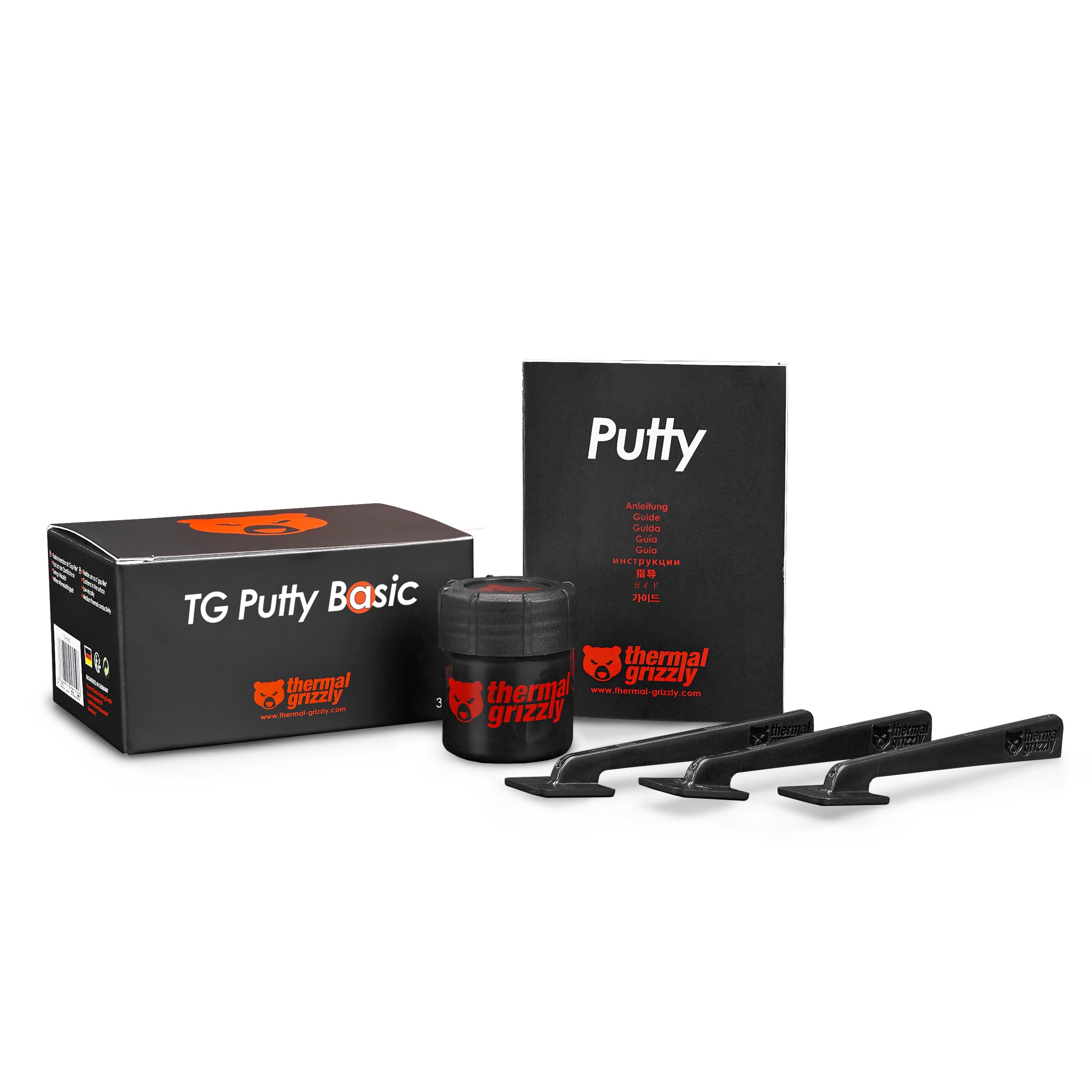
Thermal putty occupies a strange middle ground in the thermal interface world. It is not a paste, it is not a pad, and it does not fit neatly into either category. Thermal Grizzly’s Thermal Putty Basic, sold in a 30-gram tub, is aimed at the spots where neither of those traditional options works well: memory chips, VRM components, laptop internals, and consoles like the PS5. The premise is straightforward. Instead of guessing which pad thickness a particular gap needs, you press putty into the gap and let it conform.
The case for putty is easy to understand once you have dealt with a device that uses pads of several different thicknesses. Laptops and graphics cards routinely ship with pads in 0.5mm, 1mm, 1.5mm, and 2mm sizes, and getting the wrong one means either poor contact or a component that sits too high. Putty sidesteps that entirely because it fills whatever gap exists. Thermal Grizzly sells this as the “Basic” variant, which sits below its Pro putty in the lineup. The Basic formulation is the softer, more pliable option, and that softness matters more than the spec sheet suggests.
In practice, using it is closer to working with dense clay than with thermal paste. You scoop out a portion, roll or press it into a rough shape, and apply it to the chip or the heatsink surface. It does not spread like paste and it does not peel off like a pad. The 30-gram tub is a reasonable amount for a single laptop teardown or a GPU re-pad, though a full console rebuild with many memory chips will use a noticeable fraction of it. Application is forgiving in the sense that over-application is less catastrophic than with paste, but it is also messier. Putty sticks to gloves, tools, and fingers, and cleaning it off a PCB takes patience.
The functional appeal is real. Because the material flows under mounting pressure, it compensates for uneven mounting surfaces and slight height differences between components. That is the scenario where pads often underperform: a memory chip that sits a fraction of a millimeter lower than the surrounding components gets poor contact with a rigid pad. Putty conforms to that discrepancy. For VRAM on a graphics card or the memory and power delivery on a laptop, this is the most defensible use case.
Performance expectations should stay grounded. This is not a replacement for high-end paste on a CPU or GPU die. Thermal Grizzly positions putty for the surrounding components, and that is where it belongs. Its thermal conductivity is lower than a good paste, and its purpose is gap filling rather than maximum heat transfer across a thin, flat interface. Anyone expecting putty to beat a quality paste on a bare die will be disappointed. Used correctly on memory and VRM, it does the job without drama.
There are trade-offs worth naming. The Basic putty is soft enough that it can pump or migrate slightly under repeated thermal cycling, and in vertically mounted cards some users report it settling over time. It is also not reusable in the way a pad is; once compressed and contaminated, it is done. Compared with traditional thermal pads, putty is more expensive per application and requires more cleanup, but it removes the thickness-guessing problem entirely. Compared with paste, it is far more forgiving of uneven gaps but clearly inferior for direct die contact. The choice comes down to what the gap looks like.
Who should consider this? People re-padding a laptop, servicing a PS5, or dealing with VRAM on a card where pad thickness is uncertain will find putty genuinely useful. It is also a sensible option for anyone who has already bought the wrong pad thickness once and does not want to repeat the mistake. Who should skip it? Anyone working on a standard desktop CPU cooler, where paste is cheaper and better. Beginners who want a clean, reversible job may also prefer pads, since putty is messier and less forgiving of sloppy application. And anyone expecting a dramatic temperature drop on a well-cooled system should temper expectations; putty fixes contact problems, it does not create cooling capacity that was never there.
The 30-gram tub is a practical size for a single project, and the Basic formulation’s softness makes it easier to work with than stiffer putties, at the cost of some long-term stability. It is a specialized tool for a specific problem, and judged on that basis it does what it claims. It is not a universal upgrade, and treating it as one is where most disappointment comes from.