
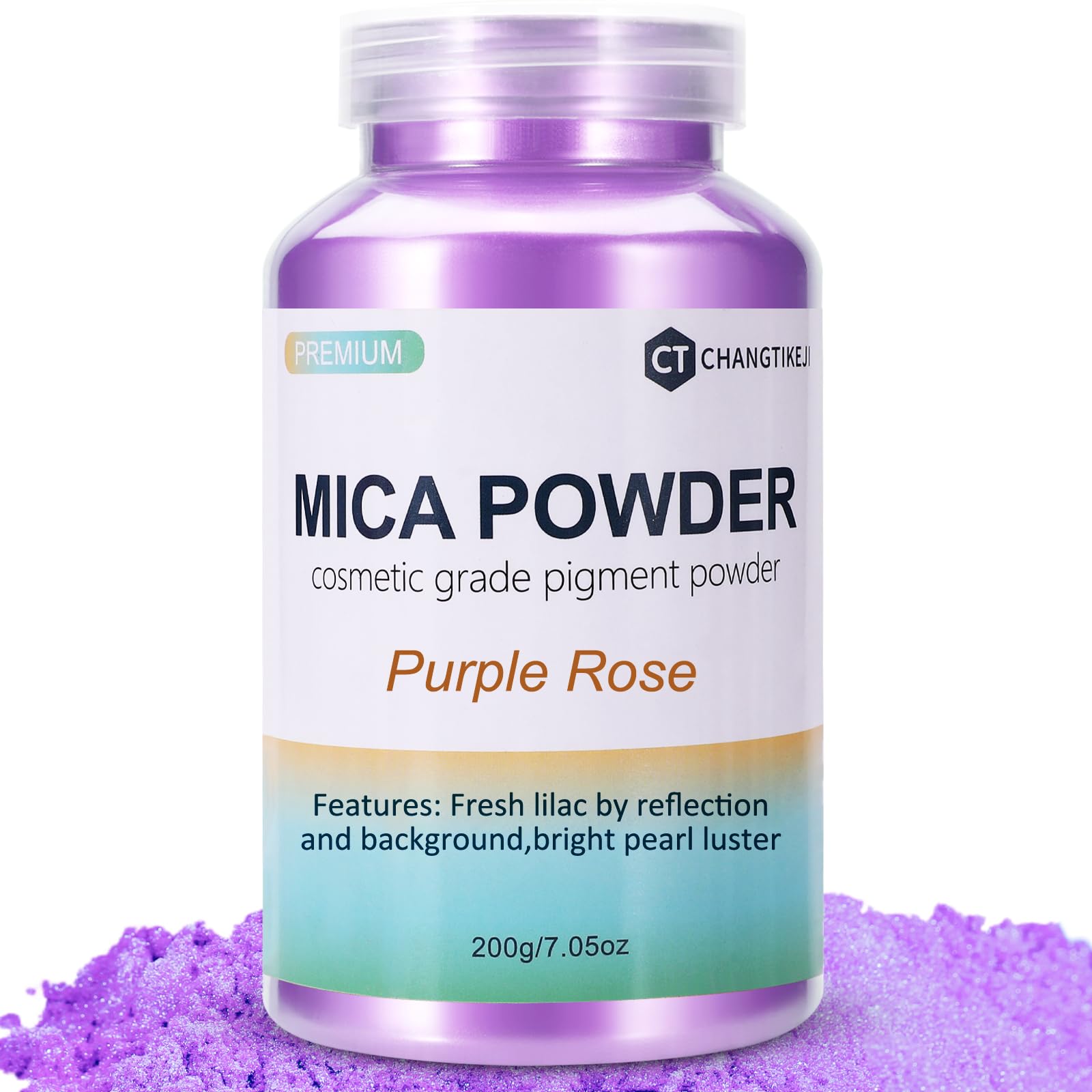
Mica powders occupy an odd space in the maker market: cheap enough to experiment with, but variable enough that the difference between a good batch and a frustrating one usually comes down to particle size, dye load, and how honestly the color is represented in listing photos. This 200g bag of Purple Rose mica from the budget end of the spectrum is a reasonable example of what buyers can expect at that price and volume. It is not a premium cosmetic-grade pigment, and it does not pretend to be, but it covers a lot of ground for people who work across several crafts.
The first thing worth noting is the quantity. At 7.05 ounces, this is a bulk-format pigment rather than a sampler jar. That matters because mica is used in small amounts — a little goes a long way in resin, and even less in soap. A bag this size will last a hobbyist through many projects, which is either a strength or a commitment depending on how much you like the shade. Purple Rose reads as a muted mauve-to-rose tone with a soft shimmer rather than a saturated jewel purple. In thin pours of epoxy it leans dusty pink; in thicker casts or over a dark base it shows more of the rose-violet character. Buyers expecting a vivid magenta should temper that expectation.
Functionally, the powder is a standard cosmetic-type mica with a fine grind. It disperses reasonably well in epoxy resin, though like most micas it benefits from being mixed into a small amount of resin or a drop of alcohol before being added to the main batch. Straight dumping tends to produce clumps that take extra stirring to break up, and over-stirring resin introduces bubbles. In melt-and-pour soap the color holds without bleeding, and in cold process it behaves predictably, though some morphing in high-pH recipes is normal for any mica and this one is no exception. For nail polish and lip gloss, the pigment suspends adequately in a gloss base but will settle over time, so shaking before use is necessary. Bath bombs and candle wax accept it without issue, though in candles the shimmer is mostly visible at the surface rather than suspended throughout the wax.
Coverage is decent but not exceptional. Reaching an opaque, fully saturated purple typically requires more pigment than the listing’s swatch photos suggest — roughly two to three times what a comparable high-end mica would need for the same depth. That is the main trade-off with budget micas, and it is worth factoring into the cost-per-use math. The bag also arrives as a simple resealable pouch, which is functional but not ideal for long-term storage; transferring it to a jar with a tight lid is advisable to prevent moisture clumping.
- Strengths: large quantity for the price, fine grind that disperses with modest effort, works across resin, soap, wax, and cosmetics, soft rose-violet shade that suits vintage or muted palettes
- Limitations: lower pigment density than premium micas, color reads lighter than swatch photos, packaging is basic, settling occurs in liquid suspensions
Compared with dedicated cosmetic-grade micas sold in smaller jars, this product sits in the craft-supply tier. Those premium pigments cost more per gram but deliver stronger color with less material and come with clearer documentation on cosmetic safety and particle size. For resin casters and soap makers who are not selling products requiring strict ingredient traceability, the difference is largely academic. For anyone formulating lip products or cosmetics for sale, the lack of detailed certification is a genuine consideration and may push buyers toward a supplier that provides it.
This mica suits hobbyists and casual makers who want one versatile colorant for mixed projects — resin coasters, soap batches, candle accents, bath bombs, and occasional nail art. It is also a sensible choice for classrooms or group craft sessions where volume matters more than precision. It is less suitable for professional cosmetic formulators, sellers who need batch documentation, or anyone chasing a highly saturated, true purple. Those buyers are better served by a smaller, denser, certified pigment even at a higher per-gram cost.
Overall, the Purple Rose mica is a workmanlike pigment that does what it claims within the limits of its price bracket. It rewards a little prep work — pre-dispersing, testing ratios, storing properly — and punishes expectations set by idealized product photos. Treated as a bulk craft supply rather than a precision cosmetic ingredient, it earns its place on the shelf.