
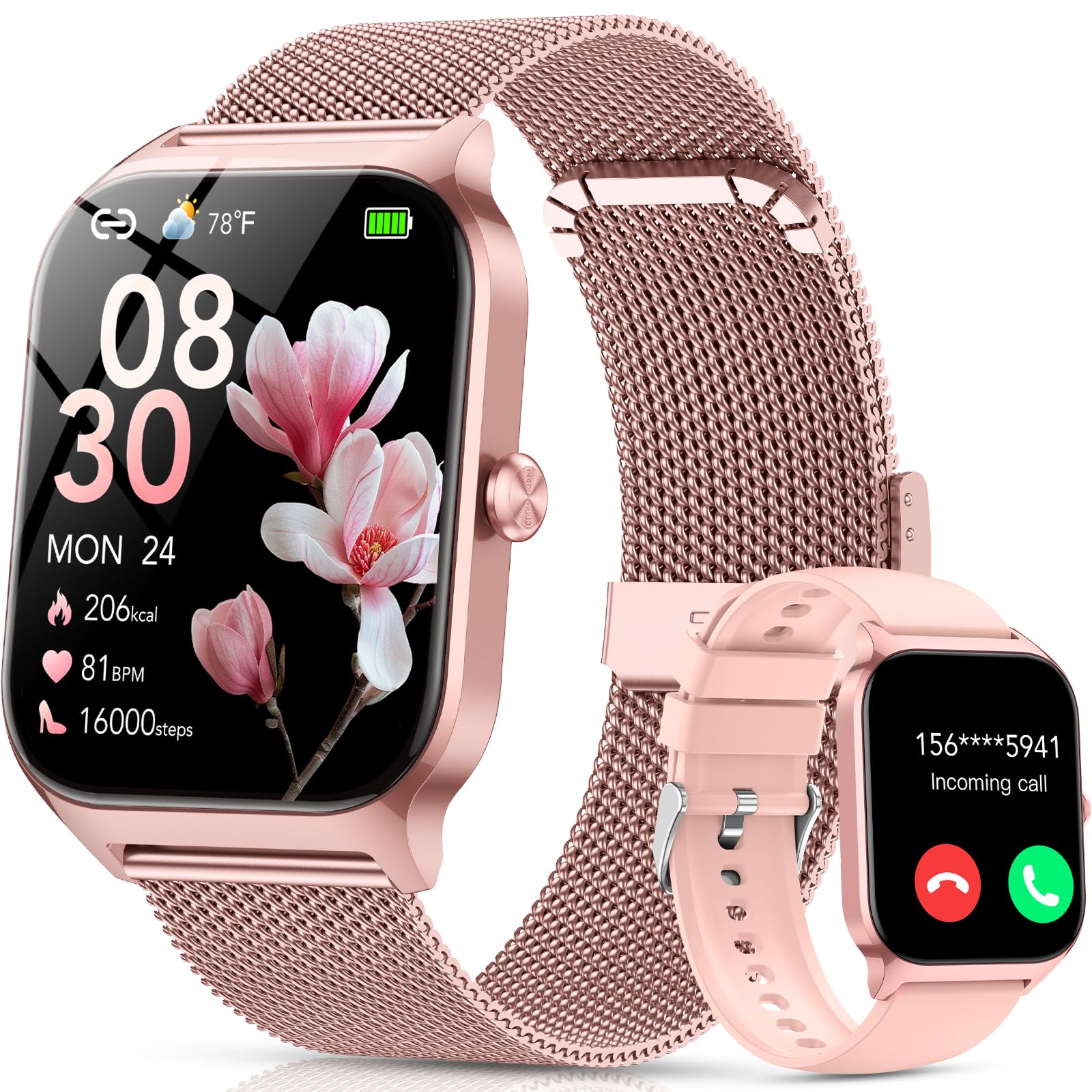
The market for smartwatches aimed at women has grown crowded, and most models in the budget-to-midrange bracket make similar promises: a large screen, call handling, health tracking, and enough battery life to get through a week. This watch from the 1.85-inch HD category follows that formula closely, but it adds a couple of details worth examining — namely an AI voice feature and a second band in the box. Whether those extras matter depends heavily on how you plan to use it.
The first thing to understand is that this is a phone-companion device, not a standalone wearable. It pairs with iPhones and Android phones over Bluetooth, and the calling feature works by routing audio through the watch’s built-in speaker and microphone rather than through a cellular connection. In practice, that means you can take a call while your phone sits in a bag or on a desk a room away, which is genuinely useful for short conversations. It is not a replacement for holding the phone to your ear during a long call; the speaker is small, and callers on the other end will notice the difference in audio quality compared with the handset.
The 1.85-inch display is on the larger side for a women’s fitness watch, and that has trade-offs. Text messages and notifications are easier to read at a glance, and watch faces have room to show more data. On smaller wrists, though, the case can look oversized, and the watch sits higher off the arm than a slimmer band-style tracker would. The included second band helps here — swapping to a different material or fit can make the watch feel less bulky during exercise or overnight wear — but the case size itself doesn’t change.
Health tracking covers the basics competently: continuous heart rate monitoring, sleep staging, and step counting. These are the same optical-sensor measurements found on most watches in this price range, and accuracy is reasonable for general trends rather than clinical use. Sleep tracking, in particular, tends to be more reliable for total duration than for distinguishing sleep stages. If you want data to inform a training plan, treat the numbers as directional. The 120-plus sport modes are broad, though many are variations on walking, running, and cycling; the count sounds impressive but most users will settle on three or four modes.
The IP68 rating means the watch tolerates sweat, rain, and brief submersion. It is fine for washing hands or getting caught in a downpour, and it will survive a swim in shallow water, but it is not a dive watch and the rating doesn’t guarantee performance at depth or under pressure. For most fitness use, IP68 is sufficient.
The AI voice feature deserves a tempered description. It typically refers to voice assistant integration or voice-command handling through the paired phone rather than a fully independent on-watch assistant. It works, but it is a convenience layer, not a core reason to buy. The same is true of the call function: useful, occasionally finicky in noisy environments, and dependent on a stable Bluetooth connection.
Battery life is the area where expectations should be managed. Manufacturers often quote optimistic figures based on light use with notifications disabled. With heart rate monitoring on, several notifications per hour, and a few short calls, most users should expect to charge every few days rather than weekly. Heavy GPS or workout use shortens that further.
Compared with a dedicated fitness band from a brand like Fitbit or Garmin, this watch offers a bigger screen and call handling but generally trails in sensor accuracy, app polish, and long-term software support. Compared with a full smartwatch such as an Apple Watch or Galaxy Watch, it costs far less but lacks the app ecosystem, contactless payments, and deep phone integration. It sits in the middle: more capable than a basic band, less refined than a premium smartwatch.
Who it suits: buyers who want a large, readable screen for notifications and calls, casual fitness tracking, and the flexibility of two bands without spending premium money. It is a reasonable pick for someone upgrading from a basic step tracker.
Who it doesn’t suit: serious athletes who need accurate GPS and advanced training metrics, users who rely on mobile payments or a broad app store, and anyone with very small wrists who prioritizes a low-profile fit. Those shoppers are better served by a dedicated fitness band or a higher-tier smartwatch.