
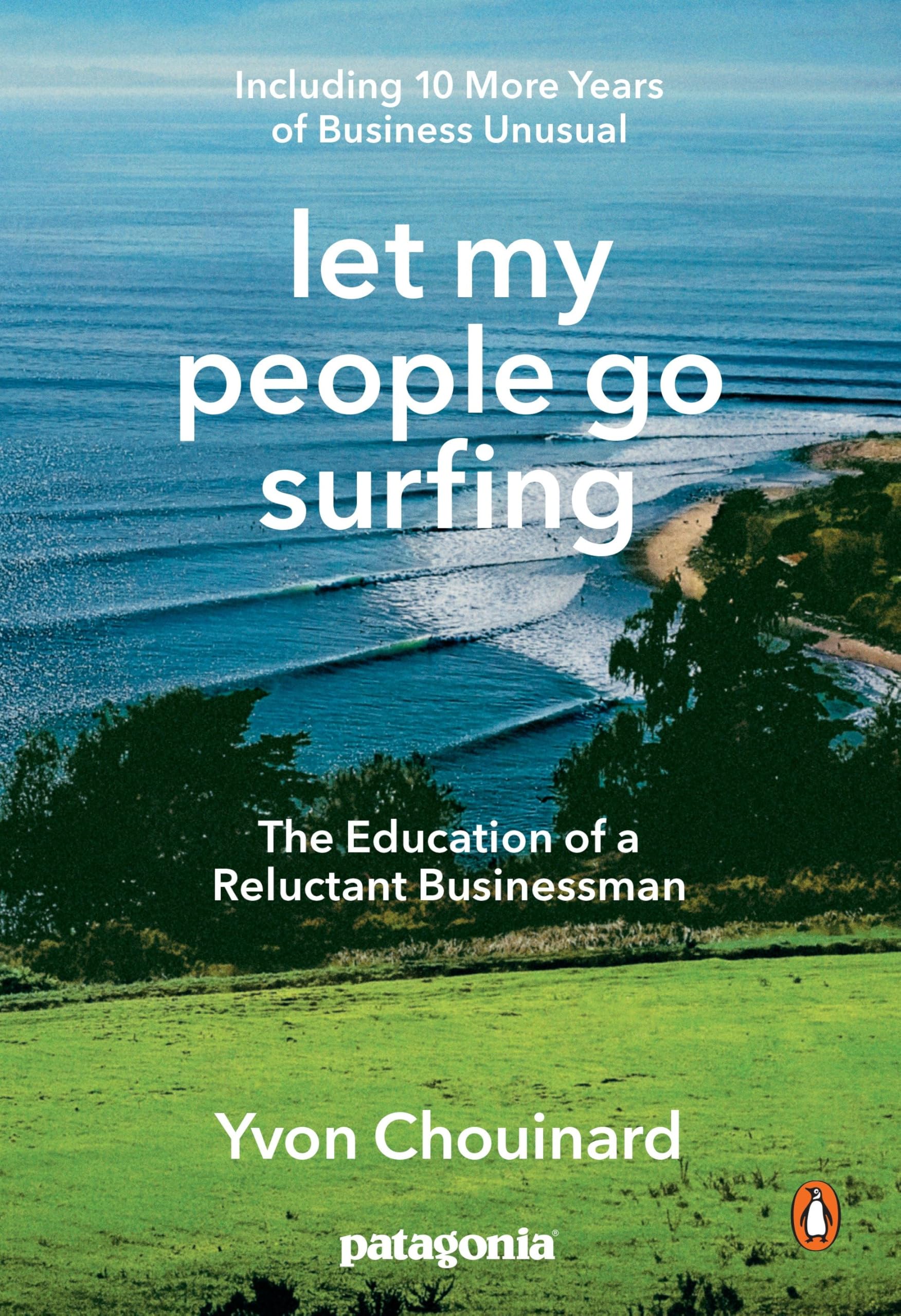
Yvon Chouinard’s Let My People Go Surfing occupies an unusual spot on the business bookshelf. It is part memoir, part company manifesto, and part instruction manual for running an organization that treats environmental responsibility as a design constraint rather than a marketing department. The expanded edition adds roughly a decade of reflection, bringing the story up through Patagonia’s later years and the company’s evolving approach to ownership and activism. Readers picking it up expecting a conventional founder’s tale of grit and scaling will find something more idiosyncratic and, depending on their temperament, either refreshing or frustrating.
The book’s structure mirrors Chouinard’s own priorities. Early chapters cover his path from rock climber and blacksmith making pitons in a backyard forge to the founder of a clothing company he never particularly wanted to run. From there the narrative gives way to detailed discussions of Patagonia’s internal philosophy: product design standards, the decision to use organic cotton, the shift toward repair and reuse, and the company’s stance on supply chain transparency. These sections read less like case studies than like a founder explaining, at length, why certain choices were made even when they cost money. The revised material extends this into newer territory, including the company’s move to dedicate ownership to environmental causes.
What distinguishes the book from the typical business memoir is how little interest it takes in conventional metrics. There is very little talk of growth hacking, competitive positioning, or quarterly targets. Instead, Chouinard spends pages on the ethics of manufacturing, the tension between making durable goods and selling enough of them to stay in business, and the practical difficulties of sourcing materials responsibly. For someone running a small company or working in product development, those passages are the most useful part. They offer a concrete, if opinionated, account of how values get translated into operational decisions—fabric choices, repair policies, catalog copy, hiring practices.
The limitations are real, though. Chouinard is a persuasive storyteller, and the book rarely turns its critical eye on itself. Setbacks are acknowledged but usually resolved in a way that confirms the company’s approach. Readers looking for a balanced account of Patagonia’s controversies—labor questions in the supply chain, the practical trade-offs of its activism, the tension between selling outdoor gear and encouraging people to consume less—will need to look elsewhere. The book is also uneven in pacing. The philosophical chapters can feel repetitive, circling the same themes of quality and restraint, while the biographical sections move quickly and leave gaps. And the expanded edition’s later material, while welcome, sometimes reads as an update appended to the original rather than fully integrated into it.
It is worth comparing the book to other business memoirs that blend personal history with company philosophy—works like Shoe Dog or Delivering Happiness. Those books tend to be more linear and more focused on the entrepreneur’s journey. Chouinard’s is less a narrative and more a set of arguments, and it assumes the reader is already interested in the questions it raises. That makes it a slower read, but also one that rewards a specific kind of attention: it works best when read as a series of essays rather than as a story with a destination.
In practice, the book tends to be picked up by people running or starting small businesses, by product managers and designers curious about how a values-driven company actually operates, and by readers interested in environmental ethics as applied to commerce. It is often assigned in business school courses on sustainability and social enterprise, where its lack of conventional strategy content can be either a feature or a gap depending on the syllabus. It also appeals to Patagonia customers curious about the company behind the label, though those readers should expect more philosophy than product history.
It is not a good fit for someone seeking a tactical playbook. There are no frameworks, no step-by-step processes, and little in the way of measurable outcomes. Readers who want a candid, self-critical account of a company’s failures will find the book too self-assured. And those who prefer tightly edited, linear memoirs may find the structure meandering.
For the right reader, though, the book’s value lies in its specificity. Chouinard describes decisions in enough detail—why a particular fabric was abandoned, how a repair center was set up, what it took to change a supply chain—that the philosophy stops being abstract. It is a book about business unusual, as the subtitle says, and it is most convincing when it stays close to the workshop floor rather than the mission statement.