
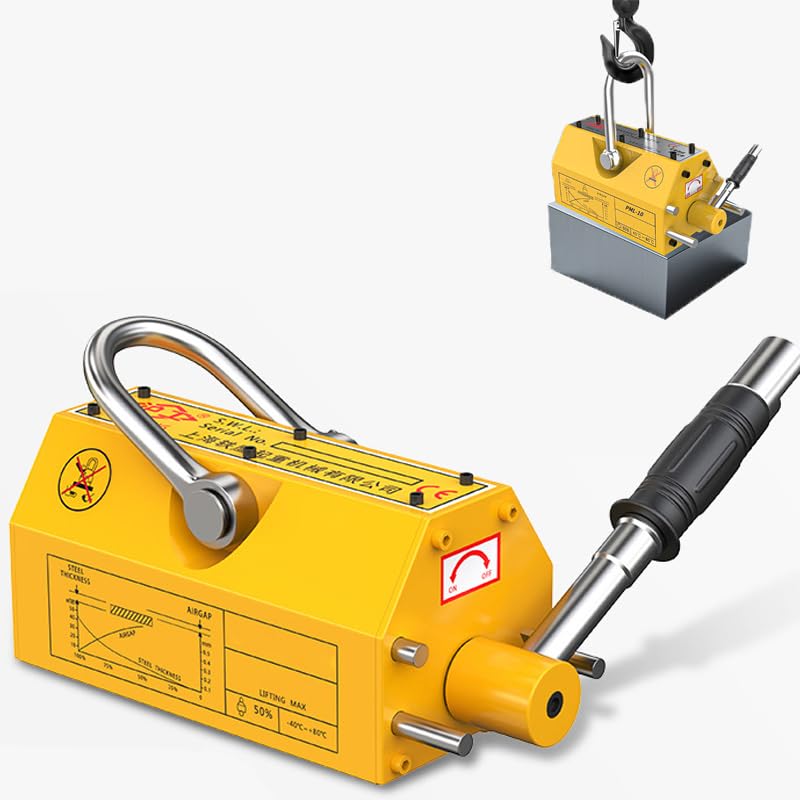
The 440 lb (200 kg) permanent magnetic lifter is one of those tools that solves a very specific problem: moving flat, ferrous steel plate without rigging slings, chains, or clamps. It is designed to hang from a shop crane, hoist, or gantry and hold material by magnetism alone, with a release lever to drop the load. For a small fabrication shop, a welding table, or a garage where steel plate and offcuts pile up, that is a genuinely useful capability. It is also a tool with clear boundaries, and buyers who misunderstand those boundaries tend to be disappointed.
In practice, the lifter is used to pick up a steel plate from a rack or the floor, swing it to a welding table or saw, and set it down. The magnet face contacts the plate, a lever engages the magnetic circuit, and the load is carried by the crane hook. The release lever reverses the circuit so the plate detaches cleanly. That lever action is the main functional distinction from a plain lifting magnet, which can be stubborn about letting go of flat stock. The rated 440 lb capacity applies to clean, flat, full-contact steel of adequate thickness; it is not a blanket figure for any ferrous object you can attach it to.
Key functional characteristics worth knowing before purchase:
- Permanent magnet, no power required. The holding force comes from the magnet assembly, not an electromagnet, so there is no cord, no controller, and no risk of losing the load if power drops. The trade-off is that holding force is fixed and depends entirely on contact quality.
- Release lever. A mechanical lever switches the magnet between on and off states. This is the feature that makes the tool practical for repeated pick-and-place work rather than one-off lifts.
- Hook-and-shackle mounting. The top of the unit is designed to hang from a crane hook or hoist, which means the lifter is only as useful as the lifting equipment above it.
- Flat-stock orientation. The magnet face is built for plate, board, and flat bar. Round stock, pipe, and irregular shapes are not what this tool is designed to hold.
The most important limitation is thickness and surface condition. Magnetic holding force falls off quickly as steel gets thinner, and a 440 lb rating on thick plate does not translate to the same capacity on 1/8-inch sheet. Rust, mill scale, paint, and poor contact reduce holding force further. A cautious operator treats the rated capacity as a ceiling for ideal conditions and works well below it for anything questionable. The lifter also does nothing for non-ferrous material, so aluminum, stainless (most grades), and wood are out of scope despite the “board” wording in some listings.
Another practical consideration is that a magnetic lifter is not a substitute for a mechanical below-the-hook device when the load must be held at an angle or transferred between fixtures. The magnet holds the plate against its face; it does not clamp edges or provide a positive mechanical lock. For vertical plate handling, edge clamps or plate dogs remain the more secure choice, and some shops keep both on hand. Compared with a vacuum lifter, the magnetic version is cheaper, simpler, and needs no air supply, but it is limited to ferrous material and is less forgiving of surface finish. Compared with slings and chains, it is faster for flat plate but adds a single point of magnetic failure that rigging does not have.
Build quality across this category varies, and the 200 kg class is crowded with imports. Buyers should look for a stated safety factor, a clearly marked rated capacity, and a lever that locks positively in both positions. A magnet that drifts toward “on” or “off” under load is a defect, not a quirk. The unit is heavy for its size, which is normal for a permanent magnet assembly, and hanging it on and off a hook repeatedly gets tiring on a busy day. Some users mount it semi-permanently on a dedicated hoist to avoid that.
Who this suits: fabricators and welders handling flat steel plate up to roughly the rated capacity under good conditions, hobbyists with a shop crane and a pile of plate offcuts, and anyone who wants a cordless, repeatable way to move flat ferrous stock around a bench or rack. It also works well for loading plate onto a welding table or positioning it for a cut.
Who it does not suit: anyone lifting pipe, round bar, castings, or irregular shapes; anyone working with thin sheet where the rating is misleading; anyone without a crane or hoist to hang it from; and anyone who needs a positive mechanical hold for overhead work where a dropped plate would be dangerous. It is a convenience tool for flat plate, not a general-purpose lifting solution, and it should be treated that way.