
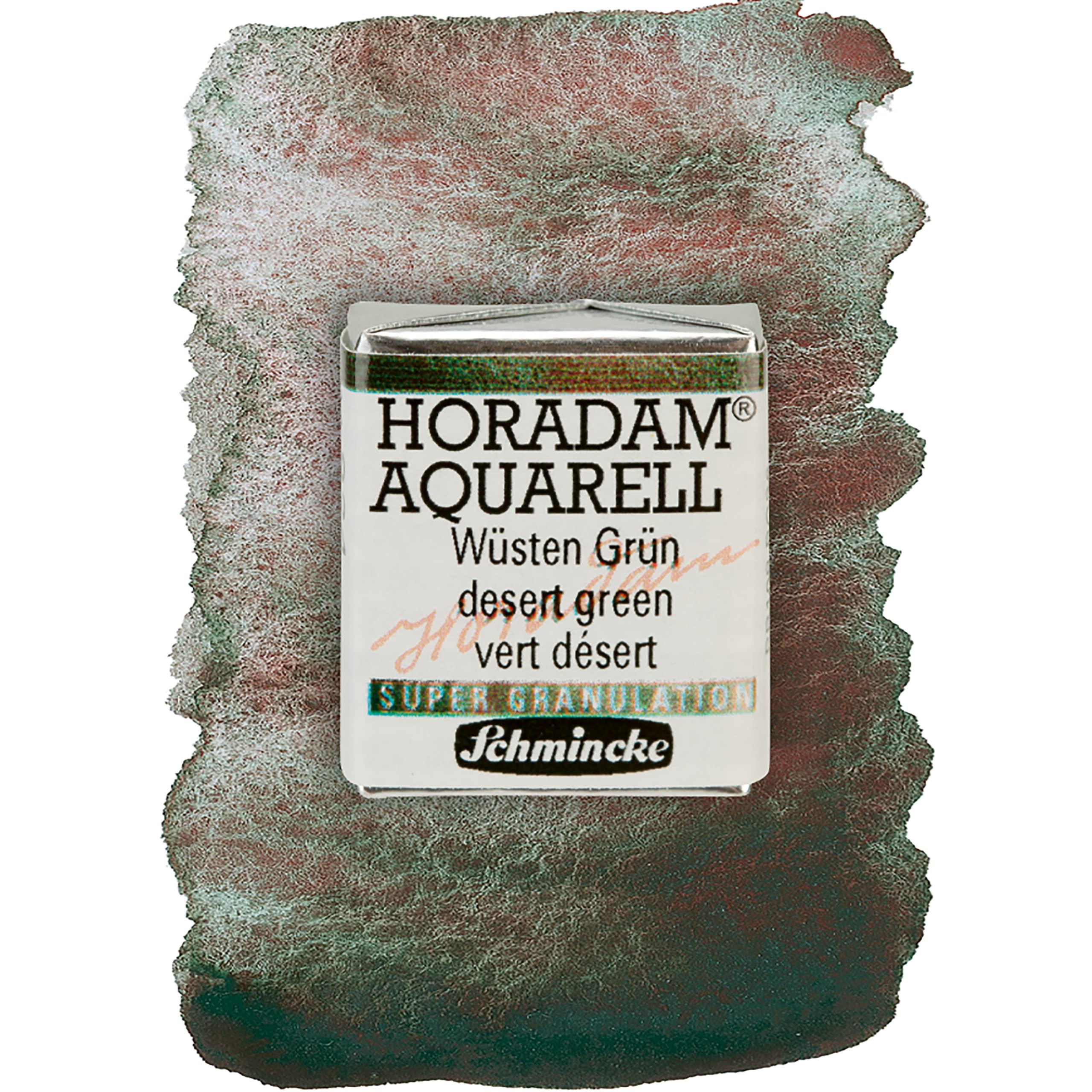
Schmincke’s Horadam Aquarell line has a reputation for quality, and the super-granulating colors are a relatively recent addition aimed at painters who want texture and visual interest straight from the pan. Desert Green (14 924 044) is one of these, a half-pan of watercolor that promises very strong granulation. In practice, that means the pigment particles settle into the paper’s texture as the paint dries, creating a mottled, speckled effect that can be both striking and challenging to control.
I’ve been testing this half-pan for a few weeks, using it on cold-pressed and rough papers, in both washes and detailed work. Here’s what I’ve found.
First impressions and real-world use
The half-pan format is convenient for plein air painting or for those who like to keep a compact palette. The paint rewets easily—no need to scrub—and a little goes a long way. The color itself is a muted, earthy green with a slight blue undertone. It’s not a vivid sap green; it’s more of a sage or olive that feels natural for landscapes. I found it particularly useful for foliage in the distance, where you want a color that recedes rather than pops. It also mixes well with yellows to create warmer greens, and with blues for cooler, deeper shadows.
The granulation is indeed very strong. On rough paper, the effect is almost immediate: as the wash dries, you see the pigment separating into tiny dots and streaks. This can be used to great effect for textured surfaces like stone, bark, or mossy ground. However, it also means that flat, even washes are difficult to achieve. If you’re painting a sky or a smooth gradient, this is not the color for the job. Even on hot-pressed paper, the granulation is pronounced, so it’s something you have to embrace rather than fight.
Key features
- Super granulation: The pigment particles are heavy and settle quickly, creating a textured finish. This is the defining characteristic of this paint.
- Single-pigment formulation: According to Schmincke, Desert Green is made with a single pigment (PW 18? Actually, it’s a proprietary blend, but it behaves like a single pigment), which means it mixes cleanly without muddying.
- High lightfastness: Rated as very good to excellent, so it should hold up well over time.
- Rewettability: The pan is easy to activate with a damp brush, making it suitable for travel and quick sessions.
- Half-pan size: Compact and economical, though it will run out faster than a full pan if used frequently.
Limitations and trade-offs
The most obvious limitation is the lack of control. Granulating colors are notorious for being unpredictable, and Desert Green is no exception. In a large wash, the pigment can pool unevenly, leaving dark spots where you might not want them. This can be mitigated by tilting the board or using a spray bottle to re-wet the wash, but it adds a layer of complexity. For beginners, this could be frustrating; it’s not a forgiving color.
Another trade-off is the color’s opacity. While it’s not fully opaque, it’s more sedimented than a transparent staining color like phthalo green. That means it can dull down mixes if you’re not careful, and it’s not ideal for glazing techniques where you want to see the layers beneath. It’s better suited for direct painting or for adding texture in the final stages.
Also, the half-pan size might be a drawback for heavy users. If you paint large formats regularly, you’ll go through it quickly. Schmincke does offer full pans, but they cost more and take up more space in a palette.
Comparison to alternatives
If you’re looking for a granulating green, you might also consider Daniel Smith’s Green Apatite Genuine or M. Graham’s Viridian. Green Apatite is similarly granulating but has a more vibrant, almost tropical hue; it’s also more expensive. Viridian is a classic single-pigment green that granulates moderately and is more transparent. Desert Green sits somewhere in between: it’s more muted than Green Apatite and more textured than Viridian. Another option is Winsor & Newton’s Green Gold, which is less granulating but offers a similar earthy tone. Ultimately, Desert Green’s unique selling point is its intense granulation combined with a subdued, natural color.
Who is it for?
This paint is best suited for intermediate to advanced watercolorists who understand how granulating colors behave and can use their unpredictability to advantage. Landscape painters will find it invaluable for natural textures, and those who enjoy experimental techniques will appreciate the effects it creates. It’s also a good choice for sketchbook work where you want to add character quickly.
However, it’s not for beginners who are still learning to control washes, nor for those who prefer smooth, even gradients. If you’re painting precise botanical illustrations or architectural renderings where consistency is key, this is probably not the color for you. Also, if you work primarily on hot-pressed paper and want a flat finish, look elsewhere.
Final thoughts
Schmincke’s Desert Green is a niche product that delivers on its promise of super granulation. It’s not a versatile color that will suit every painting, but for the right application, it’s a valuable addition to a palette. The half-pan is a sensible way to try it without committing to a larger size. Just be prepared to work with its quirks rather than against them.