
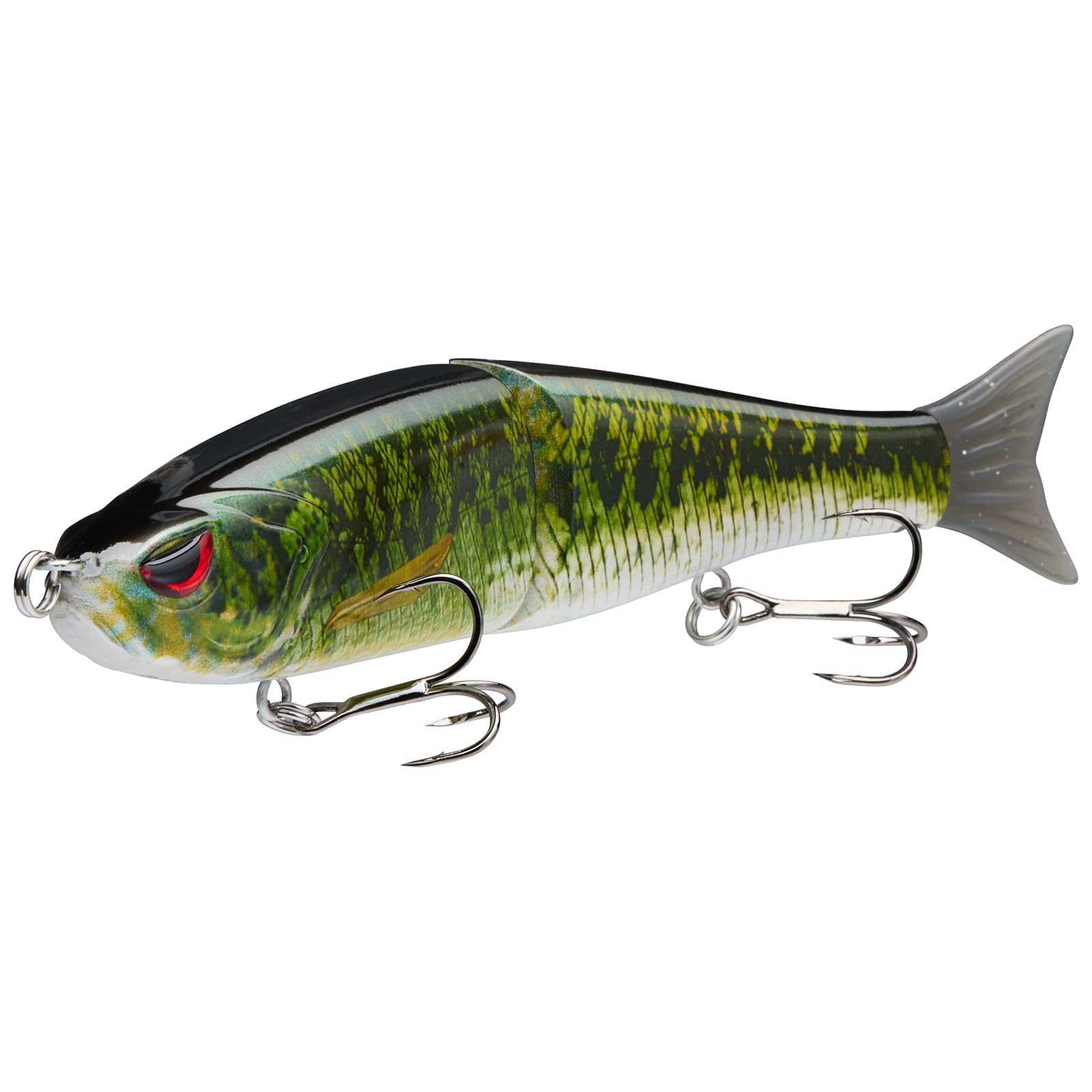
The Bassdash SwimShad Glide Bait is a jointed, multi-section swimbait aimed at freshwater predators — largemouth and smallmouth bass, pike, muskie, and larger trout and salmon. It sits in a crowded category of glide baits and segmented swimbaits, so the useful question isn’t whether it catches fish (most lures in this class will, under the right conditions) but where it fits in a tackle box and what kind of angler gets value from it.
Glide baits are usually fished with a steady reel-and-rod-tip cadence: short twitches of the rod tip make the bait dart left and right, while a straight retrieve produces a wider S-curve. The jointed body on the SwimShad is meant to do two things at once — glide side to side on the twitch and swim with a rolling action on a steady retrieve. In practice, that dual behavior is the reason people buy these baits, and it’s also where expectations need to be calibrated. A jointed bait rarely glides as far or as sharply as a dedicated single-piece glide bait, and it rarely swims as tightly as a soft plastic swimbait on a jig head. It splits the difference.
Real-world use looks like this: casting along weed edges, over submerged points, or parallel to docks in the spring and fall when bass and pike are actively chasing baitfish. The bait is typically worked on a medium-heavy to heavy casting rod with braid or a braid-to-fluorocarbon leader, since pike and muskie will punish light line. Because these baits are relatively light for their length, casting distance is decent but not exceptional — wind and a stiff rod tip will cut it down, and that matters when you’re trying to reach a weed line without spooking fish.
The functional features are straightforward. The body is segmented into sections connected by joints, which gives the tail and mid-section a hinged, swimming motion rather than a rigid wobble. Most versions come with a rear treble and a front hook, and the hardware is the usual painted finish over a hard or semi-hard body. The paint schemes lean toward baitfish imitations — shad, perch, and trout patterns — which is consistent with the name. There’s nothing exotic here; it’s a conventional design executed at a budget price point.
That budget positioning is the main thing to understand. At this price, you’re not getting the refined weighting, premium hooks, or durable finishes of a $40–$80 glide bait. The hooks are serviceable but worth replacing if you’re chasing pike or muskie, where a straightened hook is a real possibility. The finish will chip after repeated contact with rocks and dock pilings, and the joints can loosen over a season of hard use. None of that is unusual at this tier, but it’s worth saying plainly: this is a bait you fish hard and expect to wear out, not an heirloom.
Performance expectations should stay realistic. On a steady retrieve, the SwimShad tracks reasonably straight and puts out a moderate wobble — enough to draw reaction strikes from active fish, not enough to call fish from a long distance. On the twitch, it darts and pauses in a way that triggers following bass, particularly in cooler water when fish are less willing to commit. It is not a magic bait for pressured fish; on heavily fished water, a more subtle soft swimbait or a finesse glide bait will often outproduce it.
Compared with a soft plastic swimbait on a weighted hook, the jointed hard body offers more durability against teeth and more pronounced side-to-side action, but it casts differently and snags more readily around cover. Compared with a dedicated single-piece glide bait, it gives up some glide distance and precision in exchange for a swimming action that works better on a straight retrieve. Anglers who already own a few glide baits will find this a complementary option rather than a replacement.
Who is it for? It suits anglers who want to try glide-bait fishing without spending premium money, bank and boat fishermen targeting bass and pike in moderate cover, and anyone building a starter swimbait box. It’s also reasonable for trout and salmon in larger rivers and lakes where a baitfish-profile lure makes sense, though the hook sizes may be heavier than ideal for smaller trout.
Who is it not for? Muskie hunters who need reliable, heavy-duty hardware out of the box will likely be disappointed and should budget for hook upgrades. Tournament bass anglers who need a specific glide cadence or a bait that holds up to dozens of fish per season will probably outgrow it quickly. And anyone fishing extremely snaggy timber should think twice — a jointed hard bait with two trebles is not a cover-friendly lure.
Overall, the SwimShad Glide Bait is a sensible entry point into jointed swimbaits. It does the basic jobs — gliding on the twitch, swimming on the retrieve, imitating baitfish — without pretending to be a premium bait. Buy it expecting a workhorse that will show wear, plan on upgrading the hooks if toothy fish are the target, and it will earn its place in the box.