
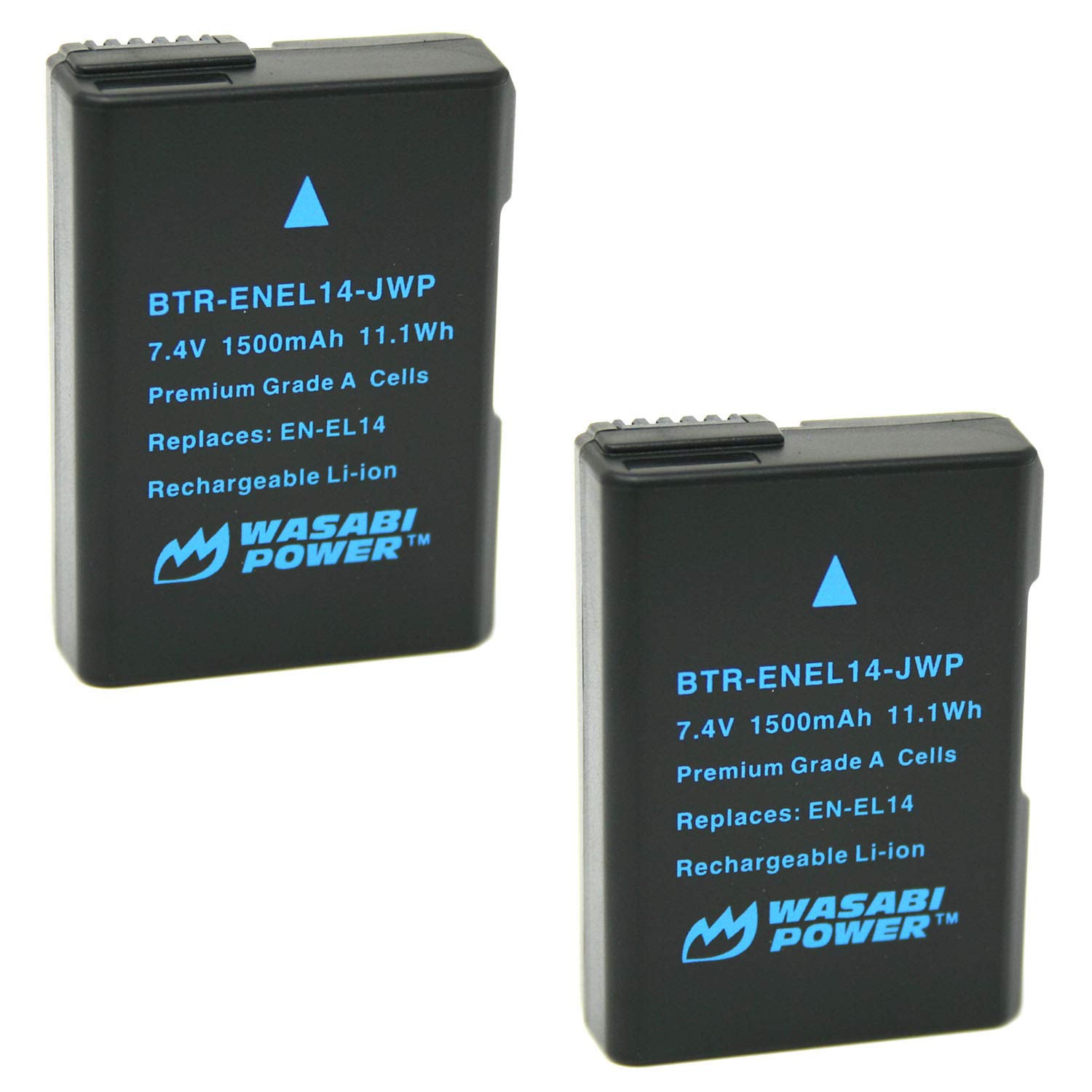
The Wasabi Power two-pack for Nikon EN-EL14 and EN-EL14a cameras sits in a crowded corner of the accessory market: third-party batteries that cost a fraction of the OEM equivalent. These are the batteries people buy when they want a spare in the bag without paying Nikon prices, and the appeal is easy to understand. Two cells plus a charger often cost less than a single first-party battery. The question is whether that savings holds up in daily use.
The EN-EL14 form factor covers a long list of cameras, from the D3100 through the D5300 and the Df, plus the Coolpix P7000 series. That breadth is why this battery remains relevant even though most of these cameras are several generations old. Plenty of them are still in active use as second bodies, travel cameras, or first cameras for people learning photography.
What you actually get
- Two lithium-ion batteries rated at 7.4V, with a capacity around 1100mAh (Wasabi lists this as roughly equivalent to the Nikon original)
- Compatibility with both EN-EL14 and EN-EL14a bodies, which matters because some Nikon firmware updates are picky about older third-party cells
- Typically sold with a USB or wall charger depending on the listing, so confirm what is included before buying
- No chip-level communication with the camera beyond basic power delivery, which is the root of most third-party battery quirks
In practice, these batteries behave like most third-party cells. They power the camera, they charge in the supplied charger, and they hold a charge reasonably well when stored. A photographer using a D5200 on a weekend trip might get through a day of casual shooting on one cell and keep the second as insurance. For a wedding or event shooter, two of these plus the original is a workable rotation, though nobody should expect them to match OEM stamina shot for shot.
Where the trade-offs show up
The most consistent complaint about third-party EN-EL14 batteries is the camera’s battery meter. Some bodies report charge level erratically, jumping from two bars to a warning with little notice, and a few report the battery as non-genuine or refuse to display a percentage at all. This is not unique to Wasabi, but it is the reality of buying unchipped cells. The practical workaround is to treat the meter as a rough guide and carry a spare rather than trusting the last bar.
Longevity is the other consideration. Third-party lithium cells often lose capacity faster than OEM batteries over a couple of years of regular use. Buyers who shoot daily may find themselves replacing these sooner, which narrows the cost advantage. For occasional shooters, the math usually still favors the two-pack.
There is also the firmware question. Nikon has, at times, pushed updates that affect how third-party batteries are recognized. Most reports suggest current Wasabi cells work fine in the listed bodies, but anyone running older firmware on a D3100 or P7000 should check recent buyer feedback rather than assume compatibility.
How it compares
The obvious alternative is the genuine Nikon EN-EL14a, which costs more per cell but typically delivers more predictable metering and slower capacity loss. A middle option is a reputable third-party brand such as Watson or Powerextra, which occupy a similar price tier with similar caveats. Wasabi’s main draw is the two-pack value and the bundled charger, which makes it a convenient one-purchase solution for someone who has lost or worn out their original and wants a complete backup kit rather than a single replacement.
Compared with buying a battery grip or a USB power bank setup, this is the simpler and cheaper route for cameras that support it. The D3xxx and D5xxx bodies do not offer in-camera USB charging, so spare cells remain the practical answer for extended shooting days.
Who should consider it
This two-pack makes sense for hobbyists and casual shooters using a D3100, D5100, D5200, or a Coolpix P7000-series camera who want a low-cost spare and do not mind watching the battery indicator with some skepticism. It is also a reasonable pick for anyone reviving an older Nikon body for a trip or a project and who does not want to invest much in it.
It is less suitable for professionals or anyone relying on accurate battery telemetry during paid work, where the unpredictability of the meter and faster capacity fade become real liabilities. Photographers who shoot heavily and need dependable, consistent performance should budget for genuine Nikon cells instead. Buyers should also verify the exact listing contents, since charger inclusion varies and the value proposition changes depending on what ships in the box.
Overall, the Wasabi Power two-pack is a sensible budget accessory with clear limits. It does the basic job at a low price, but it asks the user to accept some uncertainty about metering and long-term capacity. For the right buyer, that is a fair trade.