
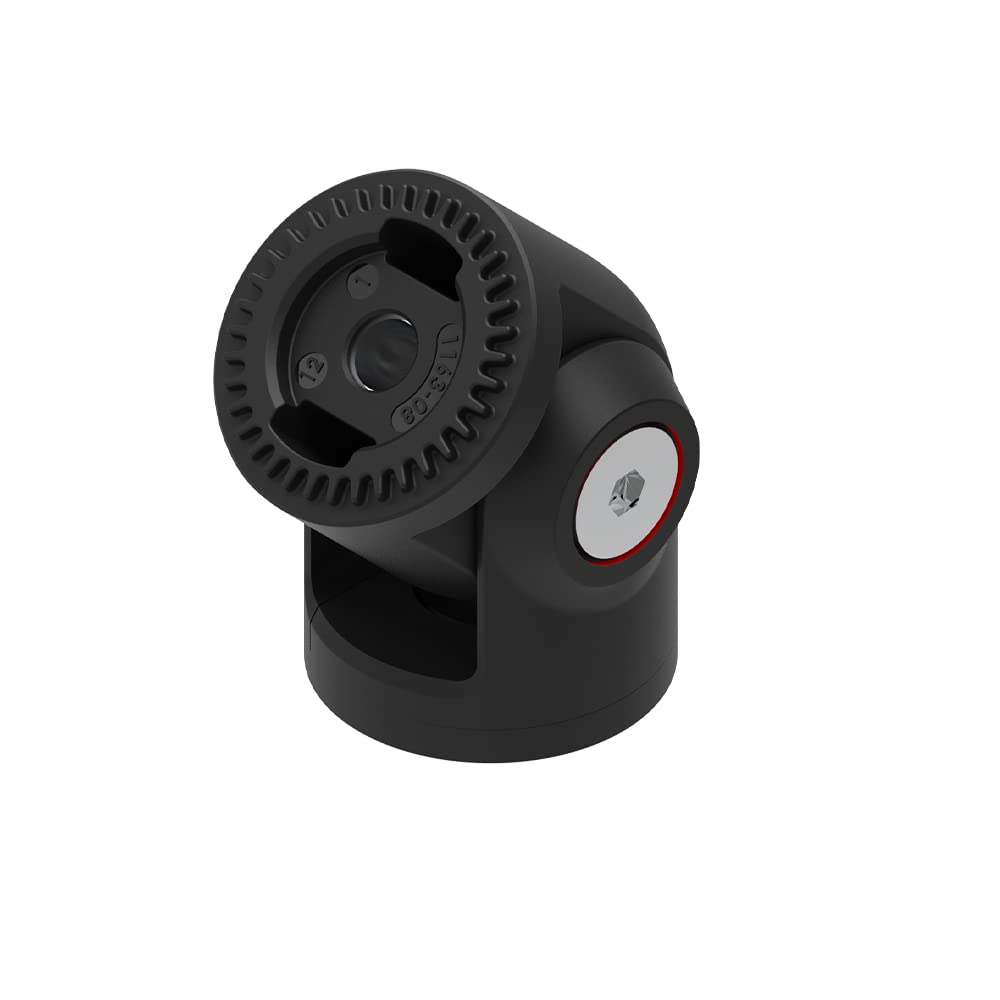
The Quad Lock Motorcycle Knuckle Adaptor is one of those accessories that exists because a phone mount system is only as good as its weakest mounting point. Quad Lock’s ecosystem is built around a proprietary twist-and-lock mechanism, and the knuckle adaptor is the piece that lets you rotate the mounting surface relative to wherever you’ve attached the base. It’s not a standalone product — you need a Quad Lock case or universal adaptor, a mount head, and typically a handlebar or stem base to make it work. That context matters, because judging this part in isolation misses the point of what it does.
The most common real-world scenario is a rider who has already installed a Quad Lock base on a handlebar clamp, fork stem, or brake reservoir mount, then finds the phone sitting at an awkward angle. Maybe the screen tilts away from the rider, or the mount head points sideways because of how the bar is shaped. The knuckle adaptor sits between the mount head and the base and provides an articulated joint, so you can dial in the angle without repositioning the entire base. On bikes with crowded cockpits — clip-ons, risers, or bars with limited straight sections — that adjustability is the difference between a usable mount and one that forces you to take your eyes further off the road than you’d like.
Functionally, the piece is simple. It’s a hinged joint with a bolt that clamps the two halves at your chosen angle. You loosen the bolt, set the angle, and tighten it down. The joint uses a toothed or splined interface in most versions, which means it holds position under vibration rather than gradually sagging — a genuine concern on twins and singles that shake at certain rev ranges. The body is glass-filled nylon, consistent with the rest of Quad Lock’s mounting hardware, and the hardware is stainless. It adds a small amount of stack height between the base and the head, which is worth knowing before you buy.
That stack height is the main trade-off. On a bike with a tight cockpit or a small windscreen, adding even a few millimetres of height and a pivot point can push the phone into contact with the screen, the tank bag, or the ignition key. Riders with very little clearance above the bar may find the knuckle makes things worse rather than better. It also introduces one more joint that can loosen over time if not torqued properly — check it after the first few rides, then periodically. And because it’s an articulating joint rather than a rigid spacer, a heavily loaded phone (large handset plus a vibration damper) puts more leverage on the bolt. Quad Lock’s own vibration damper is a separate purchase and, on many bikes, a sensible one, but stacking damper, knuckle, and head together gets tall fast.
Compared with a fixed-angle adaptor or a simple spacer, the knuckle is the more flexible choice but the less tidy one. A rigid offset or a differently shaped base gives you a cleaner, lower-profile install if you happen to need exactly the angle it provides. The knuckle earns its place when you don’t know the angle in advance, when you’re moving the mount between bikes, or when the bar geometry leaves you no good fixed option. It’s also useful for riders who switch between portrait and landscape orientation and want the mount head positioned so both work without re-clamping the base.
Build quality is in line with the rest of the range: it feels solid in the hand, the bolt threads cleanly, and the finish has held up in reports from riders who commute year-round. It is not a heavy-duty off-road component in the sense that it’s designed to survive a drop onto rocks — it’s a mounting accessory, and it should be treated as one. The plastic body will scuff if it contacts metal repeatedly, and the joint, while secure when properly tightened, is not meant to be adjusted constantly. Set it and leave it.
Who is this for? Riders who already own a Quad Lock base and head and need to correct an awkward angle, or who want one mount that can be re-angled between bikes. It’s also a reasonable purchase for someone building a mount from scratch who wants flexibility rather than a fixed geometry. Who is it not for? Anyone without the rest of the system — it does nothing on its own. Riders with very tight cockpits where added height is a problem should measure first. And riders who want a single, rigid, low-profile mount and already know their ideal angle will likely be happier with a fixed adaptor or a different base entirely.
At its price, the knuckle adaptor is a modest expense within an already pricey ecosystem, and it solves a real problem cleanly. The caveat is that it’s a problem-solver, not an upgrade — if your current setup already sits at a good angle, there’s nothing here to gain. Buy it to fix a specific fit issue, not to improve the mount in the abstract.