
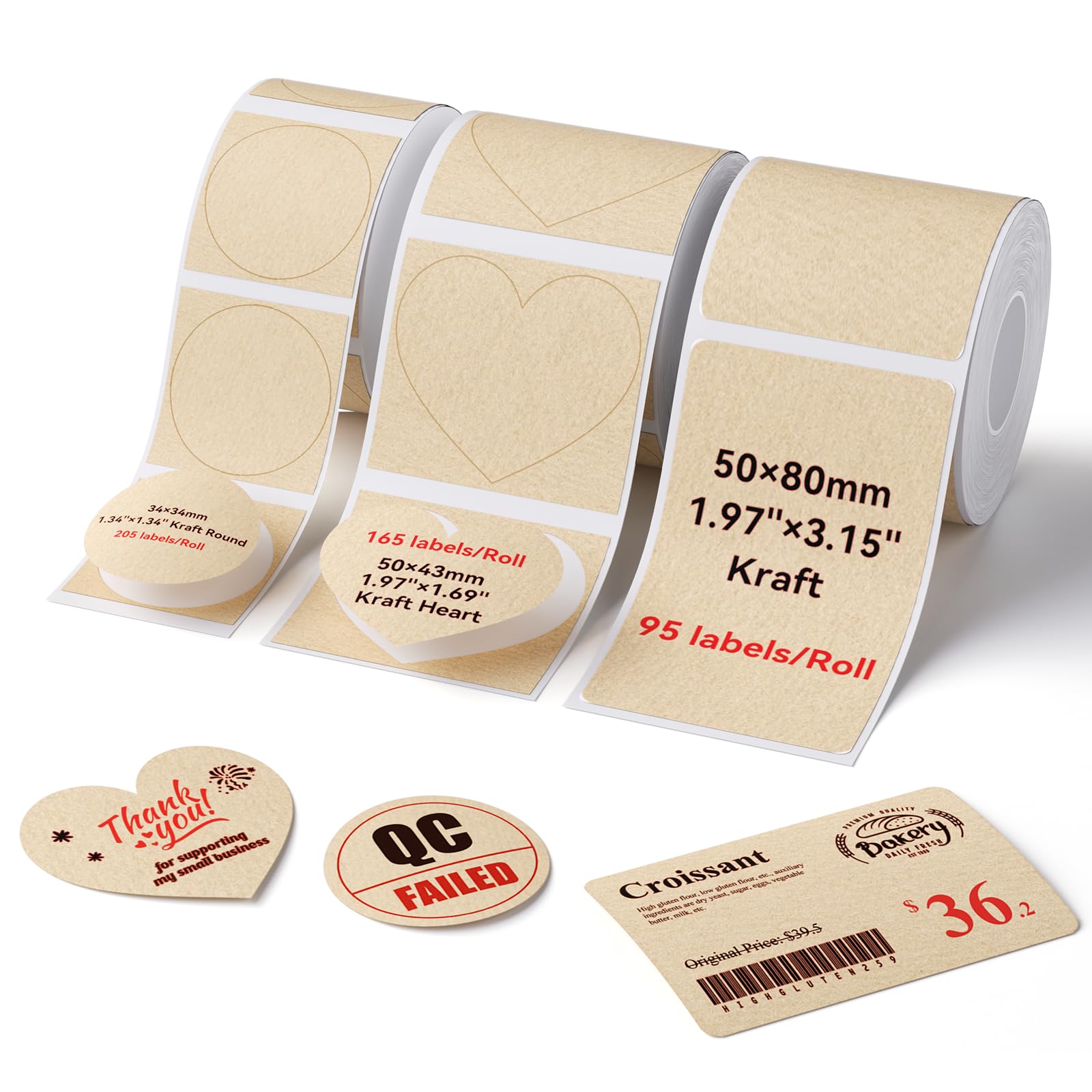
The NIIMBOT 3 Roll Set Kraft Labels is a consumable accessory rather than a standalone product, which means its value depends entirely on what you already own. These rolls are sized for NIIMBOT’s thermal label printers, and the set bundles three distinct formats: 34x34mm squares, 50x80mm rectangles, and 50x43mm rectangles. The kraft paper finish is the headline here, giving labels a warmer, more natural look than the glossy white stock that ships with most printers. For anyone labeling jars, packaging, or retail goods where a plain white sticker would look out of place, that aesthetic difference matters more than spec sheets suggest.
In practice, the three sizes cover a reasonable spread of common tasks. The 34x34mm squares suit small items like spice jars, sample vials, or candle lids where space is tight. The 50x43mm format is the general-purpose workhorse, large enough for a short product name, a batch code, and a small logo. The 50x80mm rectangles are the outlier: tall enough for address-style blocks, ingredient lists, or multi-line care instructions. Having all three in one purchase means fewer mid-project reorders, though it also means you commit to a mix you may not use evenly. Most buyers will burn through the mid-size roll first and find the tall rectangles sitting in a drawer.
Functionally, these are direct thermal labels, so they require no ink or ribbon. That keeps running costs low and the process clean, but it also means the print is heat-sensitive and can fade with prolonged exposure to sunlight, heat, or abrasive handling. Expect legible, high-contrast black text on the kraft background under normal indoor conditions. The kraft surface itself is slightly more textured than coated white stock, and fine detail or very small fonts can look marginally softer. Barcodes generally scan fine at standard sizes, but if you rely on dense QR codes or tiny serial numbers, test a sample before committing to a full run.
Adhesion is the usual trade-off with kraft stock. On clean glass, metal, and smooth plastic, the labels hold well for typical packaging and storage use. On curved surfaces, dusty jars, or items that go through dishwashing or refrigeration with condensation, expect some lifting at the edges over time. This is not a waterproof or freezer-grade label, and treating it as such will lead to disappointment. For pantry organization, shipping boxes, or retail packaging that stays dry, it performs as expected. For outdoor equipment, long-term freezer storage, or anything that gets handled wet, a synthetic or vinyl label is the better category choice.
Compatibility is the practical sticking point. These rolls are built for NIIMBOT’s ecosystem, and the printer reads the label size through the roll’s recognition tag. That convenience comes with lock-in: you cannot casually use these rolls in a Brother or DYMO thermal printer, and third-party rolls for NIIMBOT machines sometimes trigger warnings or refuse to work. The upside is that the printer auto-configures the correct dimensions, so there is no manual setup and no wasted labels from misaligned templates. The downside is that you are paying for a proprietary format, and per-label cost is higher than buying generic direct thermal rolls for a conventional desktop label printer.
Compared with standard white thermal labels, the kraft set trades versatility for appearance. White labels win on contrast, water resistance options, and price per label. Kraft wins on look, and for small businesses or craft sellers packaging goods by hand, that look is often the point. Compared with pre-cut kraft sticker sheets for inkjet printers, these rolls are faster and more consistent for batch work, but they lock you into one printer brand and offer less freedom in custom shapes. It is a narrow comparison, but worth naming: if you already own an inkjet and print labels occasionally, sheets may be cheaper; if you label in volume, the roll format is more efficient.
Who is this for? Primarily NIIMBOT owners who want a warmer, more designed label for jars, packaging, and small retail products, and who value the convenience of three sizes in one order. It suits home organizers, market sellers, and small-batch makers who label in moderate volumes and keep their goods dry. Who is it not for? Anyone without a compatible NIIMBOT printer, anyone needing waterproof or freezer-safe labels, and anyone labeling at high volume where per-label cost dominates the decision. Those users should look at conventional thermal printers with generic roll stock instead.
The honest summary: a well-chosen three-size bundle with a distinctive kraft finish and the usual direct-thermal caveats. It does what it claims, provided your expectations around durability and brand lock-in are realistic. Buy it for the look and the convenience, not for long-term outdoor or wet-environment labeling.