
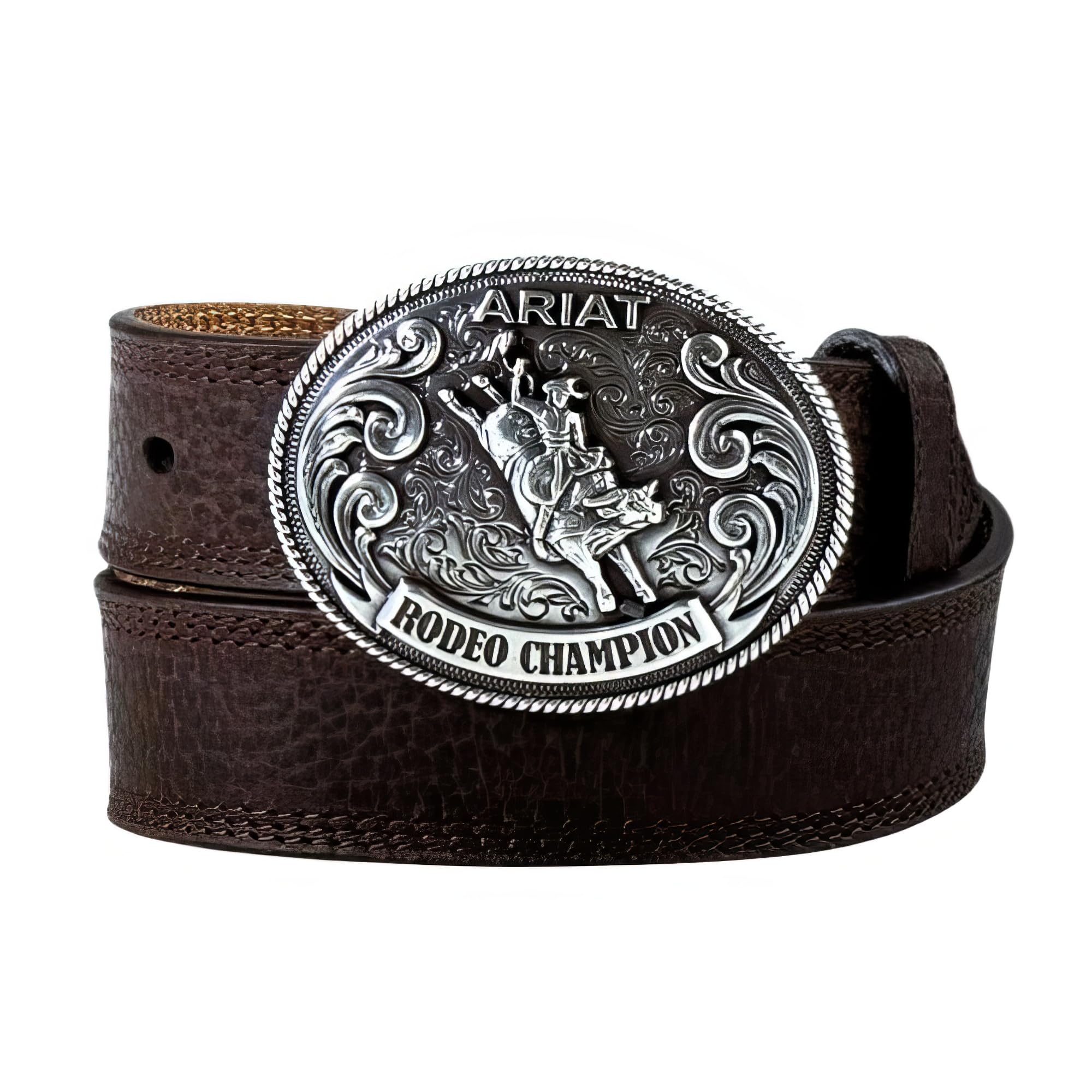
The ARIAT Youth Boys Rodeo Champion Belt is one of those pieces of kids’ gear that exists because a specific need kept coming up: young riders needed a belt that looked the part, held up to barn life, and didn’t cost as much as an adult trophy belt. Ariat is a well-known name in Western and equestrian apparel, and this belt sits in the youth category, sized here at 24 inches. It’s aimed at kids who are around the rodeo scene, taking riding lessons, or just growing up around horses and want gear that matches what the older riders wear.
In practice, a belt like this gets used in a few predictable ways. It holds up jeans or breeches during riding lessons, it gets worn to shows and rodeos where kids are expected to look put together, and it doubles as everyday wear for kids who simply like the Western look. The brown leather and stitched detailing are meant to read as authentic without being flashy, which matters for youth events where understated is often the norm.
The core of the belt is its leather construction, which gives it a stiffer, more substantial feel than the thin webbed or bonded-leather belts common in kids’ clothing. That stiffness is a genuine functional advantage in riding: a belt that holds its shape keeps waistbands in place and doesn’t fold or twist when a kid is mounting, leaning, or moving around in the saddle. The stitched pattern along the strap is decorative but also reinforces the leather, and the metal buckle is sized appropriately for a youth waist rather than being a scaled-down adult buckle that looks oversized on a child.
On sizing, the 24-inch measurement is worth paying attention to. Youth belt sizing runs small compared to adult sizing, and a 24 typically fits kids in roughly the 8–12 age range depending on build, but that’s a broad estimate. Because leather belts don’t stretch much, buying too close to the actual waist measurement is a common mistake. It’s better to measure an existing belt from the buckle to the hole the child actually uses and compare that number than to guess from age or clothing size.
Where this belt earns its keep is durability relative to typical kids’ belts. Leather of this type handles daily wear, dust, and the occasional scuff better than synthetic alternatives, and it’s the kind of item that can be handed down to a younger sibling once outgrown. The trade-off is that leather requires a little care. Left dirty and damp, it will dry out and crack over time, and a kid is not going to oil a belt on their own. Parents should expect to wipe it down occasionally and keep it away from prolonged soaking, which is a realistic maintenance expectation rather than a flaw.
The more significant limitation is fit flexibility. A leather belt with punched holes offers a fixed range of adjustment, usually a few inches. Kids grow, and a belt that fits in spring may be on its last hole by fall. Compared with a fabric or webbed belt with a sliding buckle, which can be adjusted continuously and tends to be cheaper, the Ariat belt is less forgiving of growth spurts. That’s the main trade-off: you’re paying for materials and looks, not for adjustability. For families watching a budget, a basic webbed belt will do the functional job of holding up pants just fine, especially for very young children who will outgrow it quickly.
Another thing worth noting is that this is a youth boys’ belt, and the styling leans traditional Western. It’s not a novelty belt with cartoon buckles or bright colors, so it suits kids who want to look like the older riders. It’s less suited to a child who wants something playful or brightly colored, and it’s not the right pick for a kid who is hard on gear in muddy, wet conditions daily, since leather will show that wear faster than synthetic materials.
Who is it for? Primarily kids in the roughly 8–12 range who ride, attend rodeos, or want Western-style everyday wear, and whose parents are willing to spend a bit more for leather and a recognizable brand. It’s also a reasonable choice for a child who has shown enough sustained interest in riding that the investment makes sense. Who is it not for? Very young children, kids still growing fast enough that a belt lasts one season, and anyone who needs a belt that can be adjusted continuously or withstand heavy mud and water without care. For those cases, a cheaper webbed or synthetic belt is the more practical call.
Overall, the Rodeo Champion belt is a solid, honest piece of youth gear. It looks right, holds up to normal riding use, and does what a belt should do. The caveats are the usual ones for leather: limited sizing range, some upkeep, and a price that reflects the brand and materials rather than any special feature. Buy it for a kid who will actually use it and grow into it slowly, and it’s a sensible purchase. Buy it as a fast-growing child’s first belt, and a simpler option will serve just as well for less money.