
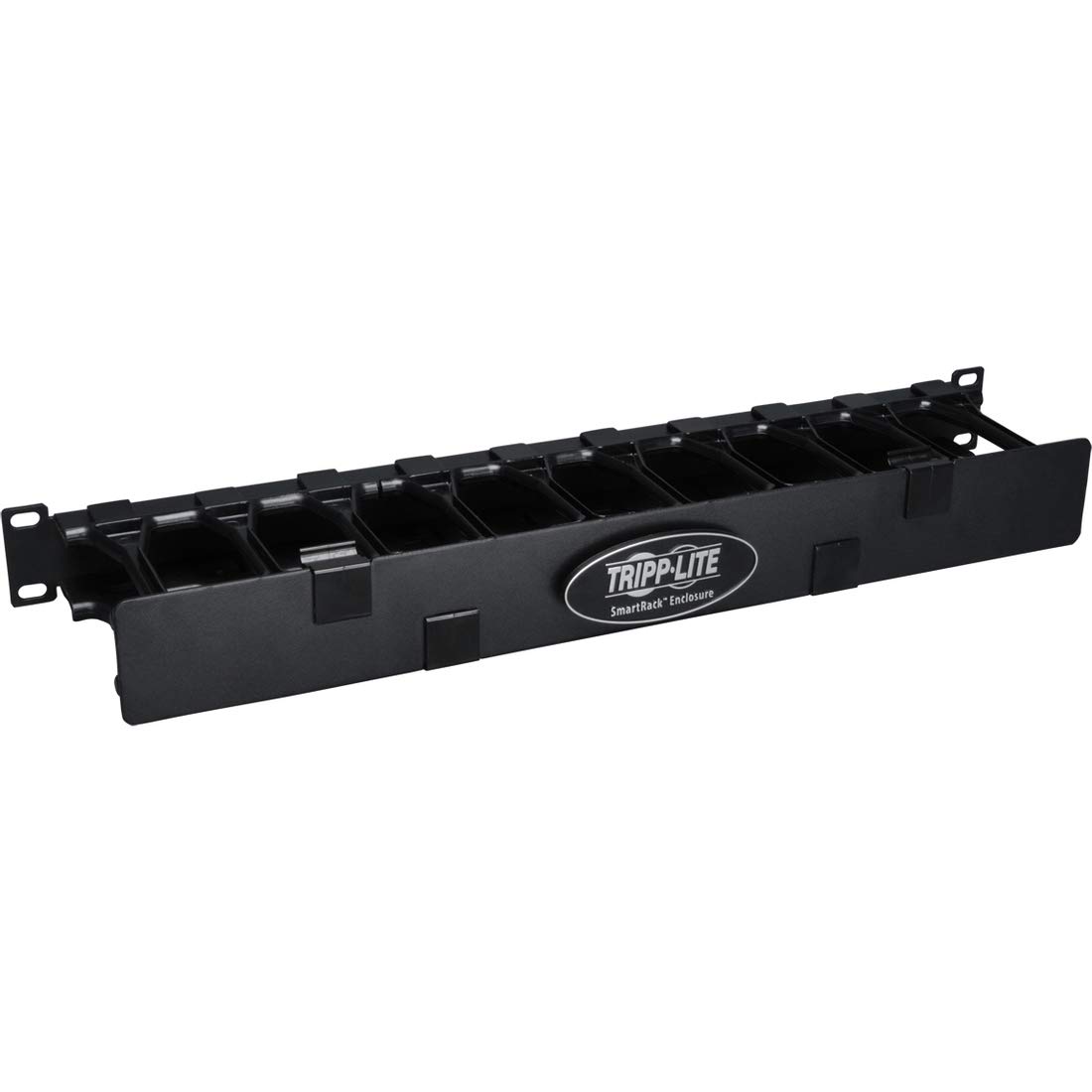
The TRIPP LITE SRCABLEDUCT1UHD is a 1U horizontal cable manager designed for standard 19-inch server racks. It’s a steel panel with integrated finger ducts—essentially a metal bar with slots and comb-like fingers to route and hold cables in place. This model is specifically the high-density (HD) version, which offers a slightly deeper channel compared to the standard SRCABLEDUCT1U, accommodating more or thicker cables. In practice, it’s mounted between patch panels or switches in a rack to keep Ethernet, fiber, or power cables organized and out of the way.
The key feature here is the finger duct design. The front of the unit has a series of vertical fingers that allow you to route cables horizontally across the front of the rack, then drop them down into the channel behind. The fingers are spaced widely enough to handle typical Cat6a or even some fiber patch cords without forcing them, but they’re close enough to prevent cables from slipping out. The steel construction feels solid and the black powder-coated finish matches most rack equipment. It installs with standard rack screws (not included) and fits into any 19-inch rack space without issues.
One limitation worth noting is the depth of the channel. While the HD version is deeper than the standard model, it’s still relatively shallow compared to some brush-style or hinged cable managers. If you’re running a lot of thick cables—like multiple 24-strand fiber trunks or heavy power cords—you might find the channel fills up quickly. The fingers are also fixed, so you can’t remove them to add or remove cables without potentially snagging connectors. This isn’t a dealbreaker for most network setups, but it’s something to consider if you frequently change cabling.
Compared to a brush-style cable manager, the finger duct design offers better cable retention and a cleaner look—cables are less likely to pop out. However, brush panels are often easier to add or remove cables because you can just push them through the bristles. The TRIPP LITE unit is more rigid and requires you to route cables through the fingers, which can be slightly slower during initial install but results in a more secure layout. It’s a trade-off between convenience and neatness.
This product is well-suited for data center technicians or IT managers who need to maintain tidy cable runs in high-density environments, especially where patch panels and switches are stacked closely. It’s also a good fit for anyone building a home lab who wants professional-looking cable management without spending a lot. However, it’s not ideal if you need to frequently reconfigure cabling—the fixed fingers make changes a bit tedious. Similarly, if your rack has very limited depth, the HD version’s extra channel depth might cause clearance issues with rear-mounted equipment or doors.
Overall, the TRIPP LITE SRCABLEDUCT1UHD does what it’s supposed to: it organizes horizontal cables in a rack with minimal fuss. It’s not flashy or innovative, but it’s a reliable workhorse. The steel build should last through multiple rack relocations, and the price is reasonable for a metal cable manager. Just be aware of the depth limitations if you plan to run a lot of thick cabling, and consider whether the fixed fingers match your workflow.