
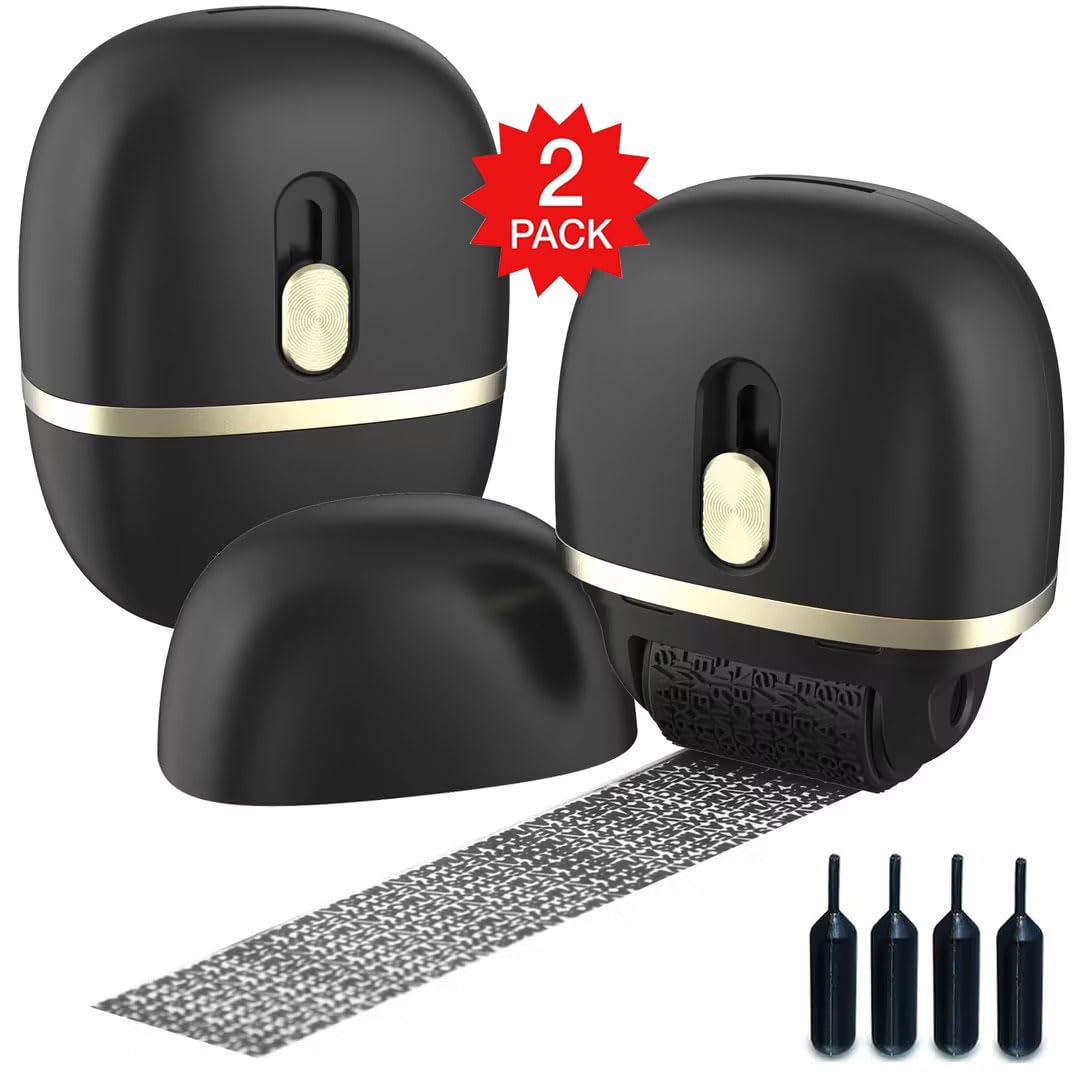
We all know the drill: junk mail, credit card offers, and old bank statements pile up, and then you face the tedious chore of shredding them—or, more likely, you just toss them in the recycling bin, hoping no one will bother to piece together your name and address. That’s where identity protection roller stamps come in. The Lomil Identity Protection Roller Stamps 2 Pack is a simple, low-tech solution that promises to obscure your personal data before you throw things away. But does it actually work, and is it worth the effort? Let’s break it down.
The concept is straightforward: instead of shredding every piece of paper, you roll a stamp head over the sensitive areas—your name, account numbers, barcodes—and the ink covers them with a random pattern of letters and numbers. The Lomil set comes with two black-ink rollers, each about the size of a highlighter, so you can keep one at home and one at the office or in your bag. The rollers are refillable, which is a nice touch, though you’ll need to buy Lomil’s specific refills when the ink runs out.
In practice, the stamp works as advertised for most text. I tested it on a standard credit card offer, rolling it over my name and address. The ink applied a dense, irregular pattern that made the underlying characters unreadable at a glance. It also did a decent job on barcodes—the pattern disrupted the lines enough that a scanner would likely fail. However, there are caveats. On glossy or coated paper, the ink tends to bead up and skip, leaving patches of visible information. You have to press harder and roll slower to get full coverage, which is a bit of a hassle. On plain printer paper, it’s much more effective.
The stamp’s design is ergonomic enough: a comfortable grip and a smooth rolling action. It’s not heavy, and it fits easily in a drawer. The two-pack is convenient for multiple locations, but the plastic casing feels a little flimsy—nothing that would break under normal use, but it doesn’t inspire confidence for years of heavy handling. The ink dries quickly, so you don’t have to worry about smudging your fingers or the paper, which is a plus.
One limitation to keep in mind: this is not a replacement for a cross-cut shredder for highly sensitive documents. If you’re discarding tax returns, medical records, or anything with a social security number, a shredder is still the safer bet. The roller stamp is best for everyday mail and routine paperwork where you just want to make the info hard to read, not impossible to recover with determined effort. For example, if someone really wanted to, they could potentially use chemical or forensic methods to reveal the underlying text, but that’s far beyond the casual dumpster-diving scenario most of us worry about.
Compared to a traditional shredder, the Lomil stamp has clear trade-offs. A shredder is faster for large volumes and provides higher security, but it’s noisy, bulky, and requires power. The stamp is quiet, portable, and doesn’t need electricity. But it’s slower if you have a stack of twenty envelopes—you have to roll over each one individually, and you need to be careful to cover every sensitive spot. It’s also not great for paper with lots of small print, like a full bank statement; you’ll spend a while rolling back and forth to cover everything.
Who is this for? It’s ideal for people who get a lot of pre-approved credit card offers and junk mail and want a quick, low-effort way to obscure their name and address before recycling. It’s also handy for travelers who need to dispose of boarding passes or hotel receipts on the go—you can throw the stamp in your carry-on without worrying about TSA rules (though the ink is a liquid, so it’s fine in checked luggage or carry-on as long as it’s not an aerosol). It’s also a decent option for small offices that don’t want to invest in a heavy-duty shredder for every desk.
But it’s not for everyone. If you regularly handle highly confidential documents, or if you’re legally required to destroy certain records (like in healthcare or finance), a shredder is non-negotiable. Also, if you’re the type who forgets to stamp every piece of mail, you might end up with a false sense of security. The stamp only works if you actually use it consistently.
Another point: the ink is black, and it’s permanent. That’s fine, but if you accidentally stamp a bill you need to read later, you’re out of luck. So be careful where you roll.
In terms of value, the two-pack is reasonably priced—about the same as a cheap shredder, but with the added benefit of portability and no noise. Refills are affordable, though you have to remember to buy them. The stamp’s longevity depends on how often you use it; a single refill can last for hundreds of rolls, so it’s not a recurring cost that will break the bank.
Overall, the Lomil Identity Protection Roller Stamps 2 Pack is a practical, if imperfect, tool. It won’t give you the peace of mind of a shredder, but for casual use, it’s far better than doing nothing. Just be realistic about its limits and pair it with a shredder for the truly sensitive stuff. If you’re looking for a low-tech, budget-friendly way to reduce your identity theft risk from everyday mail, this is a decent buy. Just don’t expect it to be the ultimate security solution—it’s a convenience tool, not a vault.