
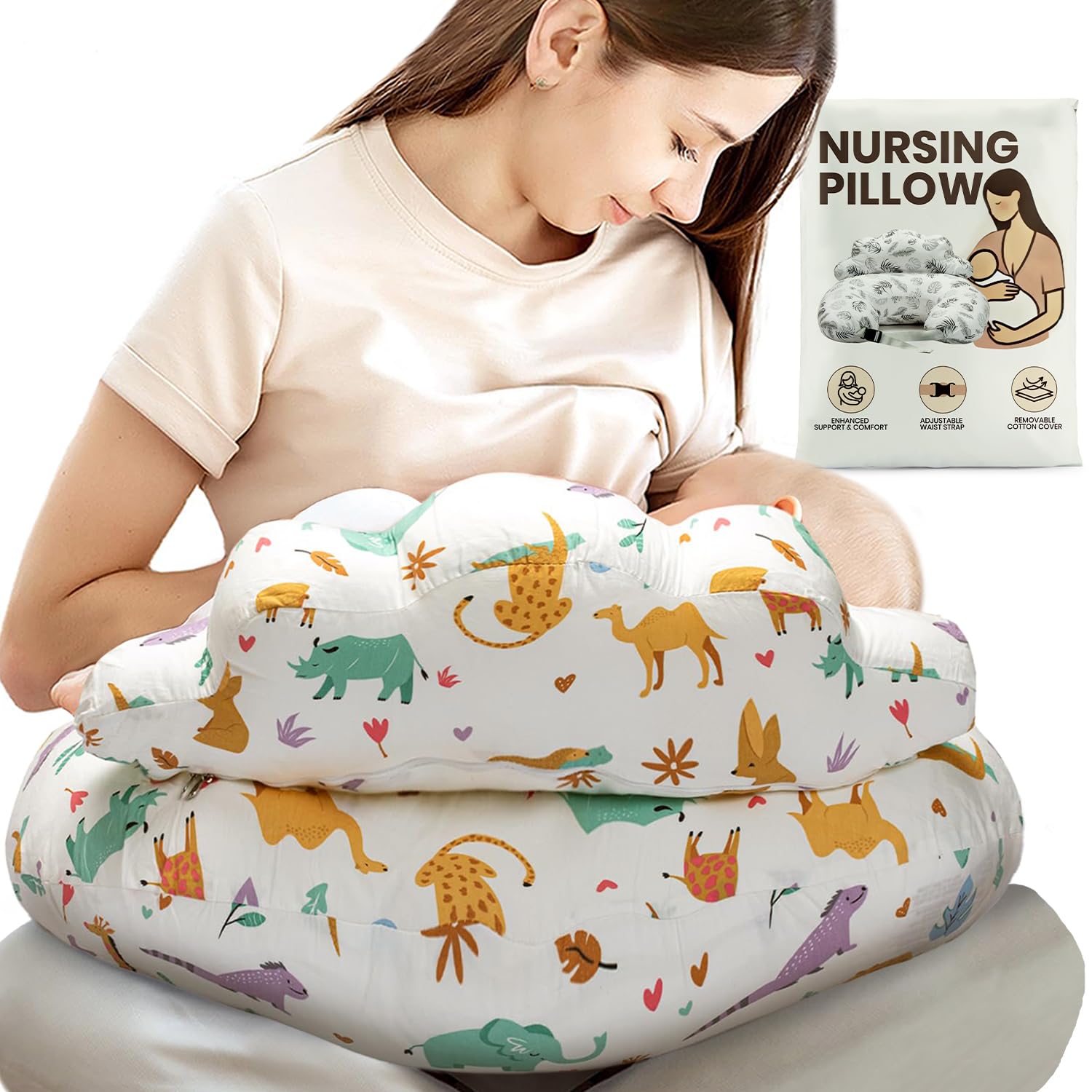
Nursing pillows are one of those items that seem straightforward until you actually try to use one. The PILLANI Nursing Pillow, with its built-in security fence and adjustable waist strap, tries to solve a few common problems at once. After spending time with it in everyday feeding sessions, here’s how it holds up in real-world use.
The first thing you notice is the shape. It’s not the typical crescent or C-curve you see on most nursing pillows. Instead, it has a wider, more contoured base with a raised section along the front—that’s the “security fence.” The idea is that the raised edge helps keep your baby positioned more securely, especially during those early months when they’re still floppy and you’re adjusting your hold. In practice, the fence does provide a subtle sense of containment. It doesn’t lock the baby in place, but it does reduce the likelihood of them rolling toward the gap between your body and the pillow. That said, it’s not a substitute for keeping a hand on your baby, and the fence can get in the way if you prefer a very low-profile pillow for side-lying or tummy time.
The adjustable waist strap is another feature that sets it apart. Most nursing pillows just rest on your lap, and you have to hold them in place. Here, the strap wraps around your waist and cinches the pillow to your body. This is genuinely useful if you’re moving around between feeds—getting up to grab a water bottle or adjust the TV remote doesn’t send the pillow sliding to the floor. It also helps if you have a smaller frame, since the pillow won’t constantly shift forward. However, the strap is not infinitely adjustable; it has a limited range, and if you’re on the larger side, you might find it too snug. The buckle is also a bit fiddly to fasten one-handed, which is a minor annoyance when you’re already holding a hungry baby.
For the actual feeding experience, the pillow’s firmness is a double-edged sword. It’s firm enough to provide solid support, which is good for maintaining a good latch without sinking down. But it’s not plush—if you’re used to a softer, more cushioned pillow like the Boppy, this one will feel noticeably harder. That can be a positive if you need more structure, but it’s a trade-off for comfort, especially during marathon nursing sessions that last 30 minutes or more. The cover is made of cotton and is removable and washable, which is essential for a product that will inevitably encounter spit-up and drool. The fabric is soft but not luxurious; it feels durable rather than premium.
One area where the PILLANI pillow falls short is versatility. Many nursing pillows double as a support for tummy time or as a sitting aid for older babies. The security fence, while helpful during breastfeeding, makes it awkward for those other uses. Tummy time on this pillow is possible but not ideal, as the raised edge can interfere with the baby’s arm movement. If you’re looking for a single pillow that does everything, you might be better off with a simpler design. But if your primary need is a stable, secure feeding position, this focus is a benefit.
Compared to a standard nursing pillow, the PILLANI offers more stability thanks to the strap and the fence. It’s also easier to use in a chair or on a couch without the pillow slipping. But it’s not a magic solution—you still need to adjust the pillow’s height with a regular cushion underneath if you’re feeding in bed, and the strap doesn’t replace proper positioning. It’s also worth noting that the pillow is a bit bulky to travel with; it doesn’t compress much, so it takes up space in a diaper bag or car.
Who is this pillow for? It’s best suited for parents who struggle with keeping a nursing pillow in place, or who have a wiggly baby that tends to roll during feeds. It’s also a reasonable choice for those with a smaller build who appreciate the secure fit. It’s less ideal for parents who want a multi-purpose pillow, who prefer a very soft feel, or who need to use it for other activities like tummy time. If you’re on the fence, consider how often you’ll actually use the strap and fence—if you’re mostly feeding in one spot and don’t mind holding the pillow, a simpler, cheaper option might be enough.
In the end, the PILLANI Nursing Pillow does what it sets out to do: it provides a stable, secure feeding surface with some thoughtful features. It’s not perfect, and the firmness and limited versatility are real drawbacks. But for the specific job of breastfeeding support, it’s a competent tool that many parents will find useful.