
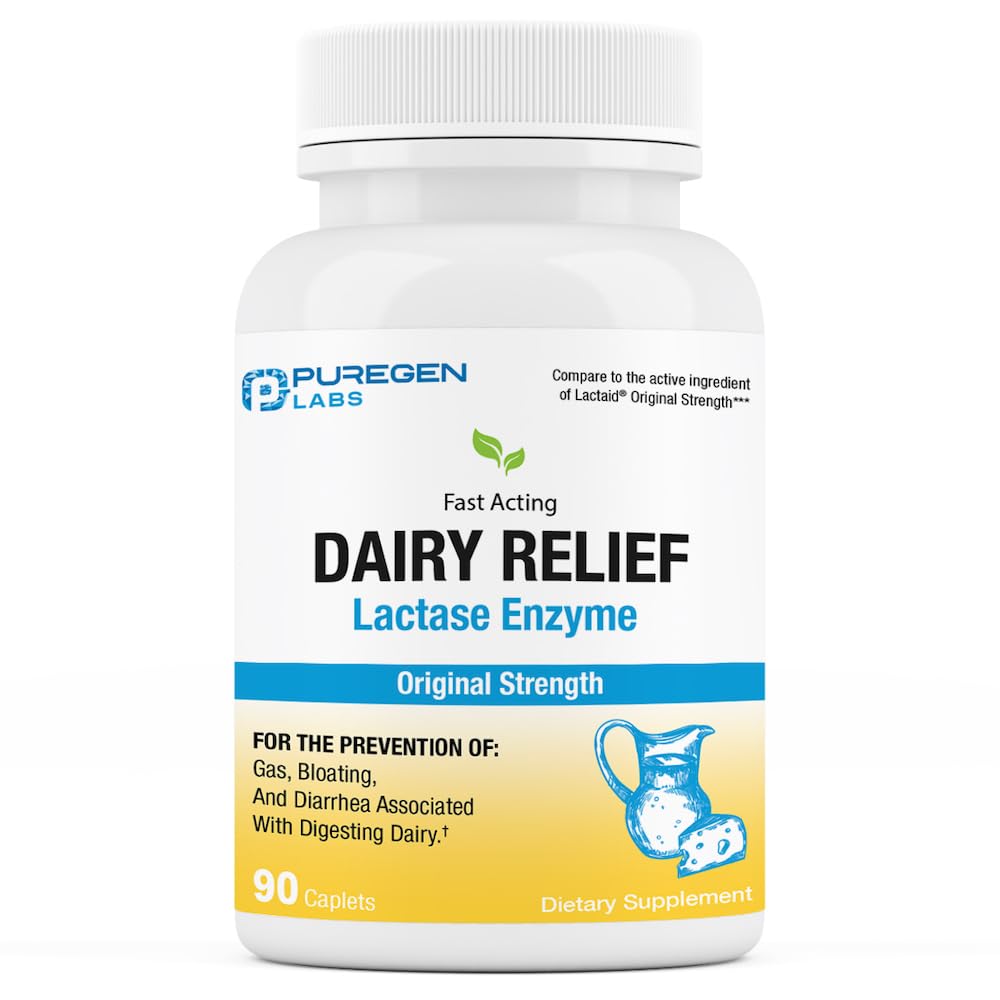
For the roughly 68% of the global population that experiences some form of lactose malabsorption, the decision to eat a slice of pizza or enjoy a creamy latte often comes with a mental calculation: is the potential discomfort worth it? Over-the-counter lactase enzyme supplements have become the go-to workaround for many, and Puregen Labs Dairy Relief Natural Fast Acting Lactase Enzyme 3000 FCC is one of the more straightforward options on the shelf. I’ve spent a few weeks testing these caplets in real-world scenarios, and the experience is a mix of genuine effectiveness and a few caveats worth noting.
The product comes in a bottle of 90 caplets, which is a fairly standard size for this category. The key number here is 3000 FCC—that’s the measure of lactase activity per caplet, and it’s on the lower end of the spectrum. For context, many competing brands offer 6000 to 9000 FCC units per pill. That doesn’t make 3000 useless, but it does mean you need to be more deliberate about timing and dosage. The caplets are small, uncoated, and easy to swallow, which is a plus for anyone who struggles with larger tablets.
In practice, I found that taking one caplet right before a meal containing moderate dairy—like a cheese sandwich or a bowl of cereal with milk—worked reasonably well. The “fast acting” claim holds up in the sense that I didn’t experience the usual bloating or cramping that would typically follow such meals. However, for heavier dairy loads, like a thick milkshake or a double-cheese pizza, one caplet felt insufficient. I had to take two, and even then, it wasn’t a foolproof shield. This aligns with the general consensus that lower-FCC lactase supplements are best for light to moderate dairy consumption, not for full-on dairy binges.
One of the more appealing aspects of this product is its ingredient list. The label shows a minimal formula: lactase, cellulose, and a few other inert binders. No artificial colors, no unnecessary fillers, and it’s naturally free of gluten and common allergens. That’s a refreshing change in a market where some supplements are packed with additives. The caplets also have a very mild, almost imperceptible taste, which is fine since you’re supposed to swallow them whole anyway.
The main limitation is the dosage flexibility. Because the pills are scored, you could theoretically split them for smaller doses, but they’re not designed for that, and the powder inside can be chalky. More importantly, the 3000 FCC level means you might need to carry the bottle with you and plan ahead. Unlike some time-release lactase formulas that claim to work over several hours, this one acts quickly but also fades quickly. If your meal stretches over a long period—say, a family-style dinner with multiple courses—you may need to take another dose halfway through. That’s not necessarily a drawback, but it’s a practical consideration.
Comparing this to generic store-brand lactase pills, which often come in 9000 FCC strengths, Puregen Labs is clearly positioned as a milder alternative. The trade-off is obvious: fewer enzyme units per pill means you need more pills for the same effect, and at roughly $0.25 per caplet, the cost per effective dose can be higher than a higher-potency competitor. On the other hand, for someone who only occasionally consumes dairy and doesn’t want to feel like they’re taking a horse pill, the smaller dose might be easier to manage.
Who is this for? It’s a solid choice for people with mild lactose sensitivity—those who get a little gassy or bloated after a glass of milk but don’t suffer severe reactions. It’s also good for travelers who want a compact, no-fuss option to keep in a bag. However, it’s not the best fit for someone with a more pronounced intolerance. If you’re the type who gets severe cramps or diarrhea from even trace amounts of lactose, you’ll likely want a higher-FCC product or a prescription-strength option. Similarly, if you regularly eat large dairy-heavy meals, the need to take multiple caplets can become tedious.
Another thing to note is that lactase supplements, including this one, are not a cure or a treatment for lactose intolerance. They simply provide the enzyme your body isn’t producing enough of, and they only work if taken at the right time. Puregen Labs doesn’t market this as a miracle cure, which I appreciate. The instructions are clear, and the packaging is straightforward, but there’s no misleading promise of “eat anything you want” immunity.
In terms of real-world reliability, I’d say this product performs as expected for its potency. It won’t blow you away, but it also doesn’t fail outright. The biggest issue I encountered was inconsistent results when I took it after starting a meal rather than right before. Timing matters a lot with lower-FCC lactase, and the label’s advice to take it with the first bite is accurate. If you follow that, the success rate is decent. If you forget and try to pop a pill mid-meal, you might as well not bother.
Overall, Puregen Labs Dairy Relief is a competent, no-nonsense lactase supplement. It’s not the most powerful, nor the cheapest per dose, but it’s clean, effective for light-to-moderate dairy intake, and easy to incorporate into a routine. For the casual dairy eater who wants a bit of insurance, it’s worth trying. For the hardcore cheese lover with a sensitive gut, you’ll probably need to look elsewhere.