
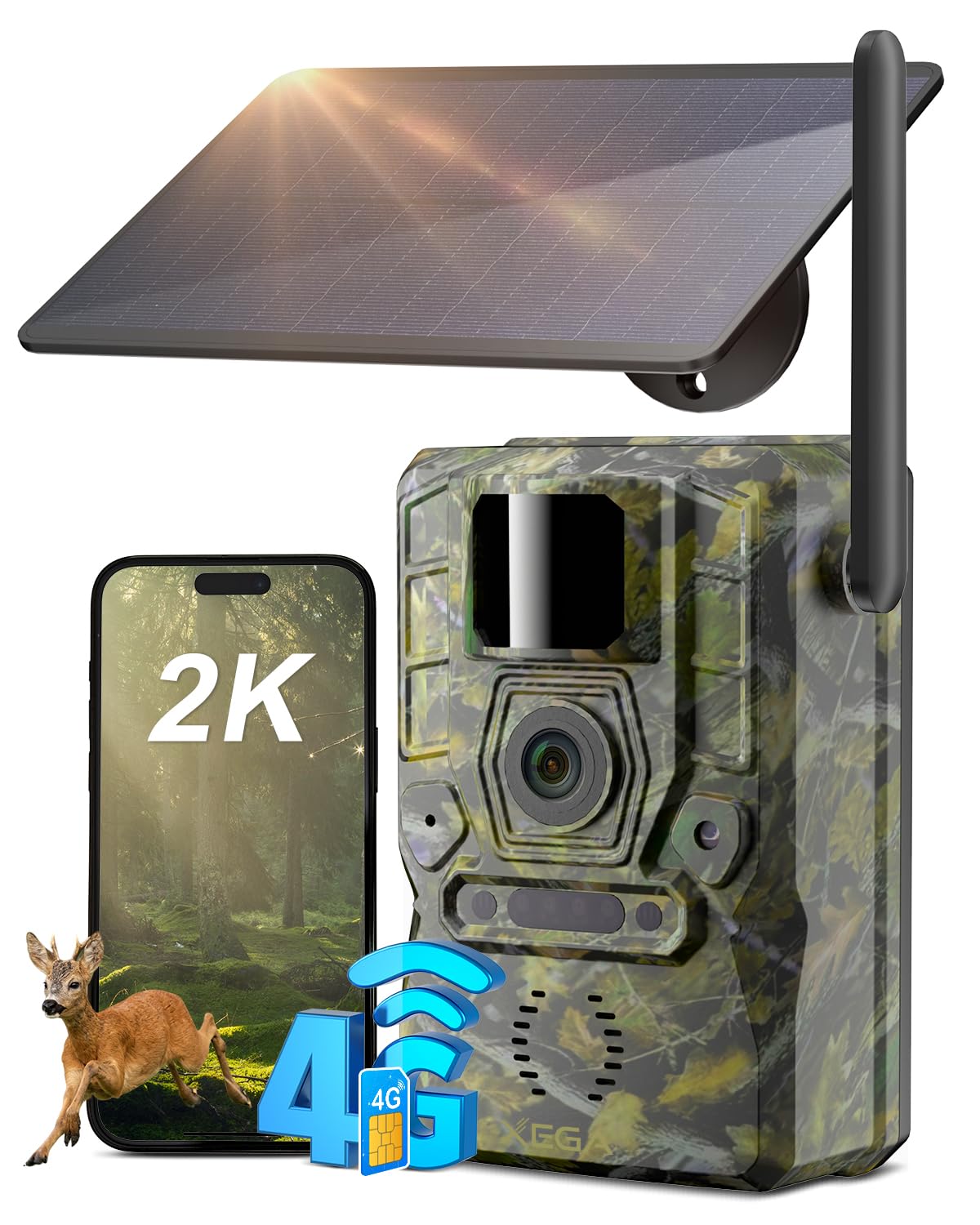
Trail cameras have evolved from simple memory-card devices to connected tools that can send images straight to your phone. The Xega 4G LTE Solar model sits firmly in that connected camp, promising solar charging, cellular transmission, and stealthy no-glow night vision. After spending several weeks with it in a mix of wooded and open terrain, here’s how it actually performs.
The first thing you notice is the build. It’s a solid, boxy unit with a hinged solar panel on top that folds down for transport or locks open for deployment. The panel is a practical touch—if you’re placing the camera in a spot that gets decent sunlight, you can largely forget about swapping batteries. In my test, the panel kept the internal battery topped up even during a stretch of overcast days, though it’s worth noting that heavy canopy cover will reduce its effectiveness. If you’re planning to mount it deep in a thick forest, you may still need to recharge manually every few weeks.
Setup is where the Xega stands apart. Instead of fiddling with a tiny menu screen, you use a mobile app to configure everything—trigger intervals, photo resolution, video length, and cellular settings. The app pairs over Wi-Fi for initial setup, then the camera switches to LTE for remote access. The process took me about ten minutes, which is reasonable for this category. Once connected, images appear in the app within a minute or two of being captured, depending on signal strength. In areas with weak coverage, that delay stretched to several minutes, and occasionally an image failed to upload entirely—a limitation you should expect with any cellular camera, not just this one.
Image quality is respectable but not outstanding. Daytime photos are sharp with accurate colors, and the 940nm no-glow LED array produces black-and-white night shots that are clear enough to identify species and, importantly, don’t spook animals. The lack of any visible glow is a genuine advantage for security or wildlife observation where you don’t want to alert subjects. That said, the night images have a slightly grainy texture at longer distances, and the detection range—rated at about 80 feet—feels optimistic in practice. I found reliable triggers up to around 50 feet, which is consistent with most similarly priced cameras.
One notable trade-off is the subscription requirement. The camera requires a data plan (it uses a standard SIM card), and you’ll need to factor in monthly costs for cellular service. Some competing models offer free cloud storage for a limited number of photos, but Xega’s pricing is straightforward—you pay for the data you use. For a single camera, a basic plan is cheap enough, but if you’re deploying a dozen units, those costs add up quickly.
Compared to traditional non-cellular trail cameras, the Xega offers a significant convenience boost: you can check activity from anywhere without visiting the site. But it also introduces dependencies—battery life is tied to solar exposure, and cellular coverage becomes a new variable. If you’re used to the simplicity of a memory-card camera that just works for months on end, the Xega requires a bit more attention. On the other hand, if you’re monitoring a remote property or tracking wildlife patterns without frequent trips, the remote access is a game changer.
Who is this camera for? It’s ideal for landowners, hunters, or researchers who need near-real-time updates and have decent cellular service in the field. It’s also a solid choice for security monitoring around a cabin or outbuilding where you want to know immediately if someone or something passes by. It is not well-suited for deep wilderness areas with no signal, nor for users who want a zero-recurring-cost setup. And if you’re on a tight budget, you might be better off with a standard camera and manual checks.
In summary, the Xega 4G LTE Solar Trail Camera delivers on its core promises—cellular uploads, solar charging, and invisible night vision—with a few caveats around coverage and image quality at the edges. It’s a well-designed tool for connected monitoring, but it’s not a magic bullet. Go in with realistic expectations about signal and light conditions, and it will serve you well.