
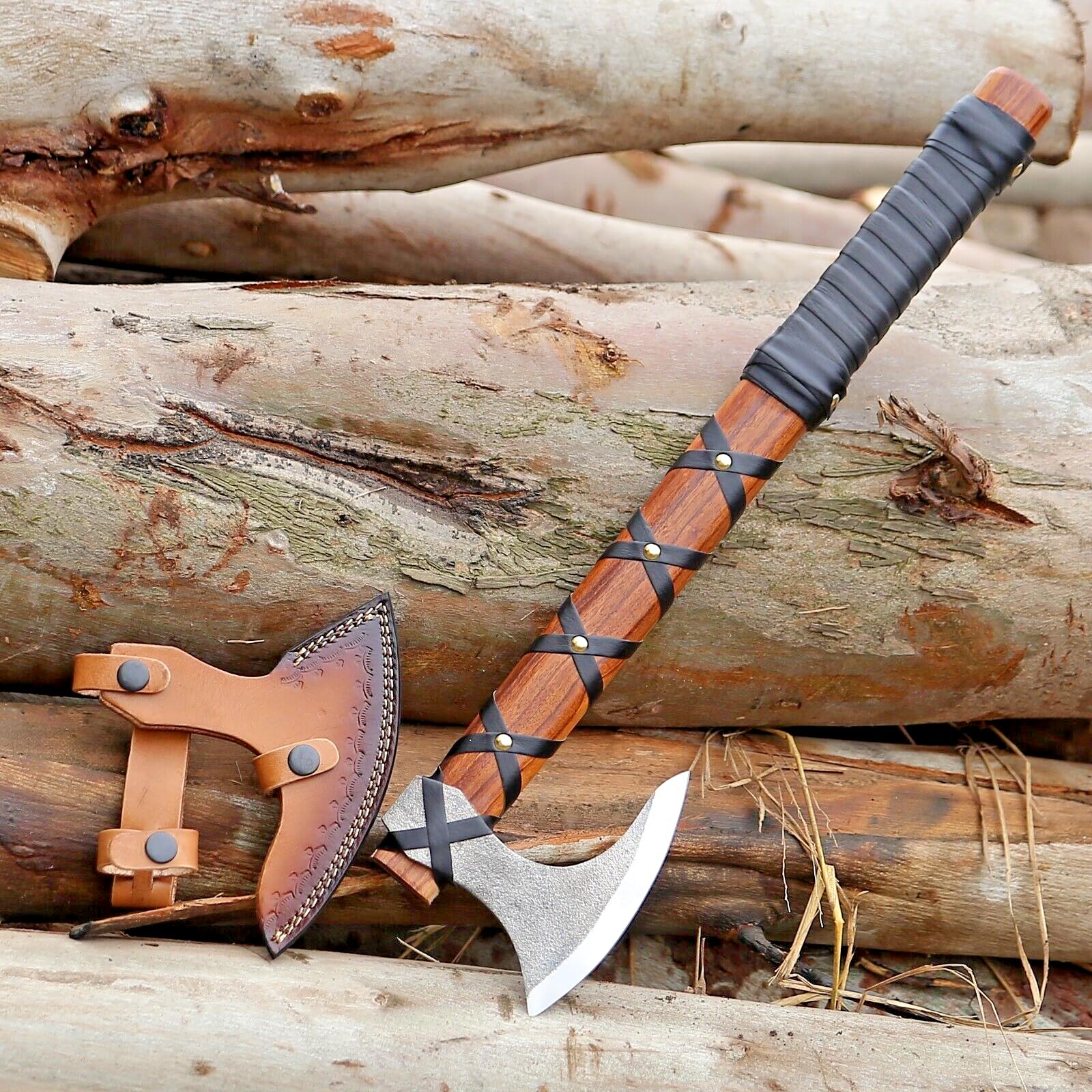
The Viking Axe of Ragnar Lothbrok is one of those products that immediately grabs your attention—whether you’re a history buff, a bushcraft enthusiast, or just someone who appreciates well-made tools. It arrives with a certain presence: the rosewood handle is smooth and dark, the head is hand-forged with visible hammer marks, and the leather sheath adds a touch of old-world craftsmanship. But does it live up to the name, or is it just another decorative piece dressed up as a functional tool? I spent a few weeks putting it through its paces in the woods and around the workshop to find out.
Let’s start with the build. The head is forged from high carbon steel, and it comes with a sharp edge out of the box—sharp enough to shave with, which is always a good sign. The bearded design (the extended lower edge of the blade) is not just for looks; it allows for a closer grip right behind the cutting edge, giving you more control for fine carving or chopping in tight spots. The rosewood handle is sturdy and fits the eye of the head snugly, with a wedge that keeps it secure. At about 16 inches in total length, it’s compact enough to carry on a backpack but still has enough heft to split kindling or process small logs.
In practice, the axe performs well for its size. I used it to split firewood—nothing massive, but plenty of wrist-thick branches and small logs—and it bit deep with each swing. The sharp edge meant I didn’t have to rely on brute force, which is good because the handle is on the shorter side. For carving tent pegs and feather sticks, the bearded edge shines; you can choke up on the handle and use it almost like a knife. The leather sheath is functional and fits snugly, though it’s not a hard case, so you’ll want to be mindful of the edge when it’s in a pack.
However, there are some trade-offs to consider. First, the axe is not a full-size felling tool. If you’re planning to take down larger trees or do heavy splitting, you’ll be fighting an uphill battle. It’s best thought of as a camp axe or a bushcraft hatchet, not a replacement for a dedicated splitting maul. Second, the high carbon steel, while it holds an edge well, requires maintenance. After a day in damp conditions, I noticed a few spots of surface rust forming, so you’ll need to oil the head regularly and keep it dry. The leather sheath also adds a bit of friction when drawing the axe, but that’s a minor quibble.
Compared to a standard hatchet from a brand like Fiskars or Estwing, this Viking axe offers a different experience. Those tools are often more utilitarian, with synthetic handles and a more modern geometry. The Ragnar axe, on the other hand, feels more traditional and has a certain character that you don’t get from a mass-produced tool. But it also requires more care—both in terms of maintenance and in how you swing it. The bearded head takes a bit of getting used to if you’re accustomed to a straight-edged hatchet, as the balance point is slightly different. That said, once you adjust, it feels natural and satisfying.
Who is this axe for? It’s ideal for campers, bushcrafters, and reenactors who want a functional tool that also looks the part. It’s a great conversation starter at a campsite, and it performs well for light-to-medium tasks like splitting kindling, trimming branches, and carving. It’s also a solid choice for someone who wants to practice traditional woodworking skills, as the design encourages a more deliberate and controlled approach. On the other hand, if you need a hard-working tool for heavy-duty use, or if you prefer a low-maintenance, drop-forged synthetic option, this might not be your best bet. It’s also not a toy—the edge is genuinely sharp, so it’s not suitable for children without strict supervision.
One thing to note is that the axe is marketed with a certain historical flair, but it’s not a faithful replica of any specific Viking-era artifact. It’s more of a modern interpretation inspired by the bearded axes of the period. That’s fine if you’re looking for a functional tool with a historical vibe, but if you’re a purist, you might want to look at dedicated historical reproductions. Also, the name “Ragnar Lothbrok” is more of a branding hook than a historical reference, which is worth keeping in mind.
In terms of value, the price point is reasonable for a hand-forged tool with a leather sheath. You’re paying for the craftsmanship and the aesthetic, which is fair. But if you’re purely looking at performance per dollar, a cheaper hatchet will do the job just as well for most tasks. The Ragnar axe is about the experience and the feel, not just the utility.
Overall, the Viking Axe of Ragnar Lothbrok is a well-made, attractive tool that balances form and function. It’s not perfect—the maintenance demands and the learning curve with the bearded edge are real considerations—but for the right user, it’s a rewarding piece of gear. If you appreciate the romance of a hand-forged blade and don’t mind a little extra care, this axe will serve you well on many trips. Just don’t expect it to replace a full-size forest axe.