
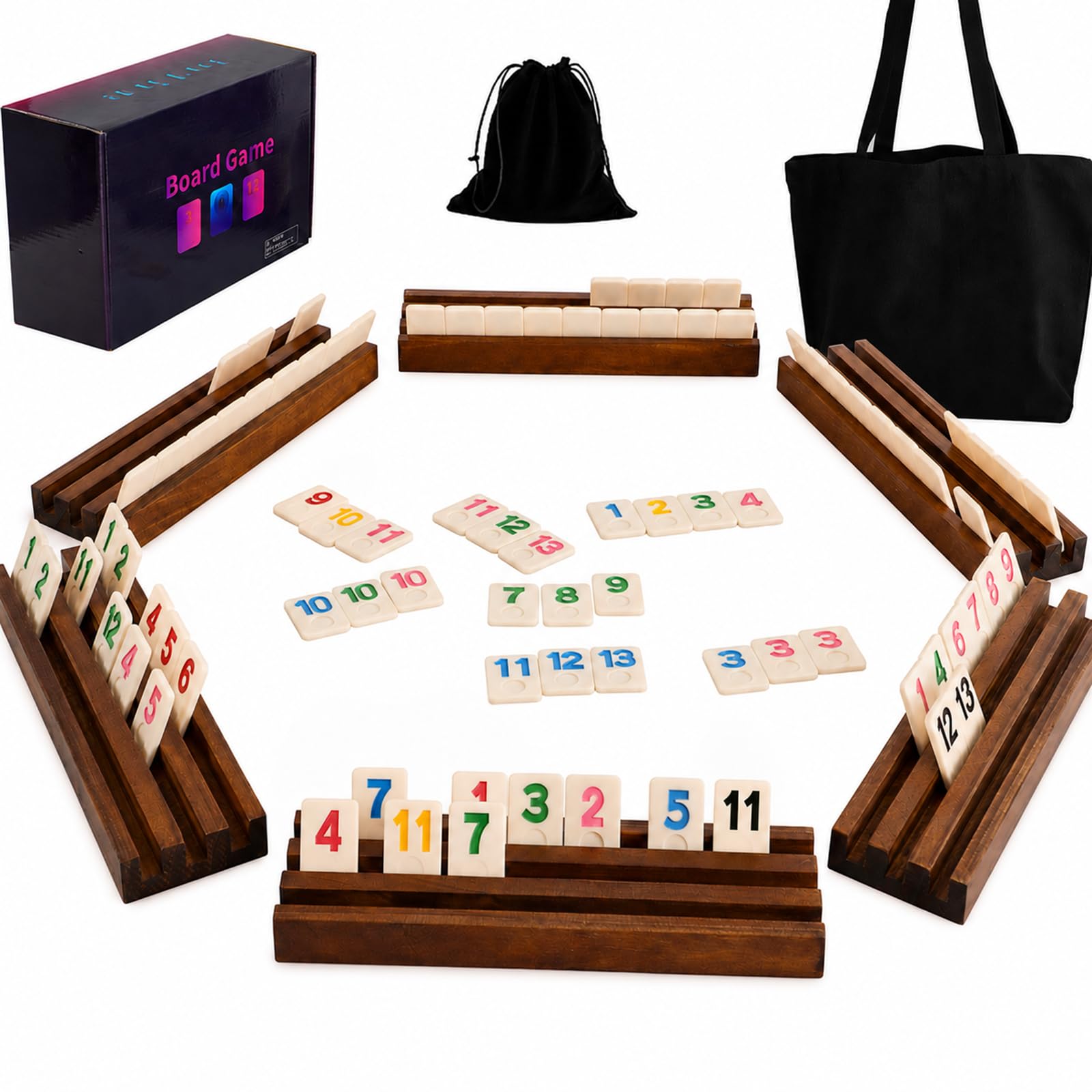
Rummy cube games have been a staple in many households for decades, and the Wahartoly version aims to offer a fresh take on the classic tile-based game. I spent several evenings playing this with a group of friends and family members, ranging from casual gamers to more competitive players. The experience was largely positive, though not without a few quirks worth noting before you commit to a purchase.
The game itself is essentially a rummy-style card game translated into a tactile tile format. Players draw and discard tiles to form sets and runs, aiming to be the first to empty their rack. The Wahartoly set supports 2 to 6 players, which makes it flexible for different group sizes. I found that it shines with four players, as the game pace feels well-balanced. With six, the downtime between turns can stretch a bit, but that’s more a function of the genre than a flaw in this particular product.
One of the first things I noticed is the build quality. The tiles are made of a dense plastic that feels sturdy in hand, with a smooth finish that makes them easy to pick up and arrange. The numbers and colors are printed clearly, and there’s enough contrast to distinguish between the red, blue, yellow, and black tiles even in dimmer lighting. The racks are functional, though not particularly elegant—they hold the tiles securely but feel a little flimsy compared to the tiles themselves. For a product in this price range, that’s a reasonable trade-off.
- Tile quality: The tiles are thick and durable, with a nice weight that prevents them from sliding around too much during play.
- Racks: Each player gets a rack, but they are a bit shallow. If you have larger hands, you might find them slightly awkward to handle.
- Carrying case: The included storage bag is a practical addition, though it’s not padded. You’ll want to be careful when tossing it into a backpack or suitcase.
In terms of gameplay, the rules are straightforward and easy to teach. If you’ve played any rummy variant before, you’ll pick it up in minutes. The game introduces a joker mechanic that adds a layer of strategy—you can use a joker as a wild tile, but you can’t take a joker back from a completed set on the table. This creates some interesting decisions, especially in the later rounds. However, the rulebook is a bit sparse and could benefit from more examples, particularly for handling edge cases like when a player draws a joker from the pool. We had to look up a clarification online during our first session.
Compared to other tile-based games like the classic Rummikub or even a standard deck of cards, Wahartoly’s version holds its own. It doesn’t bring anything revolutionary to the table, but it doesn’t need to. The core mechanics are time-tested, and the execution here is competent. That said, if you’re a purist who prefers the original Rummikub brand, you might notice that the tile fonts are slightly less polished, and the racks are less robust. But for the price, you’re getting a very comparable experience.
One limitation I encountered is the tile storage system. The bag is fine for transport, but there’s no internal divider, so tiles end up mixed together. That’s not a big deal for a game where you’re supposed to mix tiles anyway, but if you like to keep things organized, you’ll need to improvise. Also, the tiles have a slightly glossy finish that can reflect light under direct overhead lighting, which occasionally made it hard to read the numbers at certain angles. It’s a minor issue, but worth knowing if you plan to play under bright lights.
Who is this game for? If you’re looking for a portable, affordable alternative to the more expensive branded versions, and you enjoy classic rummy-style gameplay, this is a solid choice. It’s also great for families with older kids—say, ages eight and up—because the rules are accessible, and the game encourages logical thinking and pattern recognition. On the other hand, if you’re a serious board gamer who values premium components and a polished rulebook, you might find the overall presentation a bit lacking. Similarly, if you’re planning to play with more than five players frequently, you might be better off with a game that handles larger groups more gracefully.
In my time with the Wahartoly Rummy Cube Game, it proved to be a reliable and enjoyable addition to game night. It won’t replace your favorite deep strategy game, but it doesn’t try to. It’s a straightforward, fun, and social experience that gets the job done. Just be aware of the minor component quirks, and you’ll likely get a lot of use out of it.