
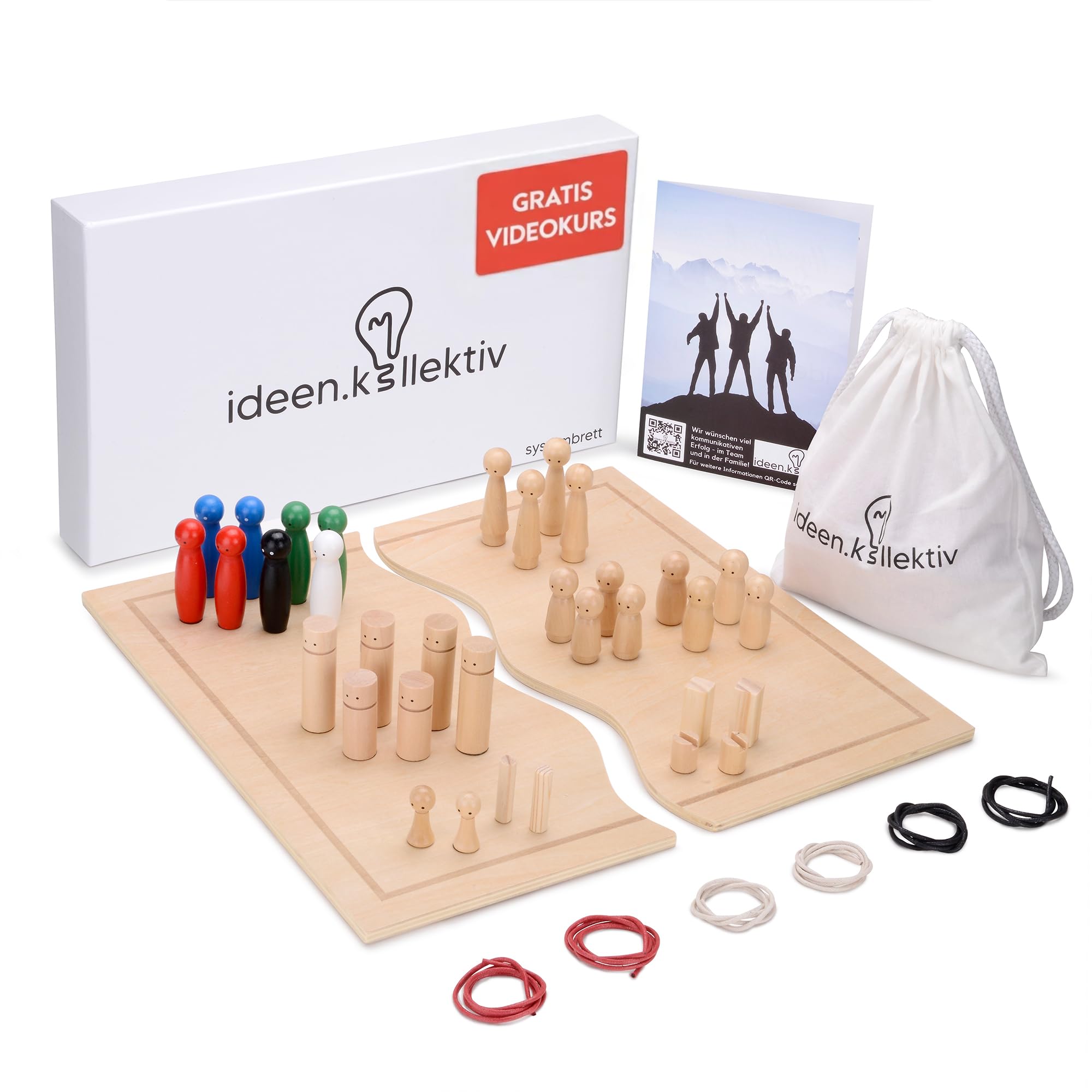
The ideen.kollektiv Constellation Board is a physical tool designed for a very specific kind of professional work: systemic constellation, coaching, and facilitation. It comes with 44 wooden figures, a manual, and a few extras, all packed into a board that acts as a stage for representing relationships and dynamics. If you are a coach, therapist, or supervisor who regularly uses constellation methods, this board could be a useful addition to your practice. But it is not a magic solution, and it has some limitations worth considering.
In practice, the board is used to set up spatial representations of a client’s system. You place the figures on the board to map out, for example, family members, team members, or abstract concepts like a project or a goal. The client or the facilitator can then move the figures, change their distances, and observe how the arrangement shifts. This is a hands-on, visual way to explore dynamics that are often hard to verbalize. The board itself is made of wood and feels sturdy. The figures are also wooden, with a smooth finish, and they come in different sizes and shapes—some are larger, some smaller, some are flat, some are round. This variety helps to differentiate between people, roles, or even emotions. The manual that comes with it is helpful for beginners, explaining basic constellation principles and offering a few sample setups. It is not a deep theoretical text, but it is enough to get started.
One of the key strengths of this board is its portability. It is relatively lightweight and folds up, which makes it easy to carry to client sessions, workshops, or off-site meetings. In that sense, it is more practical than a traditional floor-based constellation setup, which requires a large empty space and physical markers. The board also works well for one-on-one sessions where you want to keep the process contained and focused. The figures are easy to grip and move, and the board surface has a subtle grid or texture that helps with alignment. I found that the board encourages a more structured, almost analytical approach to constellations, which can be useful for clients who are more cognitive than emotional.
However, there are some trade-offs. The board is not a substitute for a live, embodied constellation with real people. The physical presence of other human beings in a room brings a level of emotional resonance and non-verbal feedback that a wooden figure simply cannot replicate. For deep trauma work or intense family dynamics, a board might feel too abstract or flat. Also, the board is relatively small, so if you are working with a large system (e.g., an extended family or a big organizational team), the figures can become cramped and difficult to distinguish. The manual, while a nice addition, is not comprehensive; it lacks advanced techniques or troubleshooting advice. And the price point is not trivial—it is an investment that makes sense for professionals who use this method frequently, but not for someone who is just exploring the idea.
Compared to other tools in this niche, the Constellation Board sits somewhere between a simple set of stones or paper cards and a full digital constellation software. The wooden figures are more tactile and engaging than paper, but they lack the flexibility of a digital tool that can store, annotate, or share constellations. For example, some practitioners use generic figurines or even small objects like pebbles and buttons, which are cheaper and more adaptable. The ideen.kollektiv board, however, offers a more cohesive and professional look, which can be important for client trust and for creating a clear, dedicated method. It is a middle ground: more polished than a DIY setup, but less dynamic than a digital solution.
Who is this board for? It is best suited for coaches, counselors, and facilitators who already work with systemic constellations and want a reliable, portable tool to use in individual sessions or small groups. It is also good for trainers who teach constellation methods, as the manual and the visual nature of the board make it easy to demonstrate concepts. On the other hand, it is not ideal for large group constellations, for deep therapeutic work that requires a more embodied approach, or for practitioners who prefer a more free-form, improvisational style. If you are on the fence, consider how often you would actually use it. For a professional who runs constellation sessions regularly, the board will likely pay for itself in terms of convenience and client engagement. For an occasional user, it might end up gathering dust.
In terms of build quality, the board and figures feel durable. The wood is not the highest grade, but it is solid and should withstand years of regular use. The figures are painted or stained in neutral tones, which is a good choice because it does not impose any specific gender, age, or cultural identity—leaving that open for the client’s projection. The extras, which include a few blank cards and a small booklet, are modest but useful. I did notice that the board’s surface can be slightly slippery, so figures can slide if you tilt the board, but that is a minor issue. Also, the folding mechanism works fine, but it is not super sturdy; you have to be careful not to force it.
Overall, the ideen.kollektiv Constellation Board is a thoughtful, well-made tool for a specific niche. It does what it promises: it provides a tangible, visual way to work with constellations. It is not a revolutionary product, and it will not replace the skill of a good facilitator. But if you are looking for a clean, portable, and professional-looking board to support your systemic work, this is a solid option. Just be aware of its limitations and consider whether it fits your specific way of working.