
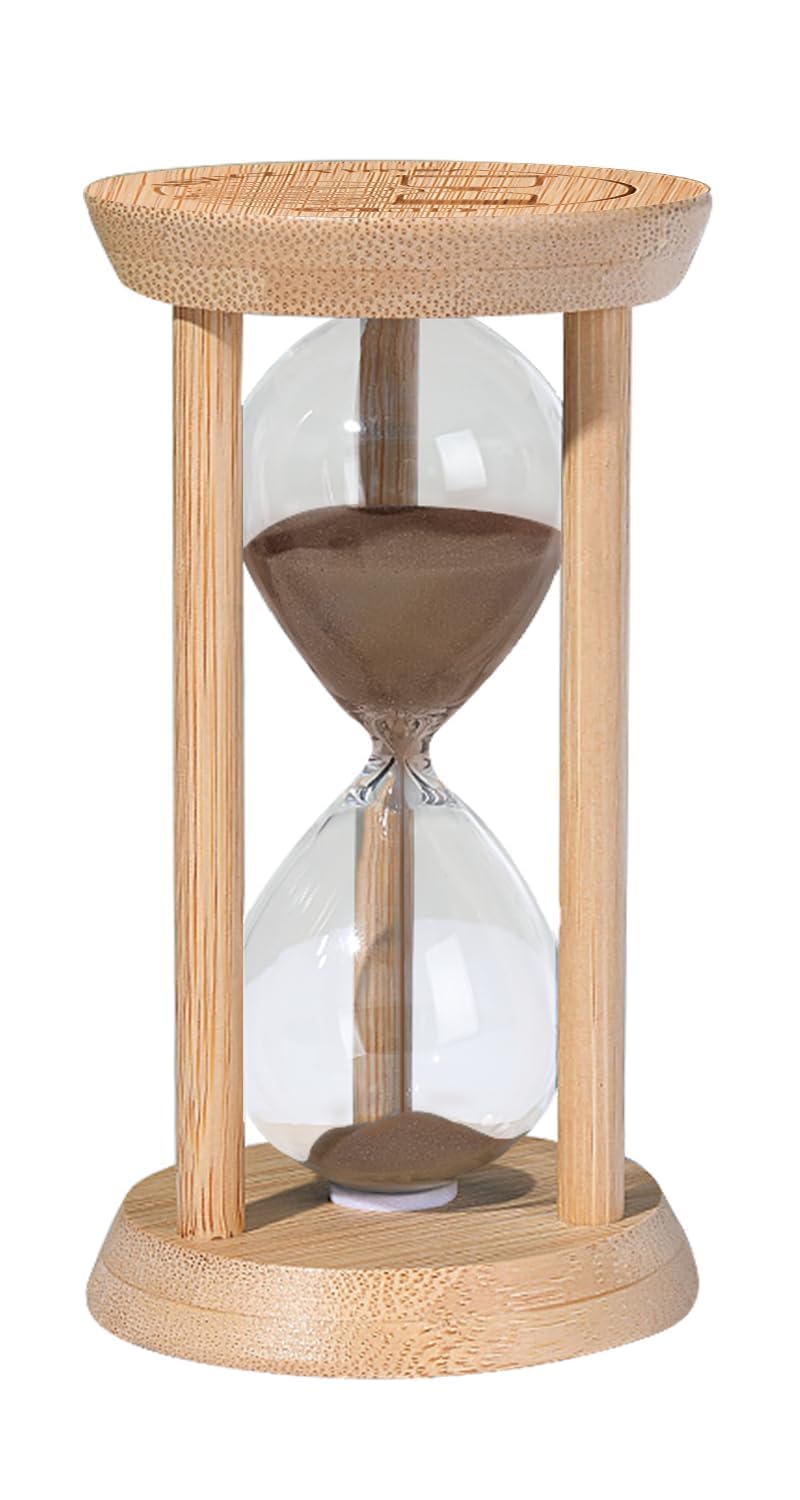
There’s something inherently calming about watching sand trickle through a glass bulb. The 15-minute wooden hourglass—often marketed under names like “Mini Sand Watch” or “Reloj de Arena 15 Minuto”—taps into that analog appeal. It’s a tool that doesn’t beep, buzz, or demand your attention. Instead, it quietly measures a quarter of an hour, and that simplicity is both its strength and its limitation.
In practice, this hourglass works best in situations where you don’t need precise timing. I found it useful for timing a quick break, a short meditation session, or even a board game turn. The 15-minute duration is a nice middle ground—long enough to feel productive, short enough to keep things moving. But it’s not a kitchen timer for serious baking. If you’re waiting for a cake to finish, you’ll need to keep an eye on it, because the sand doesn’t stop or reset on its own. It just runs out, and you flip it over.
Construction is straightforward: a wooden frame holds two glass bulbs, and sand flows between them. The wood feels decent, though not premium—think of it as a functional object rather than a heirloom piece. The glass is clear and the sand is a consistent, fine grain that flows evenly. I didn’t notice any clumping or sticking, which is good. However, the frame is a bit lightweight, so it can slide on smooth surfaces if you set it down too quickly. A rubber base or a slightly heavier frame would have been a nice improvement.
One of the first things I checked was accuracy. I ran it against a digital timer three times. The first run was 14 minutes and 52 seconds, the second was 15 minutes and 8 seconds, and the third was 14 minutes and 55 seconds. So it’s roughly on target, but don’t expect laboratory precision. For most casual uses, that variance is fine. But if you need exact timing—say, for a specific cooking step—you’re better off with a digital timer or a phone app.
Compared to a digital timer or even a smart speaker alarm, this hourglass offers a different experience. It’s silent, doesn’t require batteries, and doesn’t have a screen that glares at you. It also forces you to look up and notice the passage of time, which can be a mindful break from constant notifications. On the flip side, it’s less versatile. A digital timer can count up, count down, and be reused instantly. With the hourglass, you have to flip it manually, and you can’t pause it. If you’re in the middle of a task and need to step away, the sand keeps flowing.
Another limitation is the 15-minute fixed duration. You can’t adjust it. If you need 10 minutes or 20 minutes, you’ll need additional hourglasses or a different device. This makes it somewhat niche. It’s not a one-size-fits-all timer, but rather a specific tool for a specific window of time.
Who is this for? I’d say it suits people who appreciate analog aesthetics—gamers who want a quiet turn timer, students who use the Pomodoro technique (though 15 minutes is a bit short for a standard 25-minute session), or anyone who likes having a decorative object that also serves a purpose. It also makes a decent gift for someone who enjoys quirky desk accessories or traditional board game paraphernalia. However, it’s not ideal for serious bakers, people who need precise time tracking, or those who prefer a timer that can be paused and resumed. It’s also not a toy—the glass is fragile, so keep it away from young children.
In terms of build quality, I noticed a few minor things. The wooden frame is smooth, but the finish is a bit uneven in places. The glass bulbs are sealed well, and I didn’t see any sand leaks, which is a common issue with cheap hourglasses. But the overall construction feels a little delicate. I wouldn’t want to drop it. It’s fine for sitting on a shelf or a table, but it’s not something you’d toss in a bag.
As a home decoration, it looks nice. The natural wood tone and the soft sound of sand falling add a subtle, organic touch to a room. It’s not a statement piece, but it doesn’t need to be. It blends in with a bookshelf or a desk without shouting for attention. If you’re the kind of person who likes functional decor, this fits the bill.
One more thing: the price. It’s generally affordable, which is good, but don’t expect premium craftsmanship. You’re paying for a simple, working hourglass, not a finely crafted instrument. If you want something with more heft or a more polished finish, you might look at higher-end hourglasses with metal or walnut frames, but those can cost several times more.
Overall, the 15-minute wooden hourglass is a pleasant, low-stakes tool. It does what it promises—measures 15 minutes—and it does so with an analog charm that digital devices can’t replicate. It’s not a workhorse timer, but it doesn’t try to be. If you have a specific use for it, you’ll likely enjoy it. If you’re looking for a versatile, precise timer, you’ll probably be disappointed. I’d recommend it for casual, mindful timing, and as a decorative object that occasionally comes in handy.