
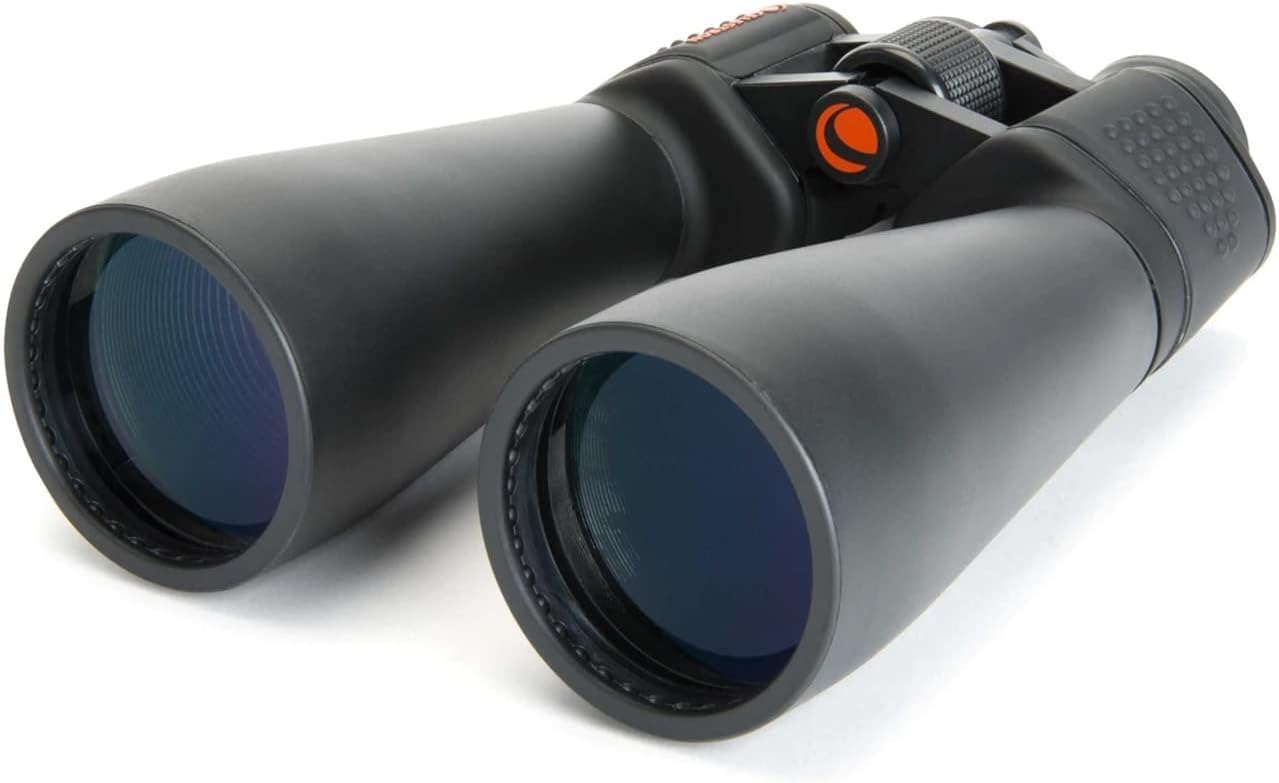
The Celestron SkyMaster 15×70 sits in a peculiar spot in the astronomy market. It is a large, porro-prism binocular with 15x magnification and 70mm objective lenses, priced low enough that many people buy it as a first serious stargazing optic. That combination of big glass and modest cost is exactly why it generates so much discussion, and also why expectations sometimes get out of step with what the instrument can realistically do.
In practice, these are not binoculars you hold up to your eyes for a quick look. At roughly 1.4 kg, the 15×70 is heavy enough that hand-holding produces visible shake within seconds, and the shake gets worse the longer you try. Most owners end up mounting them on a tripod or a parallelogram mount, which changes the experience considerably: you are now using a two-eyed telescope rather than a portable pair of binoculars. That is the honest framing. Used on a support, the SkyMaster 15×70 shows a lot of sky for the money; used handheld, it is frustrating.
Optically, the specifications are straightforward. The 70mm aperture gathers meaningfully more light than typical 42mm or 50mm binoculars, and the 15x magnification gives a 4.4mm exit pupil, which is reasonable for suburban skies and still usable under darker conditions. The field of view is about 4.4 degrees, so the Pleiades, the Andromeda galaxy, the Orion Nebula, and large open clusters fit comfortably in frame. That wide, bright, two-eyed view is the real argument for this format. Deep-sky objects that look like faint smudges in a small refractor often read more clearly here because both eyes are involved and the context around the object is visible.
Build quality is functional rather than refined. The body is rubber-armored and the prisms are BaK-4, which is the better glass choice at this price. Focusing is individual for each eyepiece, which is common on astronomy binoculars but means you set it once and leave it; it is not a fast-focus birding design. The binoculars are also nitrogen-purged and waterproof, a claim that is more about dew resistance than about surviving a dunking. The included tripod adapter is a small but genuinely useful accessory, since the central post is not threaded for a standard mount on its own.
Where the SkyMaster 15×70 draws criticism is at the edges and in mechanical consistency. Stars near the field edge show coma and some softening, and the outer portion of the view is noticeably less sharp than the center. Collimation can be imperfect out of the box, and a miscollimated pair is uncomfortable to use for long sessions; it is worth checking on arrival and returning if the two images do not merge cleanly. Chromatic aberration is visible on bright objects like the Moon and Venus, showing as purple fringing. None of this is unusual for the price, but it is real, and buyers should not expect the edge-to-edge correction of a premium astronomy binocular.
Compared with a small telescope, the trade-offs are clear. A 70mm or 80mm refractor on a tripod will outperform these binoculars on planets and the Moon, and it can reach higher magnifications. The binoculars win on wide-field, low-power sweeping and on the comfort of using both eyes. Compared with smaller 10×50 binoculars, the 15×70 gives more reach and brightness but demands a mount and is far less grab-and-go. Compared with image-stabilized binoculars, the SkyMaster is cheaper and brighter but lacks the handheld convenience that stabilization provides.
These binoculars suit someone who wants a dedicated, mounted, wide-field instrument for cluster hunting, Milky Way scanning, and bright deep-sky objects, and who accepts the need for a sturdy tripod. They are a poor fit for anyone expecting hand-held astronomy, for travel where weight matters, or for observers whose main interest is lunar and planetary detail. For the right user, mounted and used within their limits, the SkyMaster 15×70 delivers a lot of light-gathering and a genuinely enjoyable two-eyed view of the sky at a price that leaves room for a decent mount.