
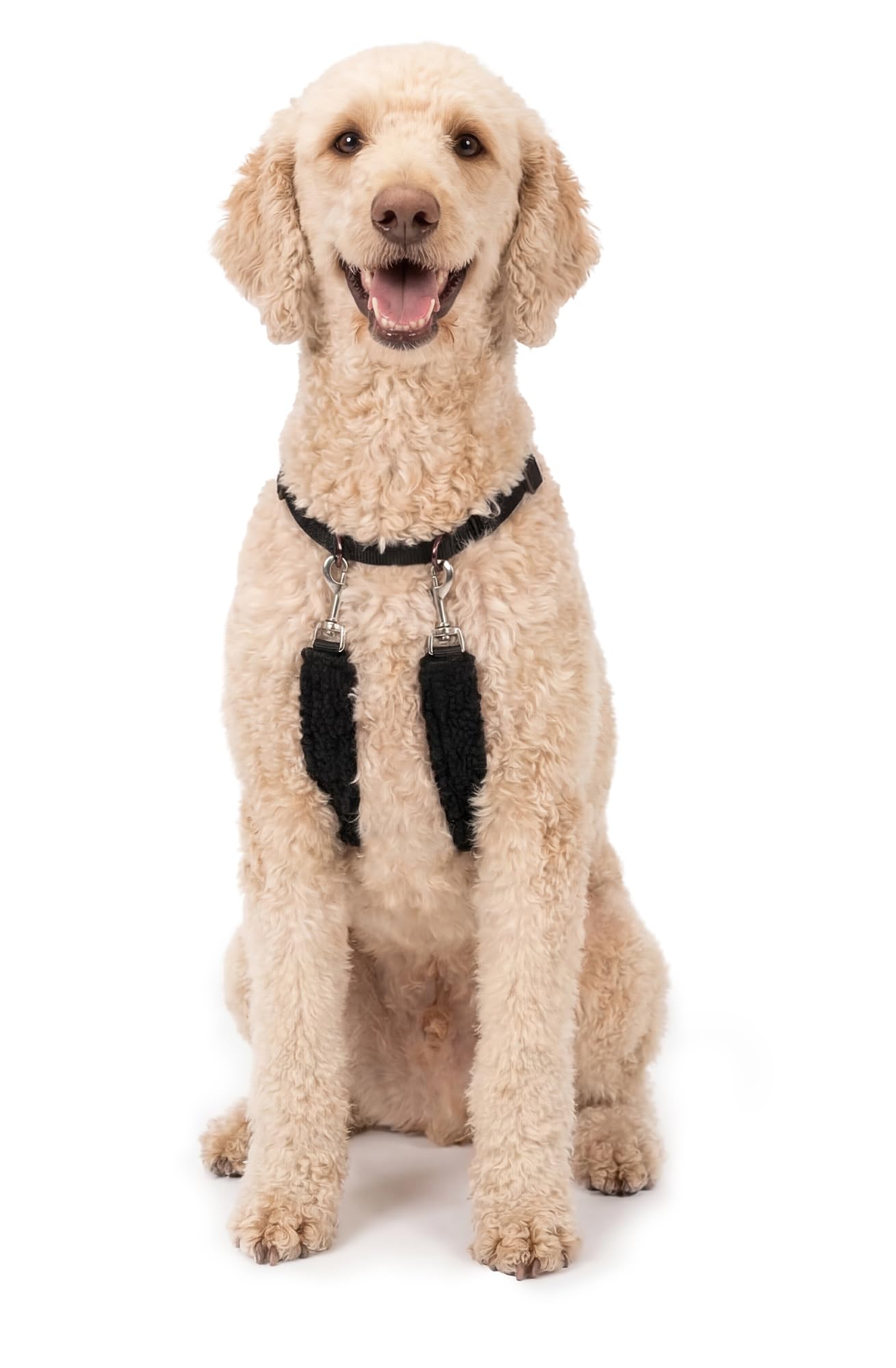
The Sporn Original Dog Halter occupies a slightly odd corner of the no-pull harness market. It isn’t a front-clip harness, it isn’t a head halter, and it isn’t a padded vest. Instead, it uses a cord-and-sleeve design that tightens across the chest when a dog pulls, then releases when the dog stops. That mechanical premise is worth understanding before buying, because it shapes both what the harness does well and where it frustrates people.
The design is straightforward. A nylon collar sits high on the neck, and two padded restraint sleeves run down behind the front legs, connected by a cord that loops under the chest. The leash attaches to a ring at the front of the collar. When the dog lunges forward, the cord draws the sleeves together and applies gentle pressure under the front legs. The dog feels that pressure, slows, and the tension eases. It’s a leverage system rather than a padded restraint system, and it works on a different principle than most harnesses sold today.
In practice, this makes the Sporn halter a reasonable choice for a specific kind of dog and handler. Large breeds that pull hard on a flat collar—Labradors, shepherds, boxers, and similar—are the intended audience. The tightening action gives the handler a mechanical advantage without cranking on the throat, which is the main appeal for people whose dogs have learned to lean into a collar. For walks around the neighborhood, it does what it claims: a determined puller will usually ease off within a few steps once the sleeves engage.
What works
- The no-choke premise holds up in normal use. Pressure lands under the front legs rather than across the trachea, which is a meaningful difference for dogs that cough or gag on collars.
- The padded sleeves are the part that touches the dog most, and the padding is adequate for daily walks, though it’s thin compared with vest-style harnesses.
- Adjustment is straightforward. The collar and chest cord can be sized independently, which helps on dogs that fall between standard measurements.
- On and off is quick once the fit is dialed in—there’s no step-in or over-the-head maneuver, which matters for wiggly dogs.
- The nylon construction is durable enough for regular outdoor use, and the hardware is metal rather than plastic on the load-bearing points.
Where it falls short
The biggest trade-off is fit sensitivity. The Sporn halter depends on the sleeves sitting in the right spot behind the front legs, and on dogs with deep chests, narrow shoulders, or heavy coats, that placement can be hard to nail. When it’s off, the tightening action either doesn’t engage or engages unevenly, and the harness loses much of its point. Expect to spend time adjusting, and expect some dogs to need a size up or down from the label’s suggestion.
There’s also a learning curve for the dog. Because the correction is pressure-based, some dogs find the initial tightening startling, particularly sensitive or anxious animals. It isn’t a punitive tool in the way a prong collar is, but it is aversive by design—the dog pulls, something uncomfortable happens, the dog stops. Handlers who prefer force-free equipment should look elsewhere.
Finally, the cord-and-sleeve layout leaves more of the dog exposed than a vest harness. There’s no broad chest panel, so a hard puller on a long line can still generate concentrated pressure points. For casual walks this is fine; for hiking, running, or reactive-dog work, a padded front-clip harness is usually the more comfortable and more controllable option.
How it compares
Against a standard front-clip harness, the Sporn halter offers more immediate feedback to a dog that ignores leash pressure, but less comfort and less control for complex situations. Against a head halter, it’s less effective at stopping a full lunge but far easier for most dogs to accept. It sits in the middle: more corrective than a vest harness, less corrective than a head halter, and more dependent on correct fit than either.
Who it suits
This halter is a sensible fit for owners of strong, medium-to-large dogs that pull consistently on walks and have not responded to flat collars or back-clip harnesses. It’s also useful for handlers with limited grip strength who want mechanical help without resorting to a choke chain. It is not a good match for puppies still growing into their frame, dogs with shoulder or tracheal issues, anxious dogs that startle easily, or owners who want a harness for running and off-leash-adjacent activities. It’s a walking tool, not an all-purpose harness, and it performs best when treated that way.