
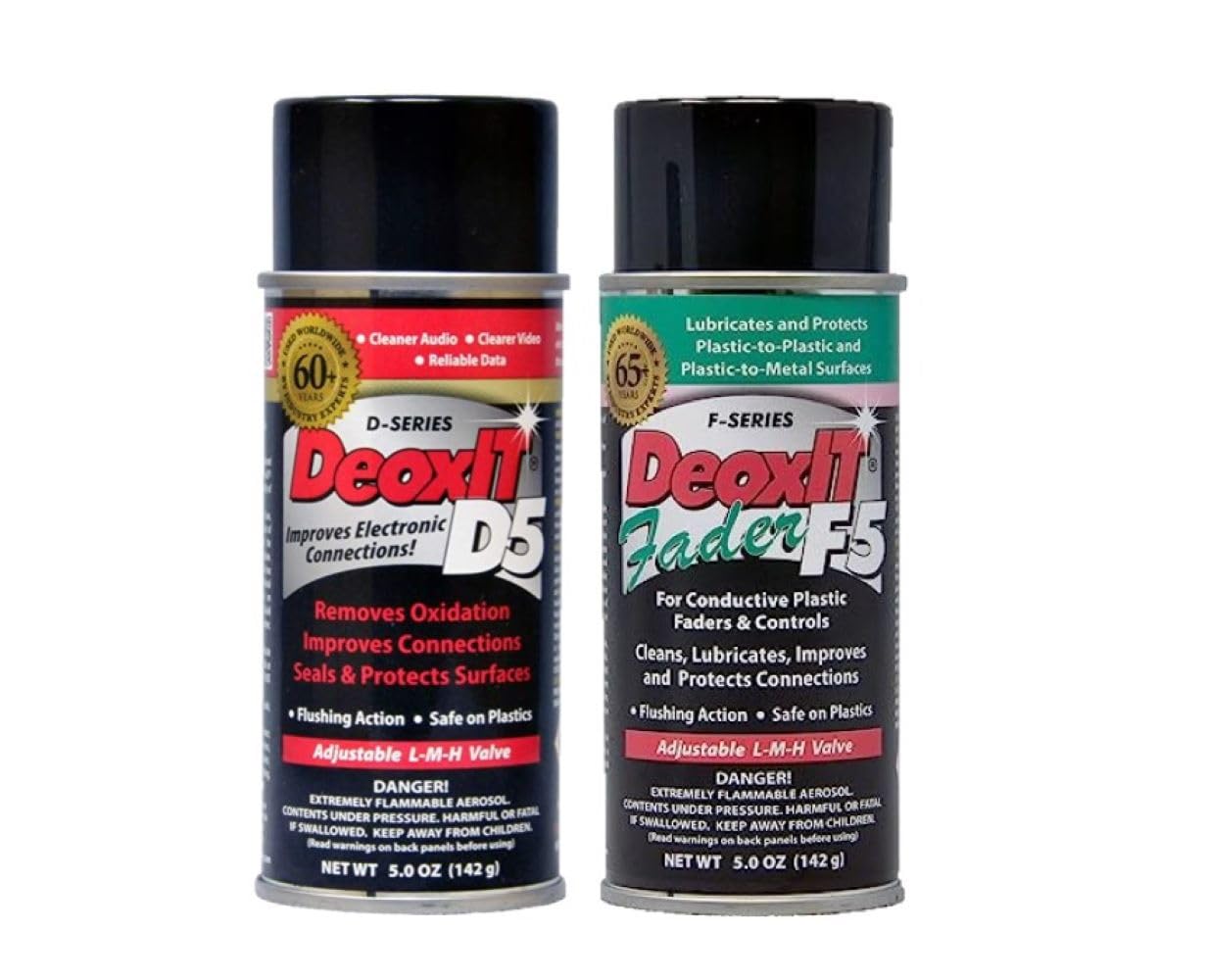
If you’ve ever wrestled with a crackling volume knob on a vintage amplifier or a finicky guitar pedal, you’ve probably heard of DeoxIT. It’s one of those products that audio engineers and electronics repair folks swear by, but it’s also easy to wonder if it’s all hype. This 2-pack pairs the D5S6 contact cleaner with the F5S-H6 FaderLube, both in 5-ounce aerosol cans. After spending time with both, I can say they do what they claim, but there are some nuances worth knowing before you buy.
The D5S6 is the workhorse of the pair. It’s designed to dissolve oxidation and contamination on electrical contacts, and it does that effectively. I used it on a few old potentiometers, a scratchy input jack on a mixer, and even the battery contacts in a wireless microphone. In most cases, the crackling disappeared after a quick spray and some working of the control. The key is that it leaves a thin, non-conductive film that actually improves conductivity by protecting the metal surface from further oxidation. That’s not magic—it’s just chemistry—but it works. The aerosol can gives a directed spray, which helps when you’re trying to hit a specific spot inside a cramped device.
The F5S-H6 FaderLube, on the other hand, is specifically for faders and potentiometers. It’s a lubricant that also cleans, but it’s meant to restore smooth, quiet operation. I tried it on a mixing console’s faders that were feeling gritty and scratchy. After a few applications, the movement became noticeably smoother, and the noise dropped significantly. It’s a good product for its niche, and it complements the D5S6 well. In fact, the two are often used together—D5S6 for the heavy cleaning, then F5S-H6 for lubrication on moving parts. That’s why the 2-pack makes sense for someone who does regular maintenance on audio gear.
But there are trade-offs. First, neither product is cheap. You’re paying a premium for the DeoxIT name, and while the results are good, you can find generic contact cleaners for a fraction of the cost. Those generics often work fine for basic cleaning, but they don’t offer the same protective residue or the fader-specific lubrication. If you’re just cleaning a few battery contacts, a $5 can of electrical contact cleaner from an auto parts store will do the job. The DeoxIT advantage shows up when you’re dealing with sensitive, high-use components like faders and pots.
Another limitation is the application process. The spray cans are easy to use, but they’re not precision tools. You’ll want to use the included straw or a separate applicator to avoid overspray, which can get messy. Also, these are not for soaking or submerging components—you’re meant to spray and let it dry. That’s fine for most tasks, but if you’re dealing with heavily corroded switches, you might need to repeat the process or use a different method. Also, the D5S6 has a strong solvent smell that lingers, so you’ll want good ventilation.
Compared to something like a simple isopropyl alcohol rinse, DeoxIT is more effective at actually reversing oxidation rather than just moving it around. Alcohol evaporates quickly and removes some grime, but it doesn’t leave any protective layer. That’s the real difference—DeoxIT is a treatment, not just a cleaner. For long-term reliability, especially in gear that sees regular use, that matters. But if you’re on a budget and just need a quick fix, alcohol or a generic cleaner might be enough.
Who is this for? If you’re a musician, audio engineer, or electronics hobbyist with a collection of older gear, this 2-pack is a solid investment. It’s also great for anyone who repairs electronics as a side gig. The fader lube alone is worth it if you work on mixers or synths with sliders. On the flip side, if you’re a casual user who just wants to fix a scratchy headphone jack once a year, you’re probably better off buying a single can of generic cleaner. And if you’re dealing with modern, sealed electronics, you might not even need this—those devices rarely have user-serviceable parts.
In terms of real-world expectations, don’t expect miracles on severely damaged components. If a pot is physically worn out, no cleaner will bring it back. But for oxidation and light contamination, this pair does a reliable job. I’ve had to reapply after a few months on high-use faders, but that’s normal—no product is a permanent fix. The 2-pack is convenient, and the 5-ounce cans last a while if you use them sparingly. Just be mindful of the price and the overspray, and you’ll get decent value.
Overall, the CAIG DeoxIT D5S6 and F5S-H6 2-pack is a practical choice for anyone serious about maintaining audio equipment. It’s not a miracle cure, but it’s a reliable tool that does what it says. Just weigh the cost against your actual needs, and you’ll know if it’s worth it.