
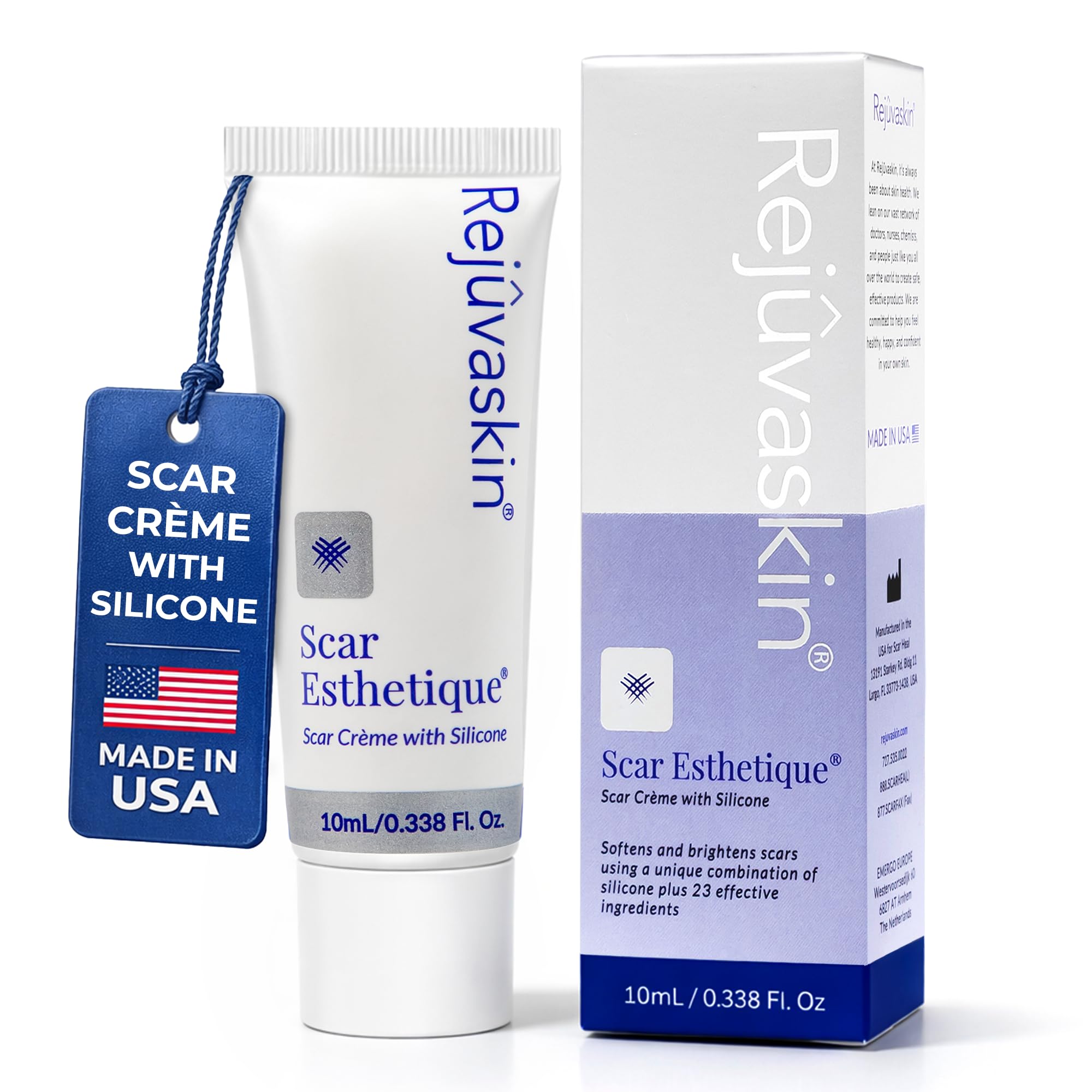
Scar creams tend to promise more than they can deliver, so it’s worth being clear about what Rejuvaskin Scar Esthetique actually is. It’s a silicone-based topical cream sold in a 10ml (0.338 oz) tube, positioned for surgical scars, burns, stretch marks, keloids, and acne scars. The small size is the first thing most people will notice. At roughly a third of an ounce, this is a travel- or trial-sized product, not a long-term supply, and that shapes how it should be evaluated.
The core functional idea is familiar: silicone forms a thin, breathable layer over the scar that helps retain moisture and modify the local environment. Silicone gels and sheets are among the more evidence-supported over-the-counter approaches to scar appearance, though results are gradual and modest rather than dramatic. Rejuvaskin’s formulation combines silicone with other emollients and skin-conditioning ingredients, which makes it easier to spread than a pure silicone gel. That’s a practical advantage on irregular areas like joints or the face, where a silicone sheet would be awkward to keep in place.
In real-world use, the cream is applied in a thin layer to the scar once or twice daily, typically after the wound has fully closed and any scabbing has resolved. Massaging it in gently for a short period is the usual method. Because it dries down rather than staying tacky, it can be worn under clothing or makeup, which is one reason people choose a cream over a sheet. The 10ml tube is genuinely pocketable and useful for testing tolerance before committing to a larger format.
- Format: Silicone-based cream in a 10ml tube, applied topically
- Target uses: Surgical scars, burns, stretch marks, keloids, acne scars
- Application: Thin layer, once or twice daily, on closed wounds
- Finish: Dries relatively clear and is less occlusive than a silicone sheet
The trade-offs are real. First, the tube is small. Depending on the scar area, a 10ml tube may last a few weeks at most, and larger scars or twice-daily use will drain it quickly. Cost per use ends up high compared with a silicone sheet, which can be washed and reused for weeks. Second, creams are less occlusive than sheets, so some users find the silicone barrier less consistent; sheets stay put and maintain contact, while a cream can be rubbed off or absorbed unevenly. Third, no topical will flatten a raised keloid or erase a mature scar. Realistic expectations matter here: improvement in color, texture, and pliability is plausible over months, not weeks, and many scars will plateau.
Compared with the broader category, this sits between two alternatives. Silicone gel sheets are the better-known benchmark for post-surgical and keloid scars, offering sustained contact and reusability, but they’re visible, prone to peeling at edges, and impractical on contoured areas. General-purpose scar creams without silicone often rely on vitamin E, onion extract, or emollients, which are comfortable but have weaker evidence for scar appearance. Rejuvaskin’s silicone-plus-cream approach is a reasonable middle ground for people who want something discreet and easy to apply, particularly on the face or hands.
Who is it for? It suits someone with a relatively small, healed scar—a minor surgical incision, a burn mark, or post-acne marks—who wants a low-friction, cosmetically acceptable product and is willing to apply it consistently for several months. It’s also a sensible trial size for anyone unsure whether silicone works for their skin. Who is it not for? People with large or widespread scarring will find the tube runs out fast and the cost adds up. Those expecting rapid or near-complete removal of a keloid should look elsewhere, ideally with a dermatologist. Anyone with an open wound, active infection, or a history of reaction to silicone should not use it, and it isn’t a substitute for professional scar management after major surgery.
Overall, this is a modest, practical product rather than a transformative one. The formulation is sensible, the application is easy, and the small size is both its convenience and its main limitation. It earns a place as a discreet option for smaller scars, provided expectations are set around gradual, partial improvement and the ongoing cost of replacing a very small tube.