
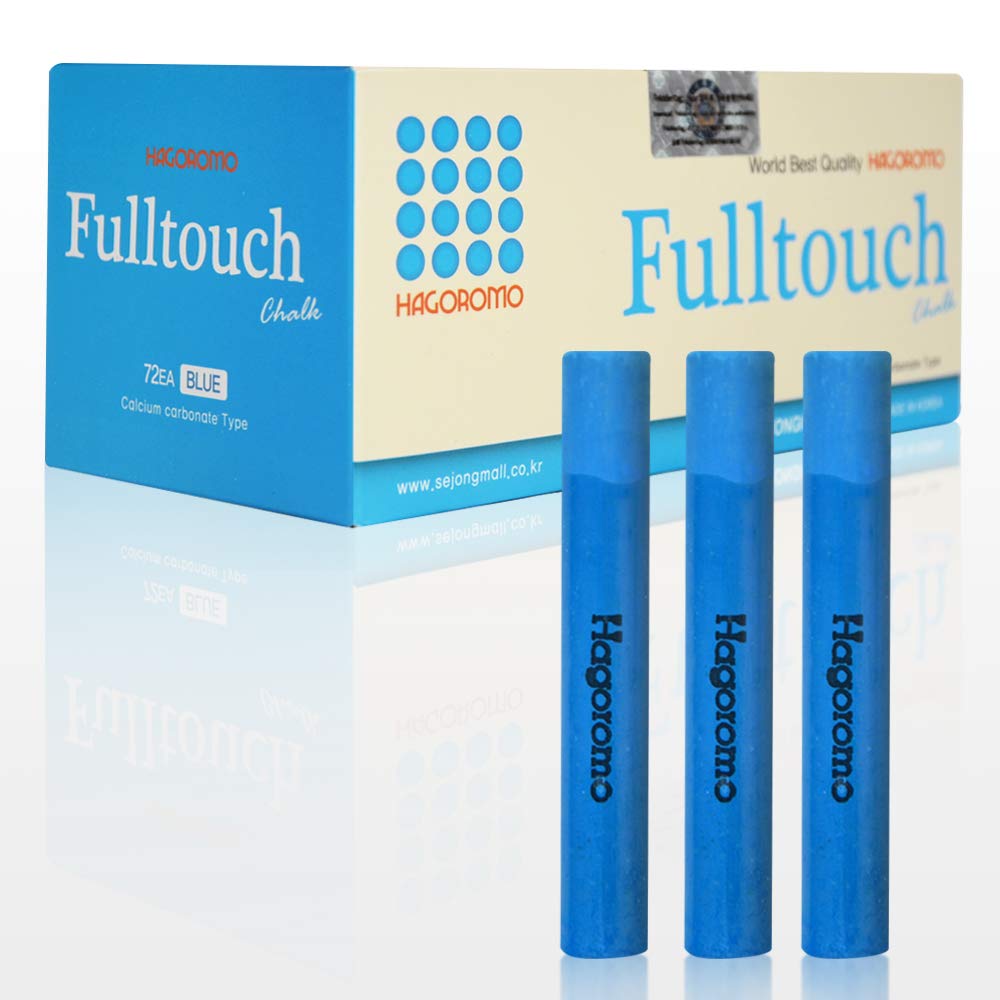
Hagoromo Fulltouch chalk has a reputation that precedes it, largely because the Japanese brand became a quiet favorite among mathematicians, teachers, and chalkboard enthusiasts before its availability outside Japan was ever guaranteed. This box of 72 blue pieces is part of that same line, and it is worth understanding what the product actually is before deciding whether it belongs in your classroom, lecture hall, or home office.
The first thing to note is the format. These are standard-diameter chalk sticks, not the thin, brittle pieces that snap under light pressure. Each stick is formulated to be denser than typical school chalk, which changes how it behaves on the board. The color is a saturated blue rather than a pale pastel, so it reads clearly against a dark green or black surface without requiring heavy pressure.
How it is actually used
Most buyers of a 72-piece box are not casual doodlers. This quantity suits classrooms, tutoring centers, university mathematics departments, and anyone who writes on a board for hours each week. The blue color is commonly chosen for diagrams, secondary annotations, or color-coded notes alongside white chalk, since it stands out without competing with the primary writing color. In practice, a single stick lasts through a substantial amount of writing, and the box is sized to keep a drawer or lectern stocked for a semester or more.
Functional characteristics
- Dense, low-dust formulation that produces less airborne powder than budget chalk
- Consistent color payoff with relatively little pressure
- Standard diameter that fits most chalk holders and trays
- Resists breakage better than thin or low-density chalk, though it is not unbreakable
- Cleans off boards with a standard eraser or damp cloth, though blue can leave faint residue if left on a board for extended periods
The low-dust behavior is the feature most people notice first. It does not eliminate dust, and anyone expecting a completely dust-free experience will be disappointed, but the reduction is meaningful in a room where a board is used continuously. The trade-off is that the chalk feels slightly harder in the hand than soft, crumbly school chalk, and some users find the feedback less satisfying for large, expressive writing.
Where it falls short
Price is the obvious limitation. A box of 72 imported sticks costs considerably more than a generic box of colored chalk from an office supply store, and the difference is difficult to justify for occasional use. The blue pigment also tends to linger on erasers and felt surfaces, so if you switch between colors frequently, you may want a dedicated eraser. And while the sticks are more durable than average, they will still break if dropped or pressed at an angle against a hard ledge. This is chalk, not a precision instrument.
Compared with alternatives
Against standard school-grade colored chalk, the Hagoromo product offers better density, cleaner writing, and less waste. Against dustless compressed chalk or liquid chalk markers, the comparison is less favorable on cleanliness but better on feel and board compatibility; markers suit glass and whiteboard surfaces, while this chalk is intended for traditional slate or porcelain boards. If your board is not a real chalkboard, this product is simply the wrong category.
Who it suits and who it does not
It is a reasonable purchase for teachers, lecturers, and frequent chalkboard users who want a reliable blue for diagrams and annotation, and who value reduced dust enough to pay a premium. It is also a sensible choice for mathematics and science instructors who write for long stretches and notice the difference between chalk that crumbles and chalk that holds together.
It is not suitable for someone who writes on a board once a month, for households with young children who go through chalk quickly, or for anyone using a whiteboard or glass surface. Those buyers will get more value from a cheaper generic box or a marker system. The 72-piece quantity also makes little sense for casual users, since the sticks will sit unused long before they wear out.
Overall, this is a well-made specialty chalk with a clear use case and a price that reflects its origin. It performs as expected for its category, with the main caveats being cost, pigment residue, and the fact that it is still chalk at the end of the day.