
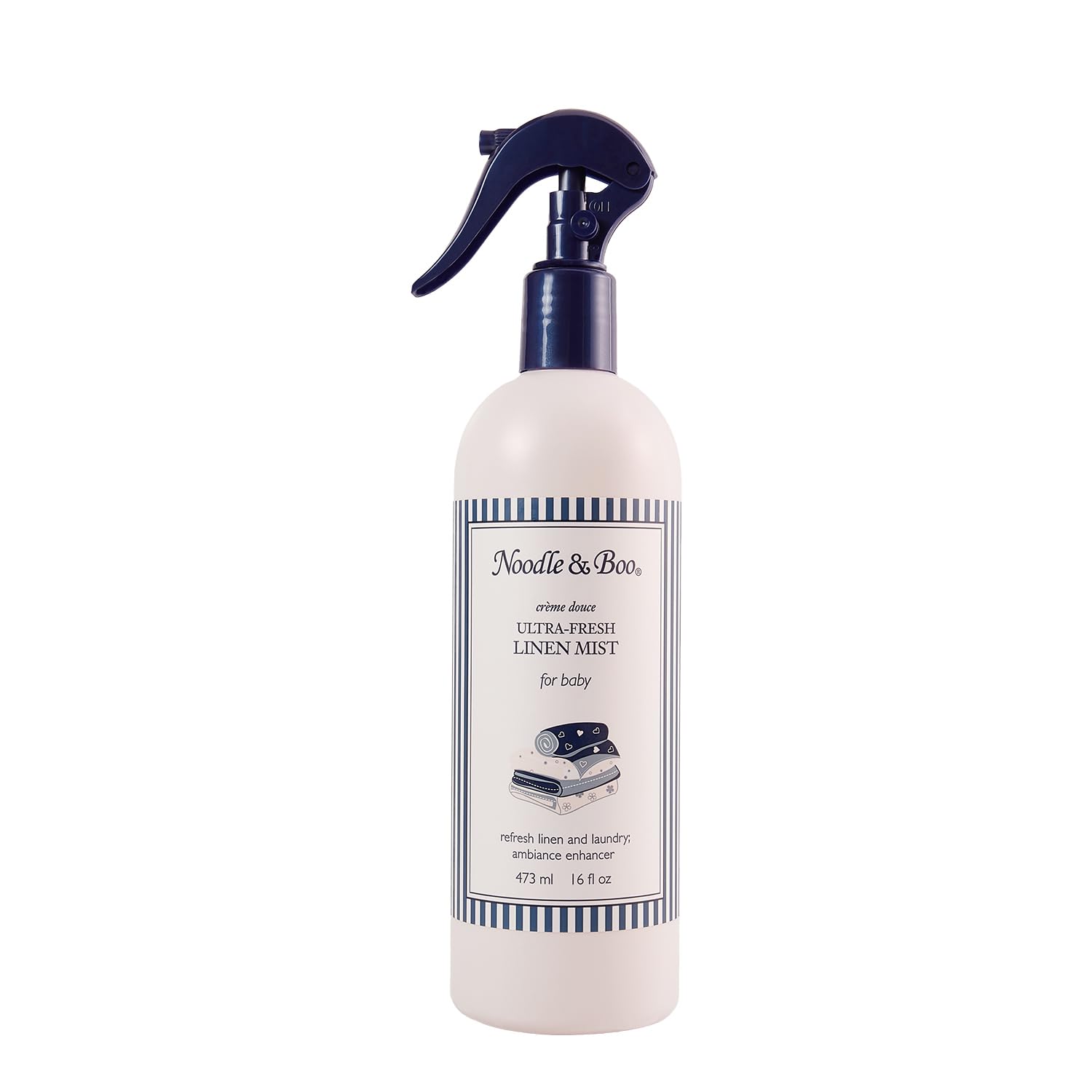
Noodle and Boo’s Ultra-Fresh Linen Mist sits in a crowded but often overlooked corner of the baby care market: the fabric refresher. It is marketed as part of the brand’s Baby Laundry Essentials line, which positions it alongside detergents and dryer products for households that want a consistent scent and a gentle formula on items that touch a baby’s skin. In practice, a product like this gets used in a few predictable ways — spritzing crib sheets between washes, freshening a car seat or stroller liner after a spit-up incident, or giving a quick pass over a lovey that cannot go in the wash every day. It is not a cleaning product, and it is not a substitute for laundering; it is a stopgap for odor and a way to reintroduce a familiar scent.
The functional story is straightforward. This is an aerosol-free pump spray, which means it relies on manual misting rather than a propellant. That matters for two reasons: the spray pattern tends to be a bit wetter and less uniform than an aerosol, and the bottle has to be held closer to the fabric to get an even application. The formula is positioned as a linen mist rather than a disinfectant, so expectations should be set around odor masking and light freshening, not sanitizing. Noodle and Boo generally builds its reputation on mild, low-irritation formulations, and the linen mist follows that pattern in its positioning — but “gentle” is a relative term, and fragrance is still fragrance. Parents who are strict about unscented products for newborns should treat this as a scented product, because that is what it is.
Where the mist earns its place is in the small, repetitive moments of baby care. A crib sheet that got a little damp overnight but is not due for a full wash, a pack-and-play that picked up a smell from a spilled bottle, a diaper bag that has absorbed the general aroma of daily use — these are the realistic targets. The scent is designed to match the rest of the Noodle and Boo laundry line, so households already using the detergent get continuity rather than a clash of fragrances. That consistency is arguably the strongest practical argument for buying it: it is a companion product, not a standalone one.
There are trade-offs worth naming. First, the wetness issue is real. A pump mist can leave fabric noticeably damp if you over-apply, and on items like a mattress cover or a thick stroller pad, that moisture takes time to dissipate. In a nursery, that means either waiting before putting a baby down or using a lighter hand than you might expect. Second, the scent, while not overpowering in small doses, accumulates. Spray the same crib sheet every day and the fragrance builds rather than fading cleanly. Third, cost per use is higher than most people assume; a bottle goes faster than a detergent because there is no dilution, and frequent reapplication is tempting.
Compared with the broader category of fabric refreshers — the mainstream drugstore sprays, the enzyme-based odor eliminators, and the unscented “just water and a little alcohol” options — this one sits in the middle. It is gentler in positioning than a generic aerosol freshener and more pleasant-smelling than an enzyme product, which often has a faintly medicinal note. But it is also less effective at true odor neutralization than enzyme-based options, which break down the compounds causing the smell rather than covering them. If the goal is eliminating a sour milk smell from a car seat, an enzyme spray will outperform a fragrance mist. If the goal is a light, familiar scent on bedding, this is the more appropriate tool.
It is well suited to parents who already use the Noodle and Boo laundry line and want a matching quick-fix spray for bedding, strollers, and soft goods that cannot be washed constantly. It also works for caregivers who prefer a pump spray over aerosols in a nursery setting. It is less suitable for households that keep infant items strictly fragrance-free, for anyone expecting disinfecting or deep-cleaning performance, and for people who want a single product to handle both freshening and odor elimination. Those shoppers are better served by an unscented enzyme spray or simply doing a faster wash cycle.
The honest summary is that this is a convenience product with a narrow but legitimate use case. It does not replace laundry, it does not sanitize, and it rewards restraint in application. Used sparingly on the right items, it fills a gap between washes without much fuss. Used as an all-purpose spray, it will disappoint — and it will run out quickly. Treat it as a small, scented finishing touch for baby textiles rather than a workhorse, and the expectations line up with what it actually delivers.