
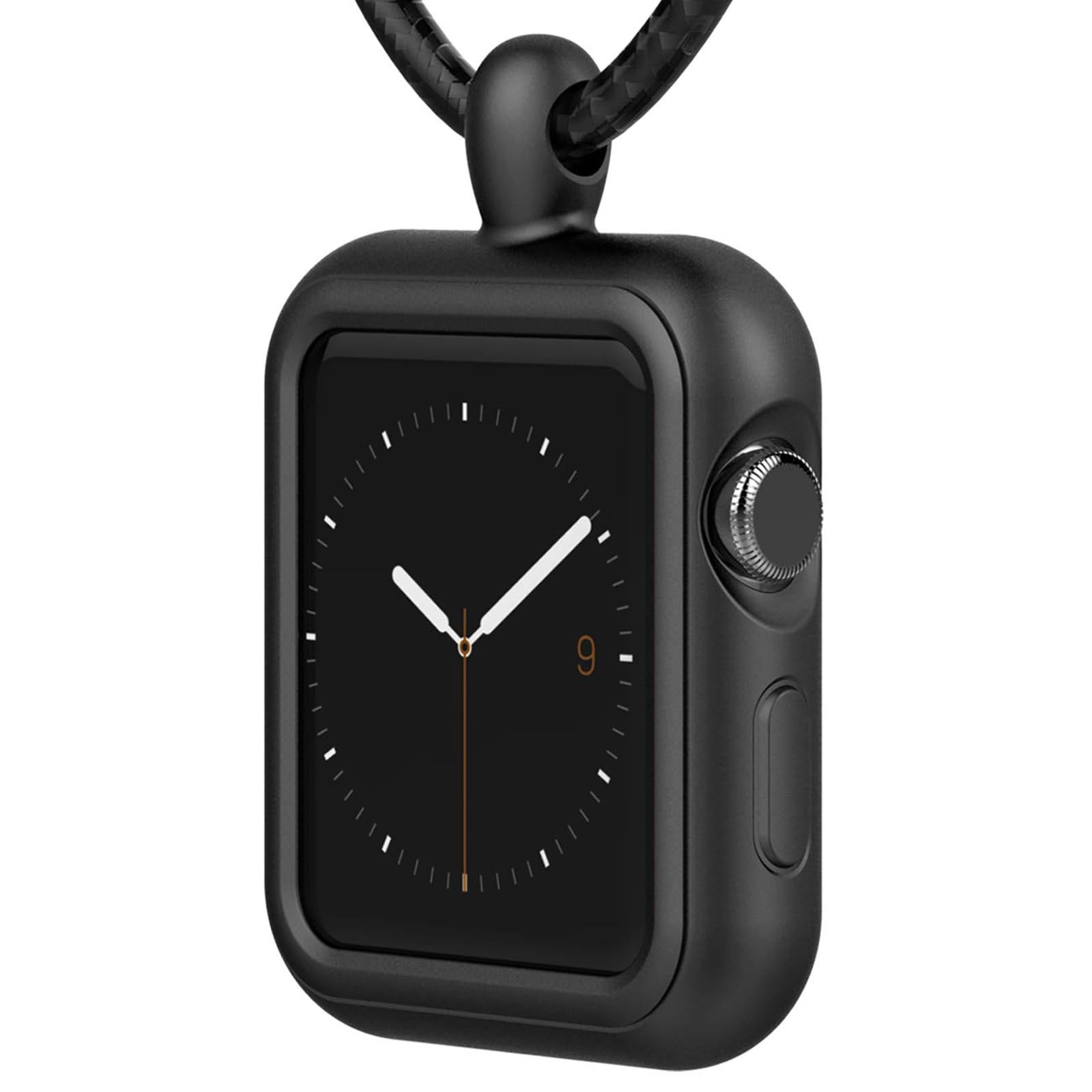
The HALLEAST necklace pendant case is one of those accessories that exists because someone asked a reasonable question: what if you want to wear an Apple Watch somewhere other than your wrist? The product is a silicone cover with an integrated pendant loop, sized to hold an Apple Watch body and hang from a chain or cord. It is a niche item, but the niche is real — nurses, chefs, gym-goers, and people who simply dislike the feel of a band all have reasons to move a watch off the wrist.
The core idea is straightforward. The silicone shell grips the watch case, and a loop at the top accepts a necklace. Because the watch face ends up resting against the chest rather than the wrist, the orientation changes: on a pendant, the screen faces outward and slightly upward, which is fine for glancing at notifications but awkward for anything requiring precise taps. That single physical fact shapes almost everything about how this case performs in daily use.
How it actually gets used
In practice, this is a situational accessory rather than an everyday one. The most common real-world scenario is work where wrist jewelry is impractical or against policy — clinical settings, food service, and some industrial environments. A second scenario is fitness: people who find wrist straps uncomfortable during certain activities, or who want the watch to stay clear of equipment. A third is simply fashion; some users prefer the pendant look and treat the watch as a piece of jewelry rather than a fitness device.
Setup is not complicated, but it is not instant either. The watch presses into the silicone cavity, and the fit depends on the model size the case was made for. Because Apple Watch bodies have changed dimensions across generations, buyers need to confirm compatibility rather than assume a universal fit. The silicone itself is soft and slightly grippy, which helps retention but also attracts lint and dust — expect to wipe it down periodically, especially if worn against skin under clothing.
- Material: Soft silicone shell with a molded pendant loop at the top.
- Mounting: Watch presses into a fitted cavity; no tools required.
- Wearing style: Designed for a chain or cord, sold separately in most cases.
- Screen access: The face remains exposed and usable, though tapping while hanging is less precise than on a wrist.
- Charging: The watch generally must be removed from the case to sit properly on a magnetic charger, depending on the case thickness.
Where it falls short
The biggest trade-off is sensor performance. Apple Watch health features — heart rate, blood oxygen, wrist detection — are designed around skin contact at the wrist. Hanging against the chest, the watch may lose consistent skin contact, which can affect auto-unlock, workout tracking, and passive health readings. This is not a flaw specific to HALLEAST; it is inherent to wearing a wristwatch anywhere else. Buyers should treat the pendant as a display and notification tool first, and a fitness tracker second.
There is also the matter of the necklace itself. The case does not typically include a chain, so the total cost and look depend on what you pair it with. A thin cord reads casual; a metal chain reads more like jewelry. Either way, a watch hanging from the neck swings, and swinging means the screen is not always where you expect it to be. Reading a notification often requires a hand to steady the pendant.
Durability is reasonable for silicone but not exceptional. The loop is the stress point, and repeated pulling over the head will eventually stretch or wear it. This is a consumable accessory, not a long-term investment, and it should be priced and treated accordingly.
How it compares
The obvious alternative is a wrist band — the standard sport band, a nylon loop, or a leather strap. Bands keep sensors in contact and keep the screen oriented predictably, which is why they remain the default. A second alternative is a pocket or clip-style holder, which keeps the watch accessible without a necklace but requires a pocket or belt. The pendant case sits between these: more wearable than a clip, less functional than a band. It solves a specific problem — keeping the watch on your person without using your wrist — and does so adequately, without pretending to be a full replacement.
Who it suits, and who it does not
It suits people whose jobs or hobbies make wrist wear impractical, users who want a jewelry-style option, and anyone who wants notifications available without a band. It does not suit athletes who rely on accurate heart-rate and workout data, users who need quick two-handed interaction with the screen, or anyone expecting a band-equivalent experience. If you need reliable health tracking, keep the watch on your wrist and treat this as an occasional alternative. If you mainly want the time, notifications, and a different look, the HALLEAST pendant case does the job without much fuss — as long as you accept that a necklace is a different tool, not a better one.