
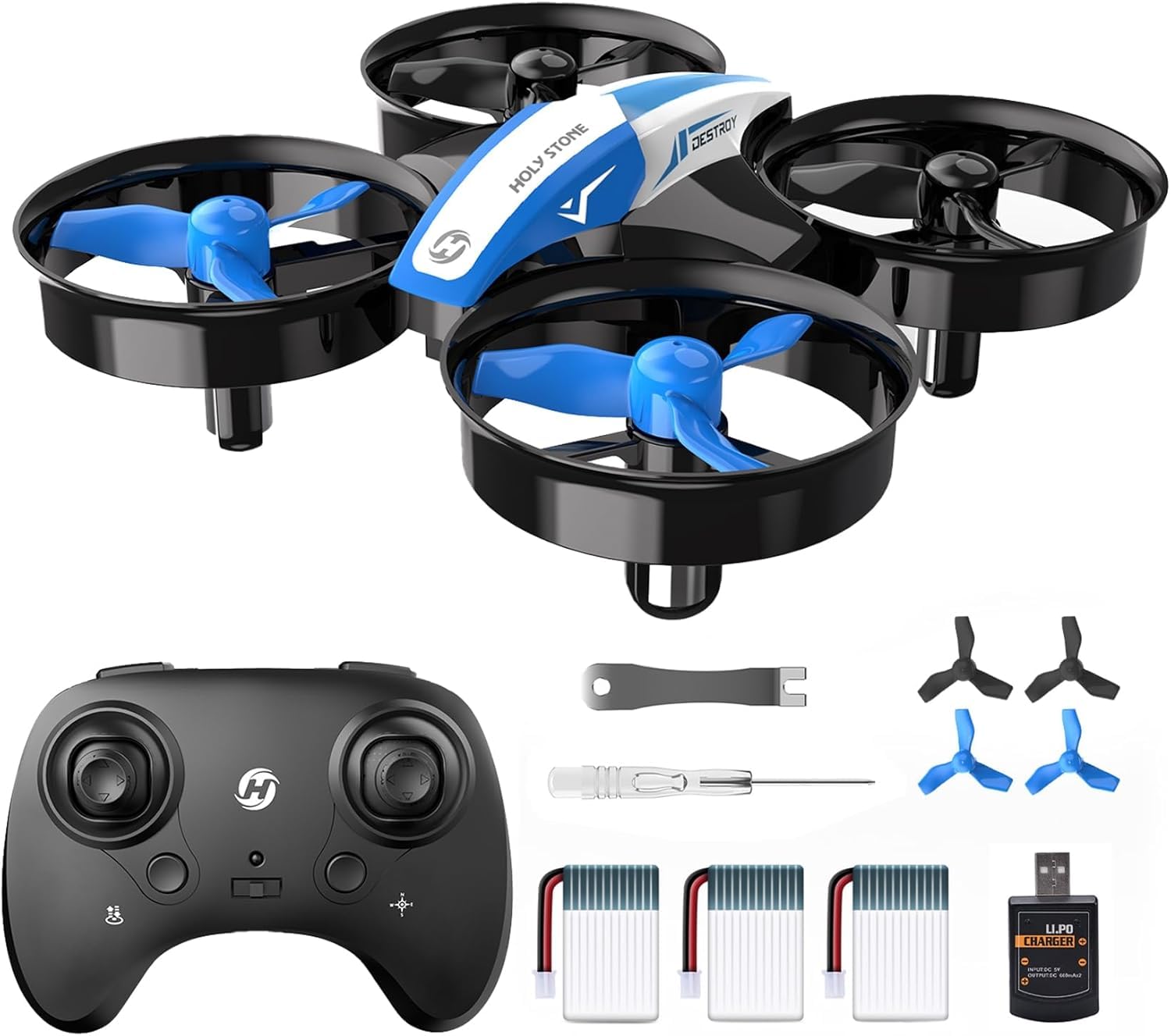
The Holy Stone HS210 is one of those tiny drones that shows up constantly in gift guides for kids, and it’s worth understanding what it actually is before buying one. This is a palm-sized nano quadcopter aimed at indoor flying, packaged with three batteries, propeller guards, and a set of beginner-friendly flight aids. It is not a camera drone, and it is not designed for outdoor wind. Judged on those terms, it’s a reasonable first aircraft for a child or an adult who has never touched a transmitter.
The core appeal is simplicity. The HS210 uses a basic controller with throttle and directional sticks, and it includes auto hovering, which holds altitude once you release the throttle. Headless mode is the other major aid: instead of controls being relative to the drone’s nose, forward always moves the drone away from the pilot. For a kid who keeps losing orientation when the quadcopter spins, that removes a lot of frustration. One-key return brings it back toward the controller, and the included 3D flip button performs a quick roll or flip when pressed. None of these are novel features, but they are the right ones for this price and audience.
In practice, the HS210 is a living-room or basement flyer. The propeller guards matter more than the spec sheet suggests, because beginners will bounce it off furniture and walls within the first few minutes. The drone is light enough that collisions are usually harmless to the aircraft, though it can knock over small objects. Flight time per battery is short, roughly in the five-to-seven-minute range in real conditions, which is typical for this class. Three batteries soften that considerably, giving a total of around 15 to 20 minutes with charging breaks in between. Charging is done through the controller or a USB cable depending on the version, and each pack takes a while to top up, so the batteries are best rotated rather than flown back to back.
Stability is decent for the size. Auto hovering keeps it at a roughly consistent height, though it drifts and requires small corrections, especially near air vents or open doorways. It is not a precise hold, and buyers should not expect the locked-in feel of a GPS drone. The 3D flips work but eat altitude, so they need a bit of room overhead. Headless mode is genuinely useful for children, but it can also mask bad habits; pilots who learn only in headless mode will struggle when they switch to a normal drone later. That’s a trade-off worth knowing about rather than a flaw in the product itself.
Where the HS210 falls short is in anything beyond casual indoor play. There is no camera, so it’s purely a flying toy rather than a photography tool. It handles almost no wind, meaning outdoor use is limited to calm days in a sheltered yard, and even then it can be blown around. The controller feels plasticky and the buttons are small, which is fine for kids but less comfortable for adult hands. Build quality is acceptable for the price but not rugged; the motors are exposed and hair or carpet fibers can wrap around the shafts, so occasional cleaning is necessary. Replacement props are cheap and worth having on hand.
Compared with camera-equipped beginner drones like the Holy Stone HS430 or similar budget models with Wi-Fi video, the HS210 gives up any imaging capability in exchange for lower cost and a simpler experience. Compared with toy-grade drones from generic brands, it offers slightly better documentation and a more consistent controller, though the gap is not enormous. It also sits in the same space as mini indoor helicopters, which are similarly limited but often harder to control. The HS210’s headless mode and altitude hold make it the friendlier option for a young first-time pilot.
Who it suits:
- Children roughly 8 and up who want a first drone and will fly indoors
- Adults curious about quadcopters who want a low-cost way to learn the sticks
- Buyers who want a gift that works out of the box without a phone app
Who should look elsewhere:
- Anyone wanting photos or video
- Pilots who plan to fly outdoors regularly or in windy conditions
- Buyers expecting long flight times or precise hovering
- Experienced hobbyists, who will find it underpowered and limited
Overall, the HS210 is a competent entry-level indoor drone with realistic limits. It does a few things well, asks for very little setup, and is priced accordingly. As long as expectations stay in the living-room category, it’s a sensible first step into the hobby rather than a long-term aircraft.