
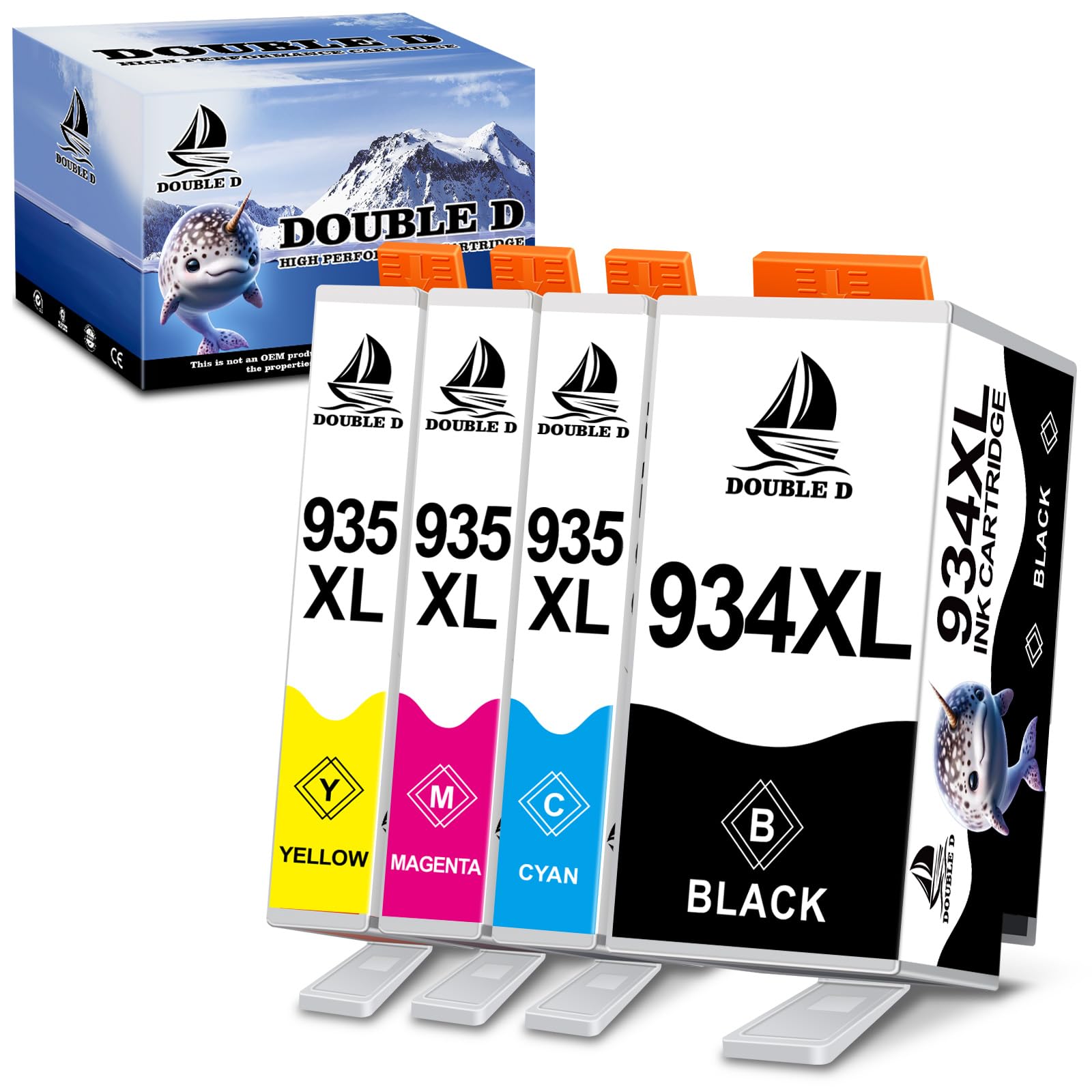
If you own an HP OfficeJet Pro 6830, 6230, or one of the other models in that family, you know the sting of replacing ink. Original HP 934XL and 935XL cartridges are not cheap, and for anyone printing regularly, the cost adds up quickly. The Double D 934 and 935 compatible cartridges offer an alternative: a four-pack with one black, one cyan, one magenta, and one yellow cartridge, positioned as high-yield replacements. This review looks at what you get, how they perform in typical use, and where they fall short.
What you get and how it works
The package includes four cartridges: black (934XL equivalent) and the three colors (935XL equivalents). Installation is straightforward—they snap into the same slots as the originals. The cartridges are not remanufactured; they are new-built compatible units, which some users prefer over refilled options. Each cartridge has a chip that communicates with the printer, and in most cases, the printer recognizes them without issue. However, as with many third-party cartridges, you might see a warning message about non-HP ink. You can dismiss it and continue printing; it does not prevent operation.
Yield claims are in line with the XL designation: the black cartridge is rated for around 900 pages and each color for roughly 800 pages, based on 5% coverage. Real-world mileage will vary depending on what you print—photos and graphics will drain the color cartridges faster. For a small office or home office printing a mix of documents and occasional color pages, the set should last a reasonable amount of time.
Performance in real-world use
In typical office scenarios—printing contracts, invoices, email attachments, and the occasional presentation with charts—the Double D cartridges perform adequately. Black text is sharp and legible, comparable to original HP ink in everyday documents. Color output is where third-party cartridges often stumble, and these are no exception: colors are slightly less vibrant and can appear a bit muted next to originals. For internal documents or school projects, that is usually fine. For client-facing marketing materials or photo prints, the difference might be noticeable. Skin tones in photos, for example, may look slightly off.
Reliability is another consideration. Compatible cartridges sometimes suffer from clogs or inconsistent flow, especially if the printer sits idle for weeks. During testing, the Double D set worked without clogs over a month of intermittent use, but long-term reliability is harder to predict. Some users report that third-party cartridges can trigger false low-ink warnings or fail to show accurate levels. That is a common trade-off in this category.
Where it falls short
The most obvious limitation is the risk of variability. Unlike original HP cartridges, which are manufactured to strict tolerances, compatible cartridges can vary from batch to batch. You might get a perfect set, or you might get one that leaks or fails early. Double D offers a warranty, but the hassle of dealing with a defective cartridge is real. Also, using third-party ink can, in some cases, affect your printer’s warranty—though in the US, the Magnuson-Moss Warranty Act protects you if the third-party product didn’t cause the damage. Still, some printer manufacturers may try to deny coverage, so it’s worth knowing your rights.
Another trade-off is print quality for photos. If you regularly print high-resolution images, the color accuracy and fade resistance of these cartridges may not match OEM ink. For documents, the difference is negligible.
How it compares to alternatives
Compared to original HP 934XL/935XL cartridges, the Double D set is significantly cheaper per page. A full set of OEM cartridges can cost upwards of $100, while this compatible set typically sells for half that or less. The trade-off is potential inconsistency and slightly lower color quality. If you print mostly black-and-white documents, the savings are substantial. If you need guaranteed performance for important color work, OEM is safer.
Compared to refill kits or remanufactured cartridges, the Double D set is more convenient—no messy refilling—and often more reliable than remanufactured units, which may have worn components. However, remanufactured cartridges can be even cheaper, though with higher risk.
Who should consider it
This set makes sense for home offices, small businesses, or students who print a moderate volume of documents and want to cut ink costs. It’s also a reasonable choice for anyone who needs a spare set on hand for occasional color printing without investing in OEM prices. If you print mostly text, the black cartridge alone could justify the purchase.
It is not suitable for professional photographers, graphic designers, or anyone who relies on precise color reproduction. Nor is it ideal for high-volume printing where reliability is critical—a failed cartridge mid-job could be costly. Those users should stick with OEM or consider a printer with lower ink costs, like an EcoTank model.
Final thoughts
The Double D 934/935 compatible cartridges are a pragmatic choice for budget-conscious users who prioritize cost over absolute print quality. They work, they’re cheap, and for everyday printing, they get the job done. Just go in with realistic expectations: you’re trading a bit of color accuracy and long-term reliability for significant savings. If that trade-off aligns with your needs, this set is worth considering.