
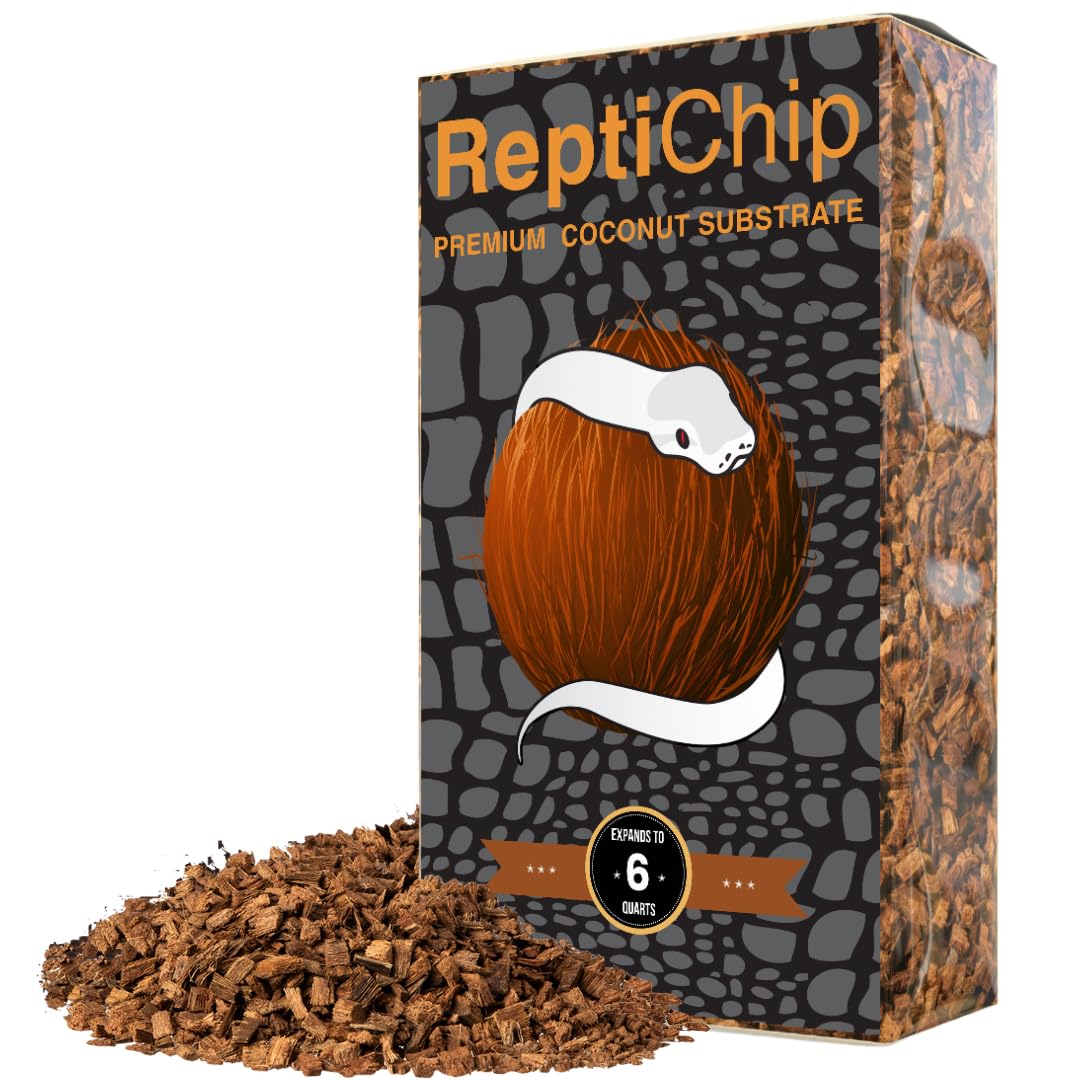
ReptiChip’s loose coconut chip bedding is a straightforward substrate option for keepers who want something that holds humidity without turning into a soggy mess. Sold in a 6-quart bag, it’s aimed at snake habitats, ball python terrariums, turtle tanks, and tortoise enclosures, though its behavior varies quite a bit depending on which of those animals you’re housing on it.
The product is made from coconut husk chips rather than the finer coir fiber many people associate with coconut bedding. That distinction matters. These are chunkier pieces, roughly the texture of coarse bark mulch, which changes how the substrate drains, holds moisture, and resists compaction. In practice, most keepers use it as a humidity-retaining layer in tropical and semi-tropical setups, often mixed with sphagnum moss or layered over a drainage base.
What it actually does well
- Holds moisture for extended periods without becoming waterlogged at the surface, which suits ball pythons and other species needing 60–80% humidity
- The chunky texture allows burrowing to a limited degree and gives snakes something to push against when shedding
- Resists matting and compaction better than fine coir or peat, so it stays loose longer between changes
- Works as a spot-cleanable substrate; solid waste and urates can be scooped out without replacing the whole bag
- Reasonably absorbent for a chip product, though not as absorbent as paper or fine coir
In a ball python enclosure, the typical approach is a 2–3 inch layer, lightly misted and turned periodically. The chips hold that moisture reasonably well and release it gradually, which is the main reason people choose coconut husk over aspen or cypress in the first place. Aspen is drier and molds more readily when wet; cypress mulch holds humidity but is heavier and often sold in larger, coarser bags. Coconut chip sits somewhere in between, leaning toward the cypress side on moisture retention while staying lighter and easier to handle.
Where it falls short
The biggest trade-off is that loose coconut chip is not a great fit for every animal listed on the label. It’s frequently marketed toward turtle tanks, but fully aquatic or semi-aquatic turtles need water, not substrate, and this product makes little sense in that context except perhaps as a land area in a paludarium. For tortoises, the chips are workable but not ideal for species that need to dig deep burrows, since the pieces don’t pack into stable tunnels the way soil or sand mixes do. A tortoise can push through it, but it won’t hold a burrow wall.
There’s also the matter of ingestion risk and impaction concerns with some reptiles, particularly younger or more enthusiastic feeders that strike at prey near the substrate. Chips are large enough that most snakes won’t accidentally swallow them, but feeding on a flat dish or outside the enclosure is a sensible precaution. Keepers of small lizards or hatchlings may find the pieces too coarse and better served by finer coir.
Bag size is another practical consideration. Six quarts sounds like a fair amount until you spread it two inches deep in a 4-foot enclosure, at which point you’ll likely need two or three bags for a single full change. For a small juvenile setup, one bag goes a long way; for adult ball pythons or medium tortoises, expect to buy in multiples.
Who it suits and who it doesn’t
This substrate is a reasonable choice for intermediate keepers running tropical or semi-tropical snake setups, especially ball pythons, corn snakes, and similar species where humidity control matters. It’s also a decent option for bioactive-style enclosures when mixed with soil and a cleanup crew. It’s less suitable for desert species that need dry conditions, for aquatic turtles, for keepers who want a fine, uniform substrate for hatchlings, or for anyone hoping to build deep, stable burrows for digging tortoises. First-time reptile owners may also find the loose chip format fussier than a simple paper towel or mat setup during quarantine.
Overall, ReptiChip’s coconut chip bedding does what it claims without much fuss. It’s not a premium or specialized substrate, and the marketing oversells its fit for turtles, but as a humidity-friendly chip bedding for snakes and some tortoises, it earns its place in the rotation. Buy it with realistic expectations about coverage per bag and species suitability, and it’s a serviceable, if unremarkable, option.