
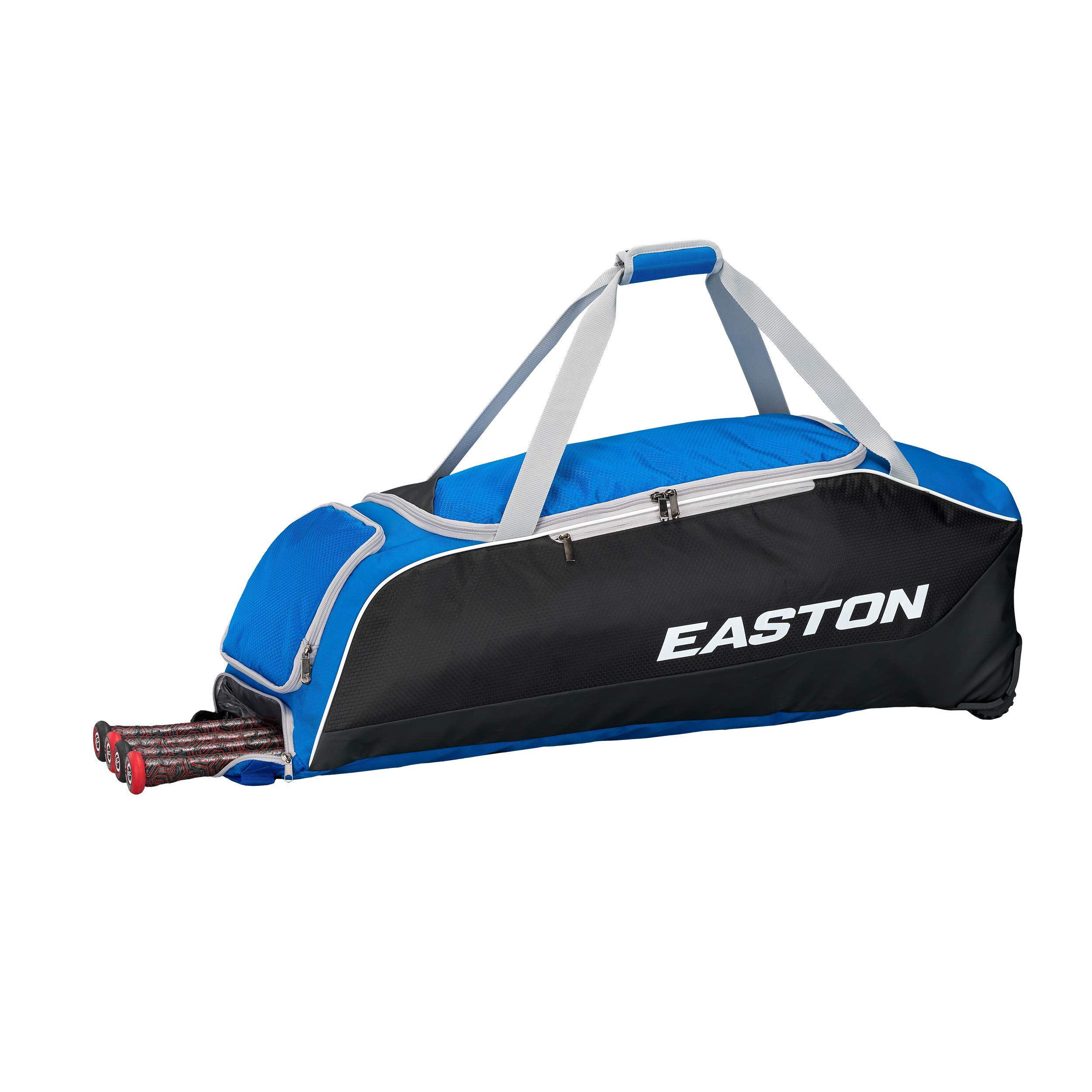
The Easton Octane wheeled bag is the kind of gear hauler that makes sense for players who are tired of juggling multiple bags or lugging a duffel over their shoulder every weekend. It’s designed to swallow a full set of baseball or softball equipment—bats, helmet, gloves, cleats, and then some—and roll it all on wheels. In real-world use, that means fewer trips from the car to the dugout, and less strain on your shoulders and back over a long season. But like any wheeled bag, it comes with trade-offs in bulk and maneuverability that are worth understanding before you commit.
From an editorial standpoint, the Octane sits in the middle of Easton’s bag lineup: more spacious than a simple bat pack, but not as feature-heavy as some of the brand’s premium rolling bags. It’s aimed at youth and adult recreational players who want a straightforward, durable transport solution without paying for extras they won’t use. The royal blue colorway is standard Easton fare—visible without being flashy—and the overall construction feels consistent with what you’d expect at this price point.
In terms of functional features, the bag is built around a large main compartment that can hold a helmet, fielding gloves, and a few layers of clothing. There’s a dedicated bat sleeve section that typically accommodates two to four bats, depending on barrel size, and it’s separated from the main compartment to keep things organized. Exterior pockets provide space for cleats (often ventilated) and personal items like keys, phone, or sunscreen. The wheeled base uses inline-style wheels and a telescoping handle, which is standard for this category. The fabric is a durable polyester or nylon blend, and the zippers are heavy-duty enough for regular use. None of this is revolutionary, but it’s executed competently.
Where the Octane makes the most sense is in the trunk-to-dugout shuffle. If you’re a travel ball parent or an adult league player who drives to games and needs to move a lot of gear efficiently, the wheels and handle reduce fatigue. The bag rolls well on smooth surfaces like concrete or turf, and the telescoping handle extends to a comfortable height for most users. The bat sleeves are easy to access without opening the main compartment, which is a small but meaningful convenience during games when you need to swap bats quickly.
However, the bag’s size becomes a limitation in certain situations. It’s bulky—not something you’d want to carry up a narrow staircase or stuff into an already packed car. The wheels, while helpful on pavement, are not designed for rough terrain; rolling it across gravel or grass can be frustrating, and the bag may tip if not balanced properly. Also, the wheeled base adds weight even when empty, so if you frequently need to carry the bag rather than roll it, you’ll feel that extra heft. The telescoping handle, while functional, is not the most robust we’ve seen—it has some wobble when fully extended, which is common in this price range but still worth noting.
Compared to a traditional player backpack or duffel, the Octane offers significantly more capacity and easier transport on flat surfaces. A backpack is more agile for quick trips or when you have to walk a distance, but it can’t match the Octane’s volume or the convenience of wheels. On the other hand, if you’re looking for a bag that can double as a carry-on for tournaments, a soft-sided duffel might be more versatile. The Octane is purpose-built for field sports, and it doesn’t pretend to be anything else.
In terms of who should consider it: this bag is well-suited for youth players (roughly 10 and up) who have accumulated enough gear to warrant a larger bag, and for adults in recreational or travel leagues who want a no-frills rolling option. It’s also a reasonable choice for coaches or team parents who need to haul extra equipment. It is not ideal for players who travel light—if you only carry a bat, glove, and cleats, a smaller backpack will be less cumbersome. Nor is it the best choice for those who frequently play on fields with unpaved parking or long gravel paths; in those cases, a sturdy duffel with a shoulder strap might be more practical.
Performance expectations should be realistic: the Octane is not a heavy-duty tournament bag that will survive years of abuse. The materials are decent, but seams and zippers may show wear after a couple of seasons of regular use, especially if the bag is overstuffed. The wheels are replaceable on some models, but not all, so check the specific version. It’s also not waterproof, so in wet conditions, contents can get damp unless you use a rain cover or plastic bags inside.
Overall, the Easton Octane wheeled bag is a sensible, mid-range solution for players who need to move a lot of gear with less effort. It’s not without flaws—bulk, weight, and limited off-road capability—but for the typical commute from car to dugout, it does its job without fanfare. If you’re in the market for a basic rolling bag and understand its limitations, it’s worth a look. Just don’t expect it to replace a rugged equipment cart or a compact backpack for every scenario.