
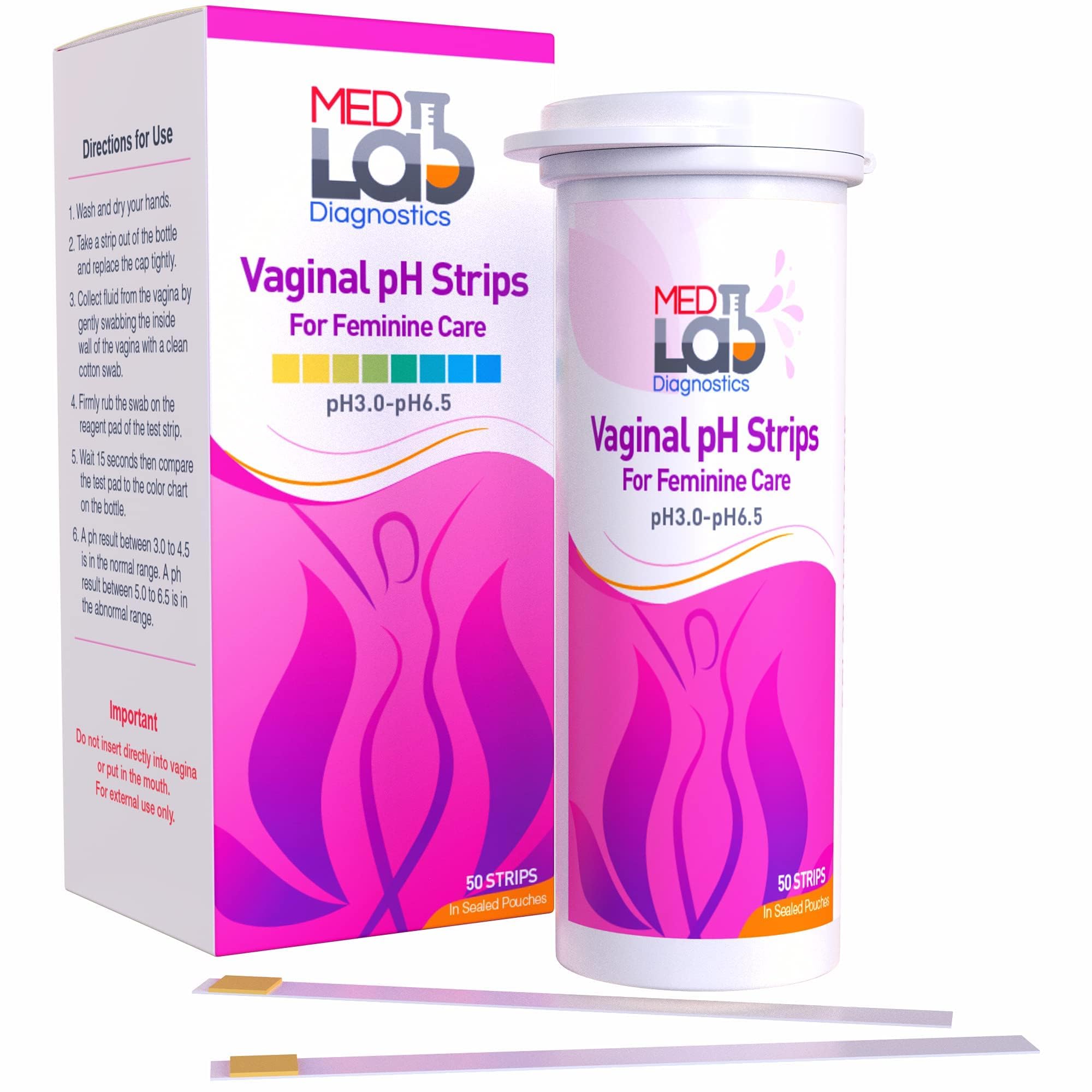
Vaginal pH test strips are a niche but increasingly popular tool for women who want to monitor their intimate health between doctor visits. The Med Lab 50 Vaginal pH Test Strips for Women offer a pH range of 3.5 to 6.5, which covers the typical acidic environment of a healthy vagina (around 3.8–4.5) and extends into the less acidic range that may indicate an imbalance. This review examines how these strips perform in real-world use, what they can and cannot tell you, and who might benefit from keeping a pack in the bathroom cabinet.
Unlike general-purpose pH strips, these are designed specifically for vaginal use, which means the color chart is tailored to the narrower range relevant to vaginal health. Each strip is individually wrapped, and the pack includes 50 strips, making it suitable for occasional testing over several months. The strips are read by comparing the color change to a chart provided on the packaging. The chart is printed on the box and also on a small card inside, which is convenient for storage.
In practice, using the strips is straightforward: you collect a sample of vaginal fluid on a swab or finger, apply it to the strip, and wait for the color to develop (usually about 10–15 seconds). The instructions recommend testing at least two hours after intercourse, douching, or using any vaginal products, as these can temporarily alter pH. The strips are sensitive enough to distinguish between pH 4.0 and 4.5, which is useful because the threshold for bacterial vaginosis is often cited as pH >4.5. However, the color differences between adjacent pH values are subtle, and reading them under poor lighting can lead to misinterpretation. The manufacturer includes a color chart with distinct blocks, but in our testing, the difference between 4.0 and 4.5 was not always obvious, especially for users with color vision deficiencies.
One of the key limitations of any pH strip is that they provide a single data point. Vaginal pH can fluctuate throughout the menstrual cycle, and a single reading outside the normal range does not necessarily indicate an infection. For example, pH can rise temporarily after menstruation or intercourse. The Med Lab strips are best used to track trends over time rather than to self-diagnose. Additionally, the strips do not detect specific infections like yeast (which typically does not raise pH) or sexually transmitted infections. They are a screening tool, not a diagnostic test.
Compared to traditional pH paper used in laboratory settings, these strips are more convenient for home use because of the vaginal-specific range and the individual wrapping that protects them from moisture. However, they are more expensive per test than a roll of universal pH paper, and the latter might be adequate for general monitoring if you are comfortable interpreting a broader range. Another alternative is a reusable pH meter, which can be more precise but requires calibration and proper cleaning, and is significantly more costly. For most women, the Med Lab strips strike a reasonable balance between convenience and accuracy, provided they are used correctly.
The packaging is discreet, and the strips are small enough to be stored without taking up much space. The expiration date is printed on the box, and the strips should be kept dry; the individual wrappers help with this, but once opened, the strip should be used immediately. We found that the strips sometimes gave slightly different readings when the same sample was tested twice, suggesting some variability in manufacturing or reading interpretation. This is not unusual for visual pH strips, but it means that a single borderline result should not be over-interpreted.
Who are these strips for? They are suitable for women who have recurrent vaginal infections or imbalances and want to track pH as part of a broader management plan, ideally in consultation with a healthcare provider. They can also be useful for women who are curious about their baseline pH and want to understand how lifestyle factors (such as diet, stress, or menstrual cycle) affect it. However, they are not suitable for women seeking a definitive diagnosis or for those who are pregnant or have underlying health conditions without medical advice. They are also not a substitute for professional care if symptoms such as itching, odor, or discharge are present.
In summary, the Med Lab 50 Vaginal pH Test Strips are a practical tool for at-home monitoring, with a range that is relevant to vaginal health. They are easy to use and come in a generous quantity, but the subjective color reading and the limitations of pH as a sole indicator of health mean they should be used with realistic expectations. For women who understand these constraints, they can be a useful addition to their health toolkit.