
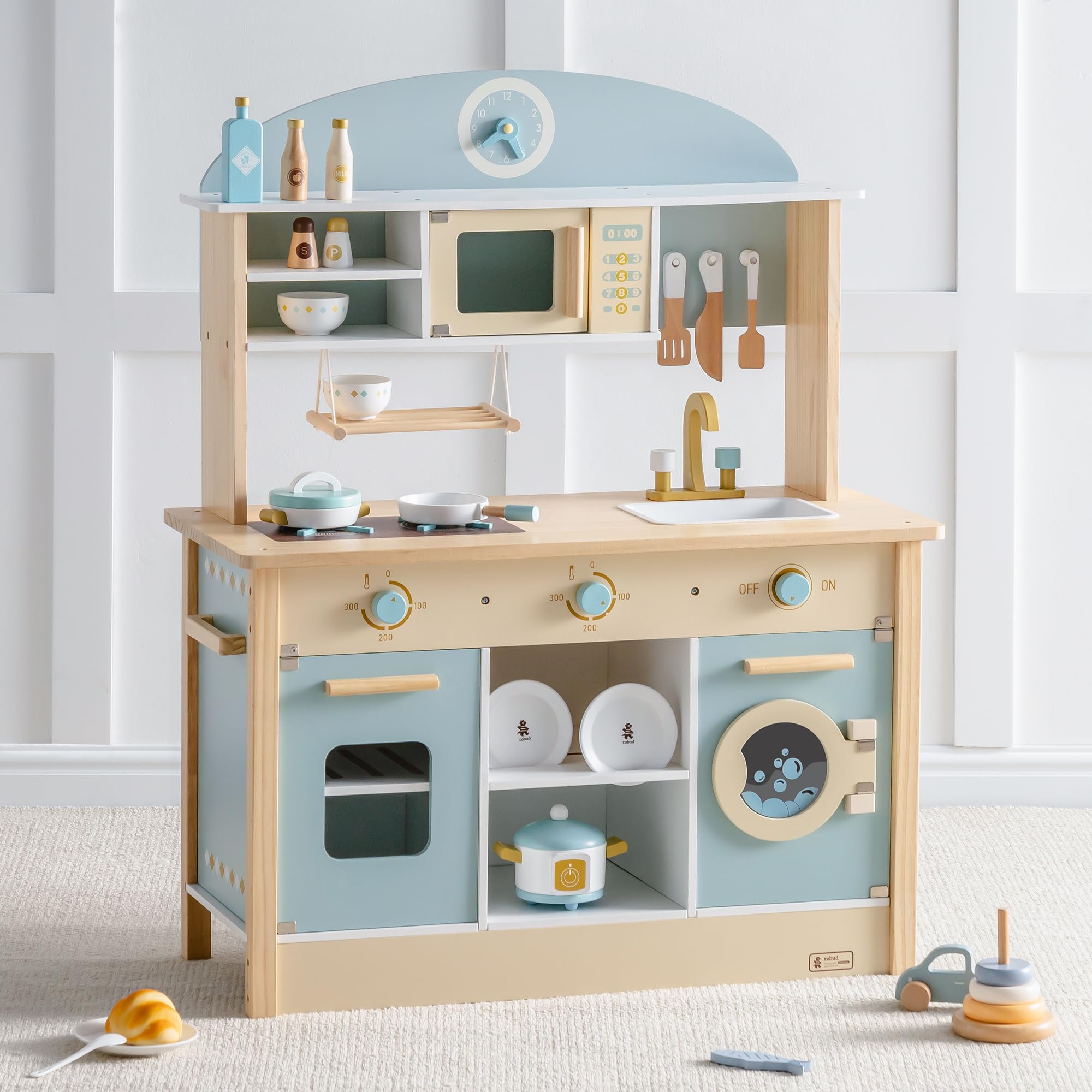
Play kitchens occupy an odd spot in the toy market. Some are sprawling plastic installations that dominate a room; others are so small they barely hold a child’s attention. The ROBUD Wooden Play Kitchen sits somewhere in the middle, aimed at parents who want a wooden alternative to the usual plastic options without committing half a playroom to the cause. It is a pretend kitchen built around a compact footprint, and how well that works depends heavily on the age of the child and the space available.
In practice, this set tends to end up in a bedroom corner, a playroom nook, or beside a living room wall where it can be seen but not tripped over. Toddlers generally use it the way they use any play kitchen: opening and closing doors, stacking pots, pretending to cook, and narrating the whole process out loud. The wooden construction gives it a sturdier feel than many plastic sets, and the muted, natural finish tends to blend into a home better than brightly colored alternatives. Parents who have spent time with plastic kitchens will notice the difference in weight and stability almost immediately.
The functional setup is fairly conventional for the category. There is a cooktop area, typically with printed or painted burner details, a sink, and cabinet or oven space for storing play food and utensils. Doors and drawers open and close, which is the part younger children tend to fixate on. The set is designed for pretend play rather than actual function, so there is no running water or real heat, and the accessories that come with it are limited. Buyers should expect to add their own play food, pots, and utensils to get much variety out of it.
One of the more noticeable trade-offs is size. The compact design is a strength in small homes, but it also means the counter space is limited and the storage is shallow. A child who wants to line up a dozen play ingredients will run out of room quickly, and larger play pots may not fit comfortably in the cabinets. It is also worth being realistic about assembly: like most flat-packed wooden furniture, it arrives in pieces and takes some time and patience to put together. The hardware and instructions are generally adequate, but this is not a five-minute setup.
Durability is where wooden sets like this tend to justify their price. The ROBUD is not indestructible, and painted edges can show wear over time, especially if children are rough with the doors or use the counter as a step. But the core structure holds up better than lightweight plastic, which tends to crack or wobble after a few months of enthusiastic play. Expect normal cosmetic wear rather than structural failure, provided it is assembled correctly and not used as climbing equipment.
Compared with larger play kitchens, including the elaborate plastic models with lights and sounds, this set is deliberately low-tech. There are no batteries, no electronic burners, and no sound effects. Some children will miss the bells and whistles; others will not care, because pretend play tends to fill in those gaps on its own. Compared with other wooden kitchens, the ROBUD is on the smaller and simpler end, which makes it a reasonable entry point for a first kitchen but less appealing for an older child who wants more counter space and storage.
Age suitability matters here. It works best for roughly two- to four-year-olds who are just getting into pretend play and do not need a lot of room to spread out. Children closer to five or six may find it limiting, especially if they have played with larger sets at a friend’s house or daycare. It is also not a good fit for households without floor space to spare, or for parents who want an all-in-one kit with a full set of accessories included. Those buyers are better off looking at larger bundled sets, even if they cost more.
The set suits parents who want a wooden, understated toy that does not take over a room, and who are comfortable buying accessories separately. It is less suitable for families who want maximum play value out of the box or who have children already accustomed to bigger, feature-heavy kitchens. Treated as a compact first kitchen rather than a centerpiece, it does its job without much fuss, though it is unlikely to be the toy a child grows with for years.