
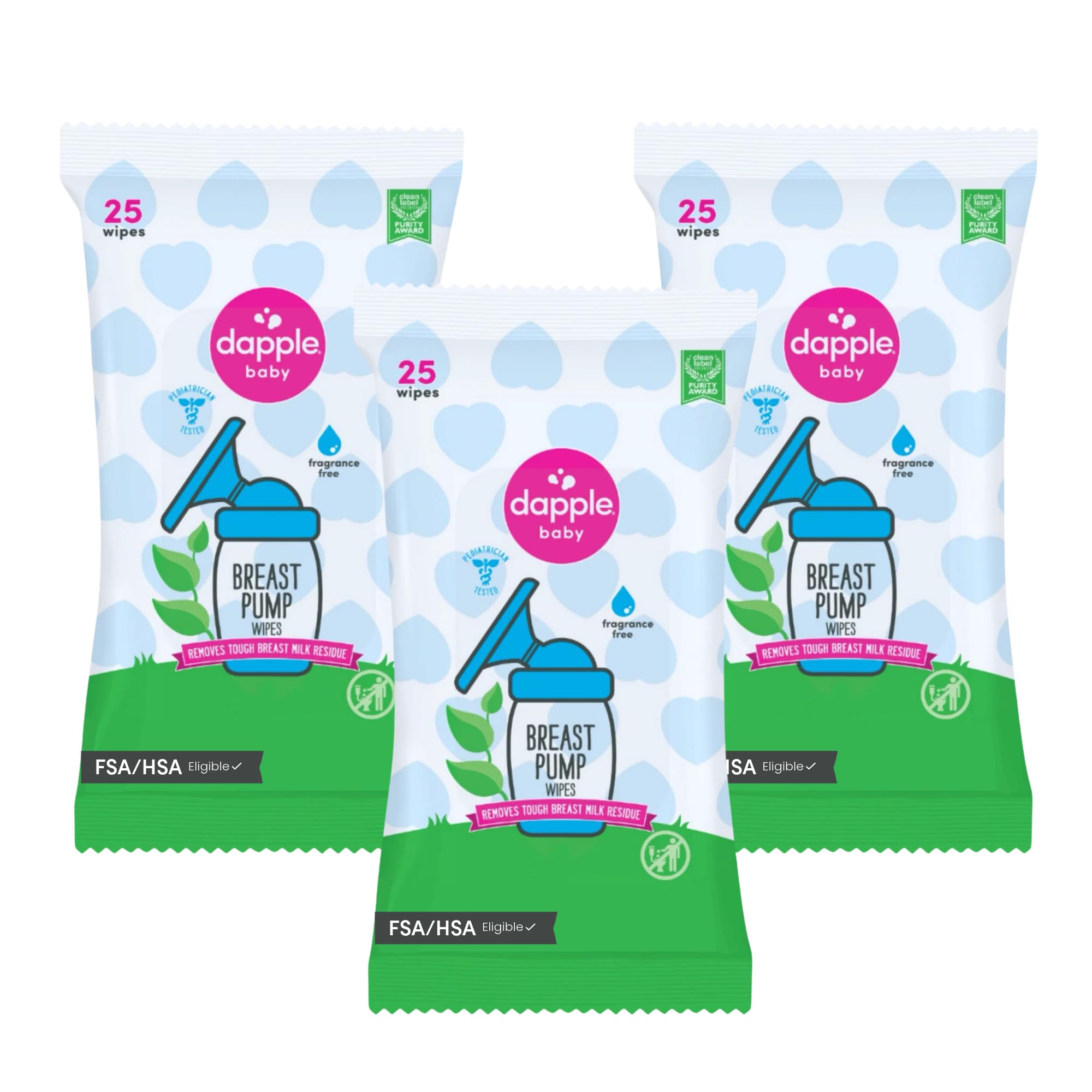
Breast pump wipes occupy an odd middle ground in the world of baby gear. They are not a cleaning solution for bottles at the sink, and they are not a sanitizing system. They are a stopgap for the moments when a pump session ends and there is no sink, no drying rack, and no time. Dapple Baby’s version, sold here in a three-pack of 25-count pouches, is aimed squarely at that scenario. Whether it earns its place in a diaper bag depends on what you expect it to do.
The premise is straightforward. Each wipe is pre-moistened and intended for wiping down pump parts—flanges, breast shields, collection bottles—between uses when washing is impractical. The three-pack format matters more than it might seem: one pouch for the diaper bag, one for the car or office, one for the pump bag itself. At 25 wipes per pouch, that is 75 total, which is a reasonable buffer for occasional use but not an indefinite supply.
In practice, these get used in parked cars, office lactation rooms, airport bathrooms, and hotel rooms. The typical routine is to disconnect the pump, wipe down the surfaces that touched milk, and let the parts air-dry before the next session. The wipes are textured enough to feel like they are doing something, and they are individually dispensable from a resealable pouch, which keeps the rest from drying out. That resealability is a small detail that becomes important if a pouch sits in a bag for weeks between uses.
On ingredients, Dapple positions these as free of harsh chemicals, and the wipe solution is generally described as gentle enough for parts that will contact milk again. That said, the product is a wipe, not a sterilizer. It does not replace a proper wash with soap and hot water, and it does not kill bacteria the way a steam bag or boiling water does. Parents who treat it as a full cleaning substitute are likely to be disappointed, and manufacturers of pump parts generally still recommend regular washing. The honest framing is that these reduce the inconvenience of a mid-day session, not that they eliminate the need for real cleaning.
One trade-off worth naming is residue. Any pre-moistened wipe leaves something behind, and some users report a faint film on parts if they do not allow them to dry fully before the next pump. That is not unique to Dapple—it is a characteristic of the category—but it is a reason to keep a clean cloth or paper towel on hand for a quick dry. The wipes also run out faster than expected if you use several per session, which is common when wiping a full flange and bottle set. A 25-count pouch may last a week or two for a frequent pumper, not a month.
Compared with the alternative approaches, the positioning becomes clearer. A pack of pump wipes sits between two other options: the refrigerator trick (storing parts cold between sessions, which many parents find logistically awkward) and a full wash-and-sanitize routine (thorough but slow). Wipes are faster than washing and more portable than either. They are also more expensive per use than soap and water, which is the real cost of convenience here. Parents who pump primarily at home may find a dedicated wash basin and drying rack more economical; those who pump on the go are the natural audience.
Who is this for? Parents who pump away from home regularly—at work, in a car, while traveling—will get the most value. It is also useful for a partner or caregiver handling a middle-of-the-night bottle feed when the sink is not an option. Who is it not for? Anyone expecting a sanitizing solution, parents who prefer to minimize disposable products, and households that already have a comfortable wash routine at every pumping location. It is also not a substitute for cleaning a pump that has been sitting dirty for a full day.
The three-pack is a sensible way to buy if you want to scatter pouches across bags, though it is worth checking whether a single pouch would be enough before committing to 75 wipes. For occasional pumpers, a single pack may be the better test. For frequent travelers, the multi-pack reduces the chance of running out mid-trip. Either way, the product does what it claims within its limits—it is a convenience tool, not a cleaning system, and it works best when that distinction is kept in mind.