
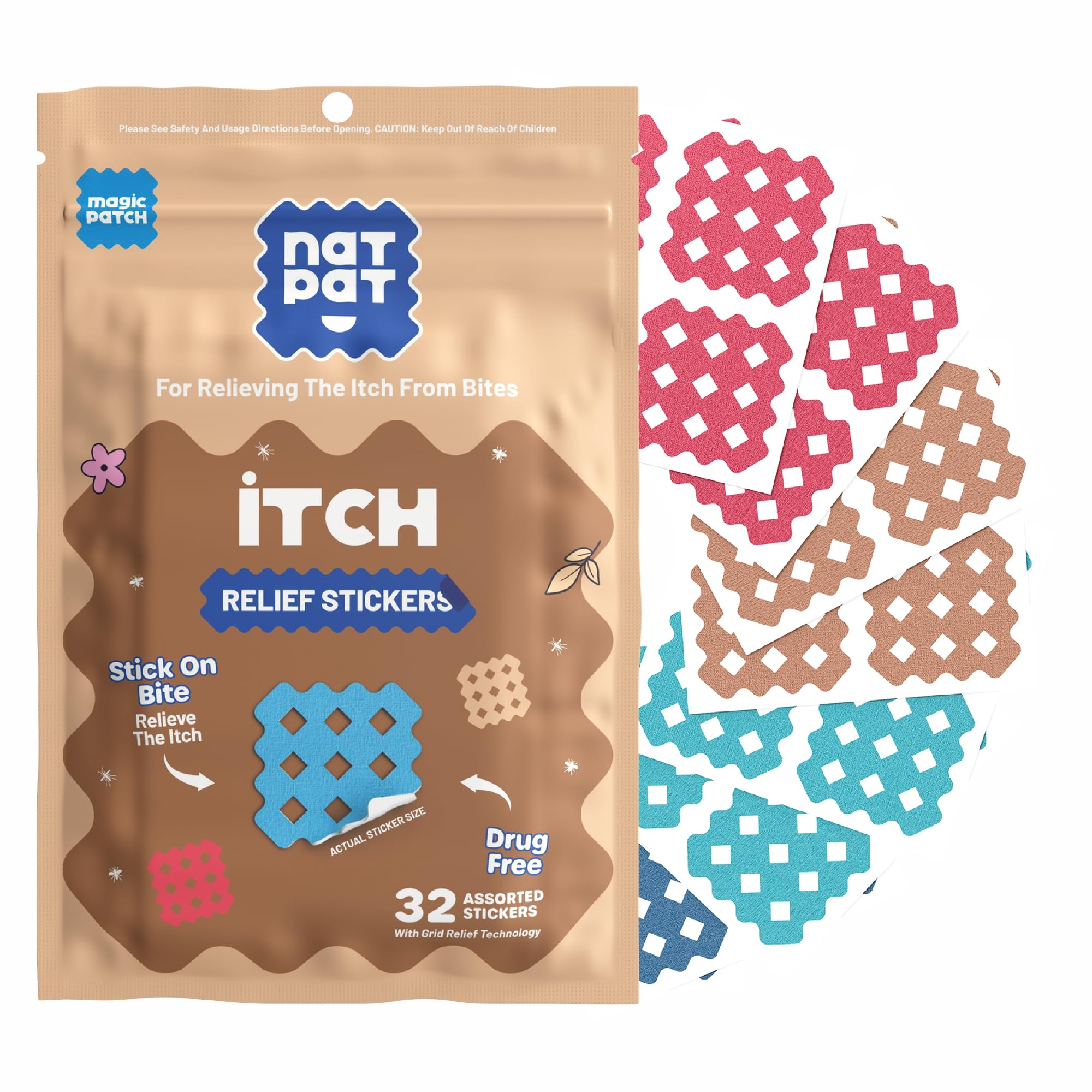
Insect bite patches occupy an odd space in the first-aid aisle. They are not repellents, not creams, and not antihistamines, yet they are marketed as a way to deal with the aftermath of a mosquito or midge bite. NATPAT’s Magic Patch stickers, sold under the Buzzpatch name in a 32-count pack, are among the better-known versions of this idea. The premise is simple: a small adhesive patch goes over the bite site, and the makers claim it helps reduce the urge to scratch and calms the irritation. Whether that holds up depends heavily on what you expect from it.
The patches are small, round, and skin-toned, roughly the size of a fingernail. Each one is individually backed, so you peel and stick directly onto a bite. The pack of 32 is aimed at families and frequent outdoor users, and the low unit cost is part of the appeal. They contain no hydrocortisone, no lidocaine, and no obvious drug ingredient, which is why they are often marketed toward children and people who want to avoid medicated creams. The mechanism is essentially physical: a barrier over the bite plus a mild cooling or soothing sensation from the patch itself.
In real use, the patches are most practical for daytime bites on arms and legs, where clothing does not rub them off. A parent dealing with a toddler who keeps scratching a mosquito bite can apply one quickly, and the child tends to leave it alone because the patch covers the spot. That behavioral effect is probably the most reliable benefit. Covering a bite reduces the scratch-scratch-scratch cycle, and less scratching means less chance of breaking the skin. For adults, the patches are less compelling but still useful on a hike or at a campsite where you want something lightweight and mess-free.
Key functional details worth knowing:
- Format: 32 individually wrapped round adhesive patches per pack.
- Application: Peel and stick directly over the bite; no cream or gel involved.
- Ingredients: The brand describes the patches as drug-free and suitable for sensitive skin, though the adhesive itself is the main thing to watch for anyone with reactive skin.
- Duration: They stay put for hours on dry, flat skin but lift at edges with sweat, swimming, or frequent hand-washing.
- Target bites: Marketed for mosquitoes, midges, sandflies, ticks, and bed bugs, though the patch does nothing to remove a tick or treat a bite that needs medical attention.
The main limitation is that these are a comfort product, not a treatment. They will not stop an allergic reaction, reduce swelling in a meaningful pharmacological way, or do anything about a bite that is already infected. If you are someone who gets large, hot welts from mosquito bites, a patch over the top may feel soothing for a few minutes but will not replace an antihistamine. The cooling effect is modest and fades; the patch is not a substitute for hydrocortisone cream or oral medication when those are actually needed. There is also the practical issue of adhesion. On a sweaty summer day, or on a child who runs around, the edges curl within an hour or two. Placed near a joint or under a sock, they come off faster.
Compared with the alternatives, the patches sit somewhere between a placebo and a mild barrier dressing. Hydrocortisone cream is more effective at reducing inflammation but is medicated and messier to apply, and it is not ideal for very young children without advice. Calamine lotion is cheap and cooling but dries chalky and rubs off. A plain adhesive bandage achieves much of the same scratch-blocking effect for less money, though it is bulkier and less discreet. The patches’ real advantage is convenience and the fact that kids accept them. If you already carry plasters, you have a rough functional equivalent.
Who should consider them: parents of young children who scratch bites raw, campers and hikers who want something compact and drug-free, and anyone with sensitive skin who reacts badly to medicated creams. Who should skip them: people with serious bite reactions, anyone expecting a pharmacological itch treatment, and those who need something that stays put during swimming or heavy sweating. Ticks deserve a specific note: a patch is not a tick-removal tool, and a tick bite should be handled properly rather than covered.
At the 32-count size, the cost per patch is low enough that trying them is not a big commitment. The honest summary is that Magic Patch stickers are a reasonable low-stakes comfort aid with a real behavioral benefit for children, but they are oversold if you read them as a treatment. Buy them as a scratch deterrent and a mild soothing cover, not as a cure for the itch.