
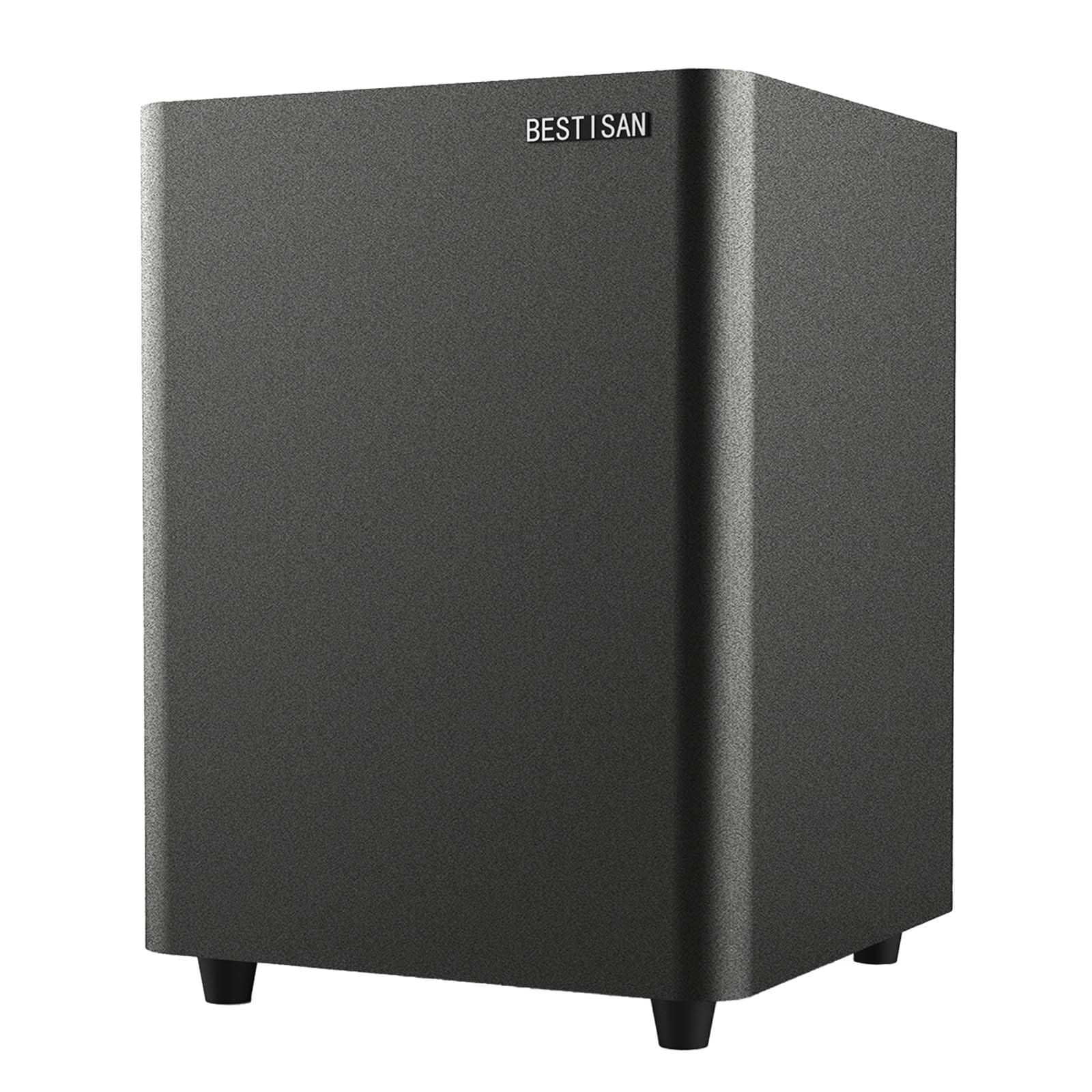
Adding bass to a home theater setup often feels like a daunting task, especially when you’re trying to do it without breaking the bank. The BESTISAN Powered Subwoofer aims to simplify that process with a down-firing design and a surprisingly flexible set of connection options. After spending some time with it in a mixed-use living room, it’s clear this subwoofer has a specific place in the market, but it also comes with a few trade-offs worth considering before you commit.
The first thing you notice is the build. It’s a compact cube, roughly 12 inches on each side, with a down-firing driver that pushes air toward the floor. This makes placement a bit more forgiving than front-firing subs, since you don’t need to worry as much about directing the sound toward the listening position. The enclosure feels sturdy enough for the price, wrapped in a black vinyl finish that won’t stand out in most media consoles. It’s not a piece of high-end audio furniture, but it doesn’t look out of place either.
Setup is genuinely straightforward, which is one of its strongest selling points. The rear panel includes RCA line-in, LFE input, and a 3.5mm AUX input, so you can connect it to a variety of sources. If you’re using an older receiver without a dedicated subwoofer output, the high-level speaker input and output terminals are a welcome addition. You can run speaker wire from your amplifier to the sub, then out to your main speakers, and the sub’s internal crossover will handle the bass management. That flexibility is rare at this price point and makes the BESTISAN a practical choice for those with legacy gear or a simple stereo setup.
In terms of performance, the 6.5-inch driver (with a claimed 200-watt peak output) delivers a surprisingly tight low end for its size. In a small to medium room, it adds a noticeable depth to music and movies. Watching action films, you’ll feel the thud of explosions and the rumble of low-frequency effects, though it’s not going to shake the walls like a larger 10- or 12-inch subwoofer. For music, it handles bass lines and kick drums competently, but it can struggle with very deep sub-bass content below 40Hz, where it rolls off noticeably. If you’re a bass head who listens to electronic or hip-hop at high volumes, you’ll likely find it lacking in sheer output and extension.
One limitation that stands out is the crossover control. The sub has a simple low-pass filter knob, but it’s not the most precise, and the frequency markings are approximate at best. You’ll need to spend some time dialing it in by ear to get a seamless blend with your main speakers. Additionally, the auto-on/off circuit can be a bit finicky—it sometimes takes a few seconds to wake up when a signal starts, which could cause you to miss the very beginning of a bass note in a quiet scene. It’s not a dealbreaker, but it’s something to be aware of if you’re sensitive to timing.
Compared to a traditional ported subwoofer from a brand like Polk or Dayton Audio, the BESTISAN is less efficient and doesn’t play as loud. However, those alternatives often cost more and may not offer the same level of connection flexibility. If you’re looking for a budget-friendly way to add bass to a desktop computer setup, a small den, or a secondary TV area, this sub does the job without fuss. It’s also a decent option for a first-time subwoofer buyer who wants to learn the ropes without a huge investment.
Who is this for? If you have a compact space, a modest receiver, and you want to add some low-end presence to movies and music without dealing with complex calibration, the BESTISAN Powered Subwoofer is a reasonable pick. It’s not for those who demand reference-level bass or who have large open-plan rooms—there, you’d need a bigger driver and more power. It’s also not ideal for audiophiles who are picky about subwoofer integration, as the imprecise crossover and auto-on lag might frustrate you.
In summary, the BESTISAN is a competent entry-level subwoofer that offers more connectivity than its price suggests. It won’t blow you away with sheer force, but it will add a welcome layer of depth to your audio. If you go in with realistic expectations and are willing to spend a bit of time adjusting the settings, it’s a solid value. Just don’t expect it to transform your home theater into a cinema-grade experience.