
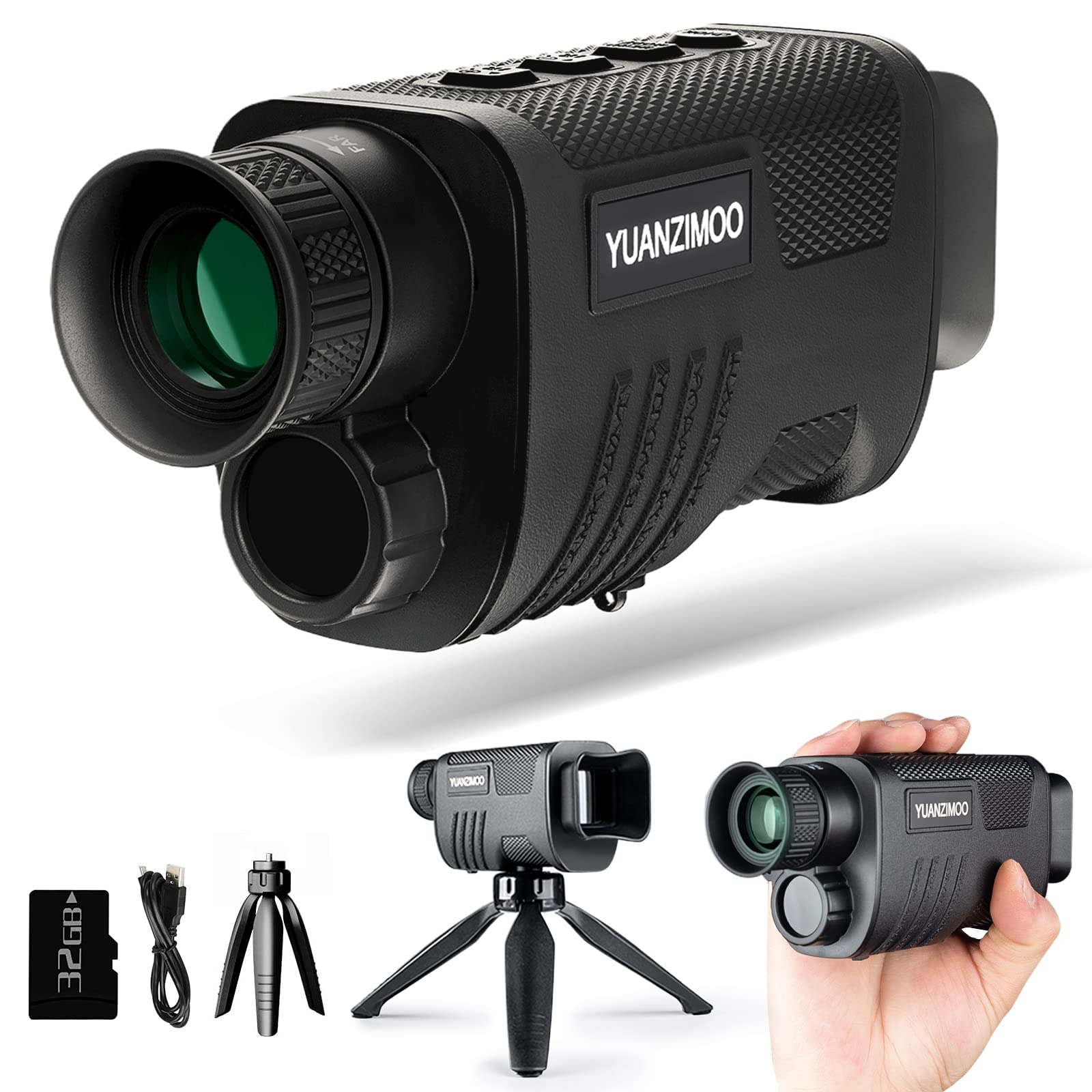
Digital night vision has quietly become the affordable alternative to traditional image-intensifier tubes, and this monocular bundle sits squarely in that budget-conscious middle ground. It pairs an infrared-sensitive sensor with a built-in IR illuminator, an 8X digital zoom, a 2000mAh rechargeable battery, and a bundle that includes a tripod, a 32GB SD card, and a card reader. On paper that is a lot of kit for the money. In practice, it is a capable entry point for someone who wants to see in the dark without spending four figures, provided expectations are set correctly.
The most important thing to understand about this class of device is that “night vision” here means digital sensor plus infrared light, not the green-tinted image-intensifier tubes used by military and law enforcement. The difference matters. In complete darkness, the unit relies entirely on its IR illuminator, which behaves like an invisible flashlight: it lights up whatever you point it at, but only within a limited range. The 2000m range claimed in the listing should be read as a maximum under ideal reflective conditions, not a realistic working distance. In open fields, expect usable detail at a fraction of that figure, and in dense woods the IR beam scatters and the effective range shrinks further.
Where the device makes sense is in the situations people actually buy it for. Hunters use it to scan a treeline before dawn or check a feeder after legal shooting light. Campers use it to see what is rustling around the tent at 2 a.m. Homeowners use it to identify animals in the garden or check a fence line. Wildlife watchers use it to observe nocturnal activity without a visible light source disturbing the animals. For all of these, a handheld monocular is more convenient than a rifle-mounted scope or a two-handed binocular, and the included tripod helps when you want to leave it pointed at a fixed spot for a while.
Functionally, the feature set is standard for the category but reasonably complete. The 8X zoom is digital, not optical, so pushing it to the maximum softens the image noticeably; most users will find the lower end of the range more useful. The 2000mAh rechargeable battery is a sensible choice over disposable cells, though runtime depends heavily on how much the IR illuminator is used, and cold weather will reduce it. The 32GB card and reader mean you can record stills and video out of the box, which is a genuine convenience since many competing units ship with nothing. The tripod thread is a small but meaningful addition for anyone who wants steadier footage.
- Works in total darkness via the built-in IR illuminator, with a visible-light mode for daytime use.
- 8X digital zoom — useful at low settings, increasingly grainy toward the top.
- 2000mAh rechargeable battery charged over USB, no disposable batteries required.
- Included 32GB SD card, card reader, and tripod — a more complete package than most rivals.
- Handheld monocular form factor with a standard tripod mount for stationary viewing.
The limitations are worth stating plainly. Image quality in digital night vision is inherently noisy, and this unit is no exception; expect a grainy, monochrome-green picture rather than the crisp clarity of a daytime camera. The IR illuminator is visible to some animals and to other people wearing night vision, so it is not truly covert. The field of view is narrow, which makes scanning large areas slow. And the build, while adequate, is plastic-heavy — it will survive normal outdoor use but is not something to drop on rocks repeatedly. Battery life claims should be treated as optimistic; carrying a USB power bank is a reasonable precaution for a long night out.
Compared with traditional image-intensifier night vision, this device is far cheaper and does not require the same legal considerations in most jurisdictions, but it cannot match the tube-based clarity, true passive operation, or instant-on responsiveness. Compared with a thermal monocular, it is dramatically less expensive and better at identifying shapes and reading detail, but thermal wins decisively for detecting heat signatures through brush and in poor conditions. Compared with a dedicated night-vision camera trap, it offers live viewing and portability but less automation.
This monocular suits casual hunters, campers, homeowners, and wildlife observers who want an affordable, self-contained way to see after dark and are willing to accept digital-image limitations. It is not the right choice for professionals who need passive, high-clarity optics, for anyone expecting true long-range identification, or for users who want a simple point-and-look experience without learning the quirks of IR illumination. Treated as a budget tool with realistic expectations, it does its job.