
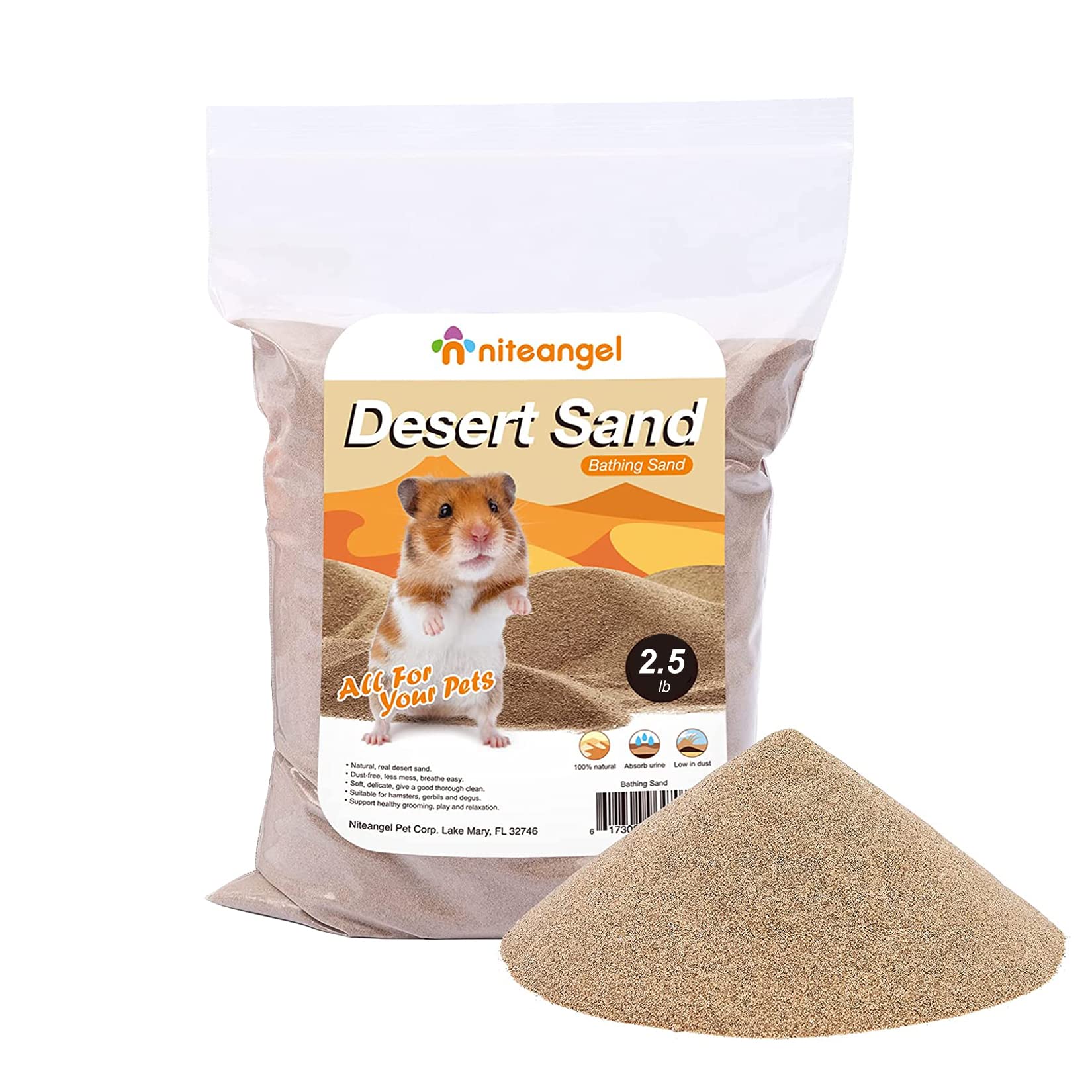
Sand baths have become a standard part of hamster care, and Niteangel’s Desert Bath Sand is one of the more widely available options in the 2.5lb/40oz range. It is marketed as a no-dust, easy-to-clump product, and the claims are worth examining against how these products actually get used in a cage rather than how they read on a listing page.
In practice, sand serves two purposes for a hamster. The first is hygiene: many hamsters use a sand area as a litter box, which keeps urine out of the main bedding. The second is grooming and enrichment: rolling in fine sand helps keep the coat clean and gives the animal something to dig and forage in. A product that clumps well supports the first job, since clumped sections can be scooped out with less waste. A product that stays dust-free supports the second, because dusty sand can irritate a hamster’s respiratory tract and eyes.
Niteangel’s sand is a fine-grained desert-style sand rather than a coarse grit. The texture is closer to what you would find in a dedicated bathing area than to a general-purpose substrate. The clumping behavior is the feature most buyers will notice first. When a hamster urinates in the sand, the wet portion binds into a clump that can be lifted out with a small scoop, similar to how clumping cat litter works. That makes spot-cleaning a sand tray straightforward and extends the life of a full tray between changes. It is not instant-setting like some clay-based litters, so very fresh deposits may need a moment before they hold together, but the clumping is consistent enough to be useful.
The no-dust claim holds up reasonably well in normal use, though it depends on handling. Pouring the sand from the bag at a height will produce some airborne particles, as with nearly any fine sand. Pouring slowly and close to the tray reduces this noticeably. Once settled in the tray, the sand does not kick up much dust during typical hamster activity, which is the part that matters most for the animal. Owners of hamsters with known respiratory sensitivity should still introduce any new sand gradually and watch for sneezing or discharge.
The 2.5lb bag is a practical size for a single hamster setup. A typical sand tray takes a modest amount, so one bag covers a full tray plus a few top-ups. It is not a bulk quantity, and households with multiple hamsters or large dig boxes will go through it quickly. That is a real trade-off: the bag is convenient to store and handle, but the cost per ounce is higher than buying sand in larger volumes, such as a plain children’s play sand or a bulk reptile sand. Those alternatives can work, but play sand often needs sifting and baking before use, and not all reptile sands are dust-free or safe if they contain dyes or calcium. The convenience of a pre-cleaned, ready-to-use sand is what the Niteangel bag is selling, and that is a legitimate difference for many owners.
Compared with paper-based litter or wood shavings used as a litter corner, sand has a different role. Paper litter absorbs but does not clump, so it needs more frequent full changes. Sand clumps and can be spot-cleaned, but it is heavier and messier if a hamster kicks it out of the tray. Some owners use a shallow glass or ceramic dish to contain it, which helps. Compared with a coarse bathing sand marketed for chinchillas, this product is finer and more likely to be used for both bathing and litter, though the finer grain also means more tracking onto cage surfaces and surrounding floor.
Who is this for? It suits owners who want a ready-to-use sand that clumps for easier cleaning and who keep one or two hamsters in standard enclosures. It is also a reasonable choice for someone transitioning a hamster from paper litter to a sand litter area and who wants a product with predictable texture. Who is it not for? Owners of large collections, or anyone running a big dig box, will find the bag size and cost limiting. People who prefer to buy plain sand and prepare it themselves will see this as an unnecessary expense. And anyone with a hamster that has shown respiratory sensitivity should consult a vet before switching substrates, regardless of a no-dust label.
Overall, the Niteangel Desert Bath Sand does what it claims with few surprises. The clumping is functional, the dust is low in settled use, and the bag size is convenient for a single pet. The main drawbacks are the relatively small quantity for the price and the fact that fine sand will track. It is a sensible option for a typical hamster owner, less so for high-volume or budget-focused setups.