
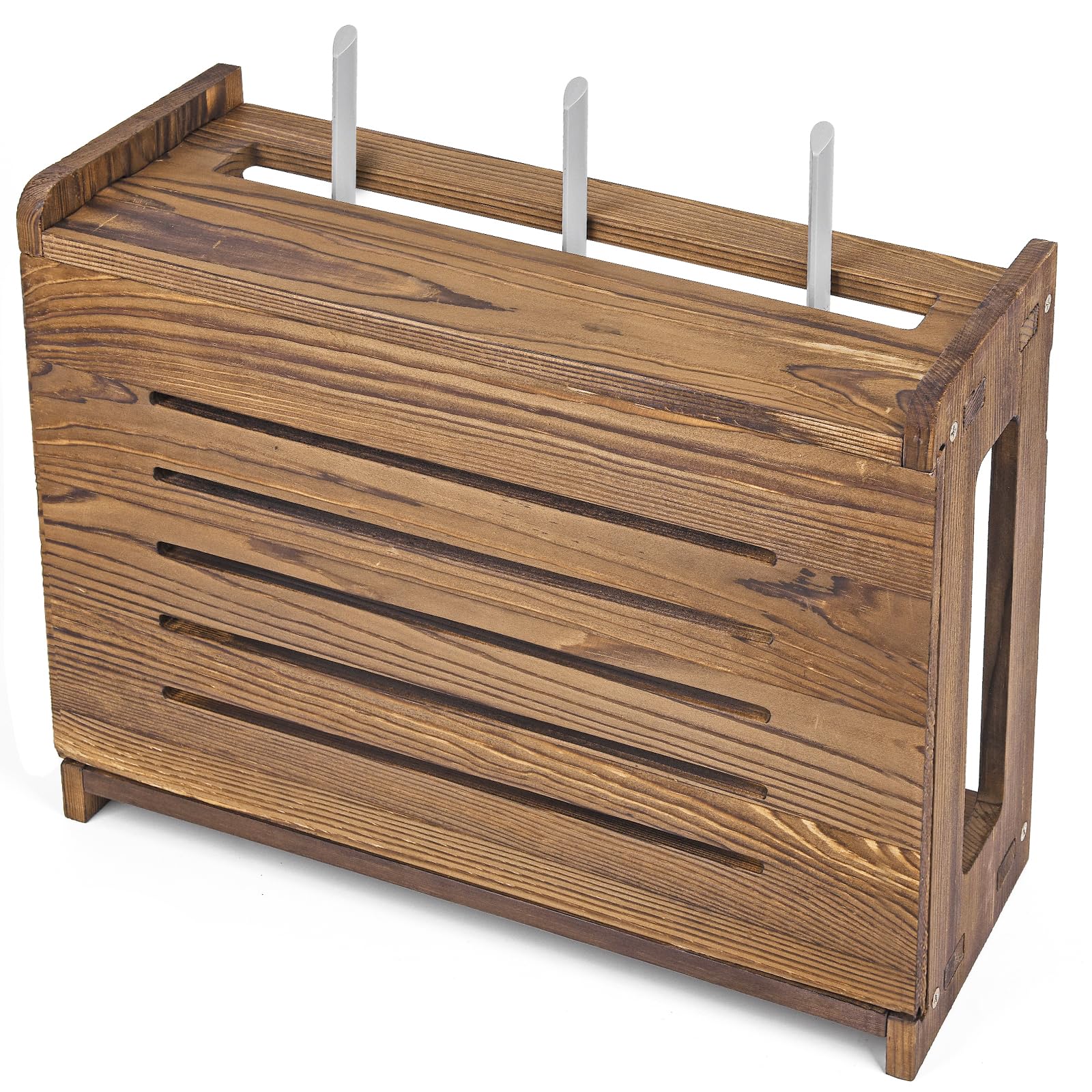
Few things ruin the look of a carefully arranged living room or home office quite like a tangle of black cables and a blinking router squatting on a shelf. The BEARUT Wooden Router Shelf tries to solve this by giving your networking gear a dedicated wooden enclosure that mounts on the wall. It’s a straightforward idea, but does it hold up in daily use? After spending a few weeks with it, here’s what stands out.
The shelf comes as a flat-pack kit. Assembly is required, and it’s not the kind of thing you’ll finish in 30 seconds—expect to spend about 20 to 30 minutes with a screwdriver. The instructions are mostly clear, though a couple of steps had me double-checking which side of the panel faced outward. The pieces are made of MDF with a wood-grain finish, which looks decent from a distance but doesn’t have the heft or texture of solid wood. Up close, you’ll notice the laminate surface, but it’s not unattractive. It’s the kind of thing that blends into a shelf or wall without shouting for attention.
Once assembled, the box measures about 14.9 by 9.8 by 5.4 inches (L by H by W). That’s enough room for a standard router and a small power strip. The design includes a cutout in the back for cables, plus a few openings on the sides to let wires pass through. This is the key feature: you can close the front door and hide the whole mess. The door is hinged and has a small magnetic catch, so it stays shut but opens easily when you need to reach the router. There are also ventilation slots on the side and back, which are crucial—routers generate heat, and stuffing one in a sealed box is a recipe for performance issues. In my testing, the slots did a reasonable job of keeping the temperature in check, though the router did run slightly warmer than it would in the open. It wasn’t enough to cause problems, but if you live in a hot climate or have a particularly powerful router, you might want to keep an eye on it.
Mounting is straightforward. The package includes brackets and screws, and the box hangs on the wall like a small cabinet. You’ll need to locate wall studs or use appropriate anchors for drywall. Once it’s up, it feels secure—no wobbling or sagging. The shelf itself is sturdy enough for the weight of a router and a power strip, but I wouldn’t pile anything heavy on top. It’s designed for its purpose, not as a general storage shelf.
One of the things I appreciated is that the front door doesn’t block the router’s signal as much as you might fear. Wood and MDF are not as signal-hostile as metal, so Wi-Fi performance remained stable in my tests. I did a few speed checks with the door open and closed, and the difference was negligible. That said, if your router has external antennas that need to point in specific directions, you’ll have to adjust them to fit inside the box, which might affect coverage slightly. This is worth considering if you have an older router with bulky antennas.
Compared to open shelves or simple cable trays, this box offers a much cleaner look. A basic floating shelf can hold the router, but you’ll still see the cables. This BEARUT unit hides everything behind a door, which is a big win for those who care about aesthetics. On the other hand, a simple shelf is cheaper and requires zero assembly. If you’re not bothered by visible cables, you might not need the extra effort. Also, if you frequently need to reset your router or fiddle with settings, the door adds a small step—though it’s not a big deal since the magnetic catch opens easily.
There are a couple of limitations worth noting. The MDF construction means it’s not moisture-resistant, so avoid placing it in a damp basement or near a bathroom. The finish can also scratch if you’re not careful during assembly. And while the cable management is decent, it’s not a miracle worker—if you have a huge power strip with thick cords, you’ll need to be creative to fit everything neatly inside. The box is designed for a standard setup, not an elaborate home theater network.
Who is this for? If you have a single router and a modest power strip, and you want to hide them while keeping them accessible, this shelf is a solid choice. It’s also good for renters who want to avoid drilling multiple holes—there’s just the two mounting points. But if you have a large modem, a separate router, and a tangle of Ethernet cables, you might find the space cramped. In that case, a larger media cabinet or an open shelving unit with cable sleeves might serve you better.
In the end, the BEARUT Wooden Router Shelf is a functional, decent-looking solution for a common problem. It’s not a premium piece of furniture, and it requires some assembly, but it does what it promises. If you’re tired of looking at your networking gear and want a simple way to tuck it away, this is worth considering—just keep your expectations realistic about the materials and the space inside.